


Electric Ferry Adoption Creates New Opportunities for Marine Batteries
Subhead: USD 1.7 billion in 2026 | USD 3.3 billion by 2036 | 6.4% CAGR
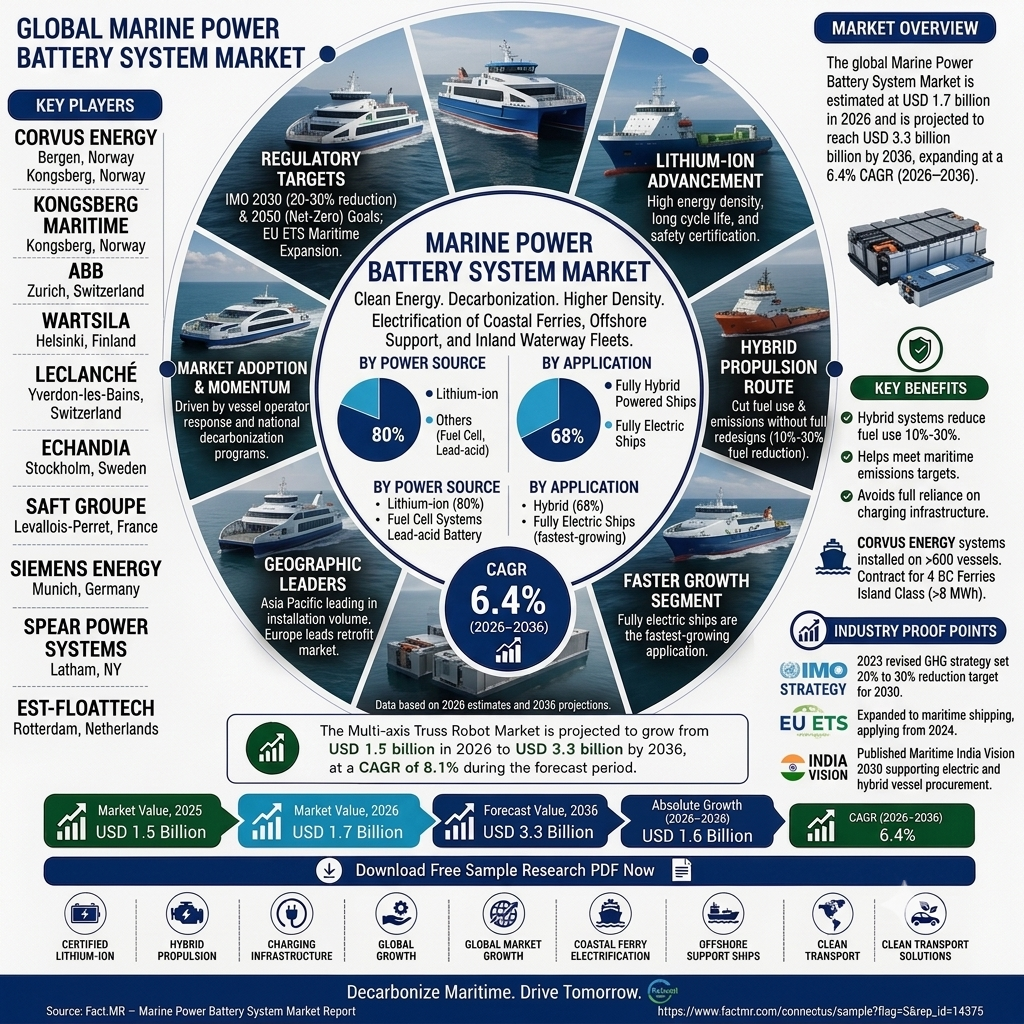
August 26, 2026 — The global marine power battery system market is estimated at USD 1.7 billion in 2026 and is projected to reach USD 3.3 billion by 2036, expanding at a 6.4% CAGR from 2026 to 2036, according to Fact.MR. The market was valued at USD 1.5 billion in 2025.
The market is gaining momentum as vessel operators respond to maritime emissions targets and national decarbonization programs. Fact.MR links demand growth to the electrification of coastal ferries, offshore support vessels, and inland waterway fleets. Improvements in lithium-ion energy density and cycle life are also supporting adoption. Hybrid propulsion gives operators another route to cut fuel use and emissions without fully redesigning vessels. However, maritime class approvals can extend battery qualification timelines by 12 to 36 months compared with land-based applications.
Get detailed market forecasts, competitive benchmarking, and pricing trends: https://www.factmr.com/connectus/sample?flag=S&rep_id=14375
Regulatory Targets Strengthen Battery Demand
Third-party regulatory programs are supporting the shift toward marine battery systems. The International Maritime Organization (IMO), in its 2023 revised GHG strategy, set a 20% to 30% emissions reduction target for 2030 and a net-zero ambition by 2050. The European Commission's May 2023 Directive 2023/959 expanded the EU Emissions Trading System to maritime shipping, with the maritime extension applying from 2024. In March 2021, India's Ministry of Ports, Shipping and Waterways published Maritime India Vision 2030, which supports electric and hybrid vessel procurement.
Key Numbers
|
Market Metric |
Fact.MR Data |
|
Market value, 2025 |
USD 1.5 billion |
|
Market value, 2026 |
USD 1.7 billion |
|
Forecast value, 2036 |
USD 3.3 billion |
|
CAGR, 2026–2036 |
6.4% |
|
Lithium-ion share, 2026 |
80% |
|
Hybrid powered ship share, 2026 |
68% |
|
Absolute growth, 2026–2036 |
USD 1.6 billion |
*Source: Fact.MR analysis. *
Segment Breakdown
By power source: Lithium-ion batteries hold 80% share in 2026. Fact.MR says their energy density, cycle life, safety certification, and power delivery support their leading position in commercial marine applications. Fuel cell and lead-acid battery systems are also covered by the report.
By application: Hybrid powered ships account for 68% share in 2026. Hybrid systems can reduce fuel use by 10% to 30%, according to the Fact.MR report, while helping vessels meet emissions requirements without relying fully on charging infrastructure. Fully electric ships are identified as the fastest-growing segment.
By geography: Asia Pacific leads installation volume because of shipbuilding scale and inland waterway electrification. Europe remains a major retrofit market because of strict emissions rules.
Country CAGR Outlook
|
Country |
CAGR Through 2036 |
|
India |
8.5% |
|
South Korea |
7.9% |
|
China |
6.4% |
|
United States |
5.8% |
|
Norway |
5.0% |
*Source: Fact.MR proprietary forecasting model and primary research. *
India records the fastest country-level growth at 8.5% CAGR. South Korea follows at 7.9%, while China is projected at 6.4%. Fact.MR links India's growth to Maritime India Vision 2030 and inland and coastal ferry electrification. South Korea benefits from its major shipbuilding base, while China's growth is supported by inland vessel electrification.
Competitive Landscape
The market is moderately concentrated at the integration level. Corvus Energy, Kongsberg Maritime, ABB, Wartsila, and Leclanché account for the maximum share of certified global installations by capacity, according to Fact.MR. However, the page does not disclose individual percentage market shares for these companies, so no company-level share is assigned here.
Corvus Energy has systems installed on more than 600 vessels, according to Fact.MR. The company introduced its Blue Whale NxtGen marine LFP battery platform in December 2025. In May 2025, Corvus Energy confirmed a contract covering four BC Ferries Island Class vessels, with more than 8 MWh of total installed energy storage capacity.
Other profiled companies include Echandia, Saft Groupe, Siemens Energy, Spear Power Systems, and EST-Floattech. Competition centers on certification coverage, vessel references, engineering support, and long-term service capabilities.
Analyst View
Shambhu Nath Jha, Principal Consultant at Fact.MR, said the report shows how “IMO 2030 and 2050 targets are driving a multi-decade marine battery replacement cycle” across key vessel segments.
Frequently Asked Questions
How large is the marine power battery system market in 2025?
Fact.MR valued the market at USD 1.5 billion in 2025.
What will the marine power battery system market be worth by 2036?
The market is projected to reach USD 3.3 billion by 2036.
What is the CAGR of the marine power battery system market?
Fact.MR projects a 6.4% CAGR from 2026 to 2036.
Which marine battery segment has the largest share?
Lithium-ion batteries hold the largest power-source share at 80% in 2026.
Which country has the fastest projected growth?
India leads the listed countries with an 8.5% CAGR through 2036.
About Fact.MR
Fact.MR is a market research and consulting firm providing market intelligence, forecasts, and strategic analysis across global industries. Its marine power battery system research covers market sizing, segment forecasts, regional analysis, competitive positioning, regulatory developments, and technology adoption.

 English
 Arabic
 French
 Spanish
 Portuguese
 Deutsch
 Turkish
 Dutch
Dutch
 Italiano
 Russian
 Portuguese (Brazil)
 Greek
Greek