


DGFT Consultant in India | DGFT Services for Export Import- License
Introduction
If you've ever tried to import a machine part, export a chemical sample, or bring in gold for your jewellery business, you've probably run into the same wall someone tells you "you need DGFT clearance for that" and then walks away. Nobody explains what that actually means.
We get calls about this every week. Business owners who've built a solid company but never had to deal with the Directorate General of Foreign Trade until now, and suddenly they're staring at an ITC-HS code, wondering whether they need a licence, a certificate, or just a simple registration.
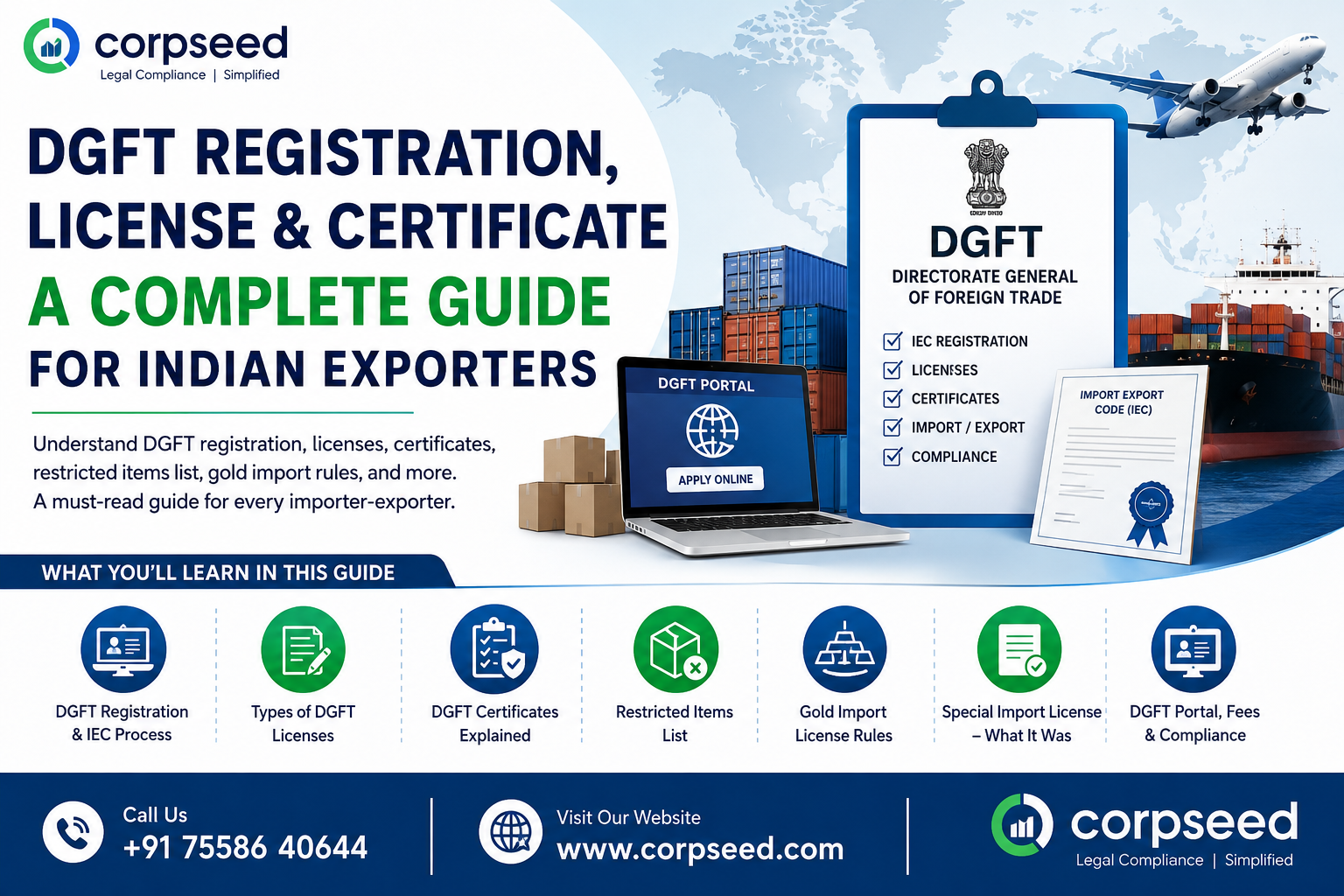
This guide clears that up. We'll walk through what DGFT actually does, how DGFT registration works, the difference between a DGFT licence and a DGFT certificate (people mix these up constantly), what's on the restricted items list, how gold import licensing works, and what a Special Import Licence actually was because that last one confuses even people who've been importing for years.
What Is DGFT and Why Does It Control Your Import-Export Business
DGFT stands for the Directorate General of Foreign Trade. It sits under the Ministry of Commerce and Industry, and it's the body that administers India's Foreign Trade Policy (FTP) the rulebook that decides what can be freely imported or exported, what needs prior approval, and what incentives exporters can claim.
Think of DGFT as the gatekeeper and the reward system, both at once. On one side, it issues the Importer Exporter Code (IEC) that every trading business needs before it can move a single shipment across the border. On the other, it runs the schemes — Advance Authorisation, EPCG, RoDTEP, and others that reduce duty costs or reward export performance.
Every restriction, every incentive, and every compliance filing tied to cross-border trade in India eventually traces back to a DGFT notification, public notice, or policy circular. That's why getting the registration and licensing right at the start saves so much trouble later.
DGFT Registration: What It Actually Involves
"DGFT registration" is usually shorthand for two separate things, and knowing which one you need matters.
1. Importer Exporter Code (IEC) Registration
This is the foundational step. No IEC, no import or export customs will not clear your shipment without it. The IEC is a 10-digit number linked to your PAN, and you apply for it online through the DGFT portal.
You'll need:
-
PAN card of the business/proprietor
-
Bank account details with a cancelled cheque
-
Address proof of the business premises
-
A valid digital signature certificate (DSC) or Aadhaar-based authentication for filing
Once issued, the IEC has to be confirmed annually between April and June on the DGFT portal a step a surprising number of businesses forget, which then gets their IEC deactivated at the worst possible time, usually right before a shipment.
2. RCMC Registration (Registration-cum-Membership Certificate)
If you want to claim any export benefit duty drawback, RoDTEP, or a scheme-linked authorisation most Export Promotion Councils will ask for your RCMC before processing your application. It's issued by the relevant EPC or commodity board and confirms that your business is a genuine, registered exporter of that product category.
Skipping RCMC doesn't stop you from exporting, but it can stop you from claiming the incentives that make exporting worthwhile.
Types of DGFT License You Should Actually Know About
This is where most confusion sets in, because "DGFT license" isn't one thing it's a category covering several distinct authorisations, each solving a different problem.
Advance Authorisation — lets you import inputs used in export production without paying customs duty, as long as you fulfil a corresponding export obligation. Popular with manufacturers who import raw materials for finished goods that get re-exported.
EPCG (Export Promotion Capital Goods) License — allows duty-free or concessional import of machinery and capital equipment, on the condition that you achieve a defined export obligation over a set period, usually six years. If you're setting up or upgrading a manufacturing line and plan to export the output, this is usually the license worth exploring first.
DFIA (Duty Free Import Authorisation) — similar in spirit to Advance Authorisation, but transferable once the export obligation is met. That transferability is the whole appeal it turns the authorisation into something with resale value.
Import Authorisation for Restricted Items — a case-by-case license required when the item you want to import falls under the "restricted" category (more on this below). This isn't a scheme with duty benefits; it's simple permission to import something that isn't freely allowed.
SCOMET License — required for items on the Special Chemicals, Organisms, Materials, Equipment and Technologies list dual-use goods with potential military or strategic application. This is a stricter, security-driven approval process, and it's not one to attempt without proper guidance, given the penalties for getting it wrong.
Each of these has its own application form (ANF series) on the DGFT portal, its own documentation trail, and its own timeline. Picking the wrong one, or applying with mismatched HS codes, is the single most common reason applications sit in "deficiency" status for months.
DGFT Certificate: Which One Does Your Business Actually Need
A DGFT certificate is different from a license a certificate typically recognises status or fulfilment rather than granting permission to import or export something specific. Here are the ones that come up most often:
-
Status Holder / Export House Certificate — recognition (One Star, Two Star, up to Five Star Export House) based on your export turnover over recent years. It comes with procedural relaxations simpler documentation, priority customs clearance, and eligibility for additional scheme benefits.
-
Export Obligation Discharge Certificate (EODC) — proof that you've completed the export obligation attached to an Advance Authorisation or EPCG license. Without this, your bank guarantee and bond stay locked, and you remain exposed to future audits.
-
AEO Certificate (Authorised Economic Operator) — issued jointly with customs, this recognises businesses with a strong compliance track record and rewards them with faster clearances and fewer inspections. It's a customs-facilitation certificate rather than a DGFT scheme document, but DGFT consultants are usually the ones helping businesses prepare for it because the compliance history overlaps so heavily.
-
IEC Certificate — the actual certificate confirming your Importer Exporter Code, downloadable from the DGFT portal once your application is approved.
If someone tells you "get a DGFT certificate," it's worth asking exactly which one they mean the paperwork, timelines, and eligibility criteria are completely different for each.
DGFT Restricted Items List for Export: What You Can and Can't Ship
Not everything is freely exportable, and this catches a lot of first-time exporters off guard. Under India's Foreign Trade Policy, every item falls into one of four buckets:
-
Free — no licence needed, the vast majority of goods fall here.
-
Restricted — exportable only with a licence or authorisation from DGFT, granted after review by the EXIM Facilitation Committee.
-
Prohibited — not allowed to be exported at all, barring rare exceptions.
-
State Trading Enterprise (STE) — can only be exported through a designated government agency.
The actual restriction against any product is listed against its ITC-HS code in the ITC (HS) Classification of Export and Import Items an 8-digit classification system based on the internationally recognised Harmonized System.
Items that commonly show up on the restricted export list include:
-
Wildlife and species covered under the Wildlife (Protection) Act and CITES
-
Certain chemicals and precursor substances
-
SCOMET-listed dual-use items
-
Antiques and articles of archaeological or historical value
-
Specific categories of leather and hides
-
Red sanders and select forest produce
Restriction status also shifts with global events export curbs on onions, certain pulses, or medical items during supply shocks are a good example of how quickly DGFT can amend Schedule 2 of the export policy through a public notice. This is exactly why checking the current ITC-HS entry for your product before shipping matters more than relying on what was true even a year ago.
DGFT License for Gold Import: Who Can Actually Import Gold Into India
Gold sits in a category of its own. It's classified as a restricted item for import, which means ordinary importers can't simply bring it in the route runs through a small, defined set of entities:
-
Nominated banks and agencies notified jointly by DGFT and the RBI this list is refreshed periodically, so it's worth checking the current version before assuming a bank is still on it.
-
Star Trading Houses and Premier Trading Houses registered as nominated agencies with DGFT.
-
Qualified Jewellers, who can import gold through the India International Bullion Exchange (IIBX) under norms set by the RBI and IFSCA.
Getting nominated agency status, or importing as a Qualified Jewellery, involves demonstrating financial standing, past trade performance, and compliance history DGFT and RBI aren't handing this out casually, given how closely gold import is tied to India's current account and forex position.
If your business model depends on regular gold or bullion import, the smarter move is confirming your eligibility route and documentation upfront rather than discovering mid-shipment that your entity isn't on the notified list.
What Is a Special Import Licence (SIL) Under DGFT
This one comes up in search a lot, and it deserves an honest answer: the Special Import Licence was a scheme under India's earlier Exim Policy that granted certain exporters export Houses, Trading Houses, and businesses meeting specific export performance criteria an additional licence they could use (or sell) to import otherwise restricted items over and above their normal entitlement.
It was a genuinely useful instrument in its time. But it was phased out as India's trade policy moved toward the duty credit scrip model the mechanism you now see in schemes like RoDTEP and the earlier MEIS/SEIS. If you're being pitched a "Special Import Licence" as a live, currently issued DGFT scheme, that's worth double-checking against the current Foreign Trade Policy, because it isn't part of the active licensing framework anymore.
What people usually actually need today, when they say "SIL," is one of two things: an Import Authorisation for a restricted item, or guidance on which current duty credit scrip scheme replaces the benefit they're expecting. Either way, it's worth a direct conversation before applying for something that no longer exists in its original form.
Where Businesses Usually Go Wrong With DGFT Compliance
A few patterns show up again and again in the cases we handle:
-
Applying under the wrong scheme because the HS code classification wasn't verified first, leading to rejection or a deficiency letter.
-
Missing the annual IEC update window, which quietly deactivates the code without much warning.
-
Assuming an item is freely exportable based on last year's policy, when a public notice has since moved it to the restricted list.
-
Not tracking export obligation deadlines on Advance Authorisation or EPCG licenses, risking penalty and denied entity list (DEL) status.
-
Treating the EODC and bond closure as optional, when leaving them pending keeps your bank guarantee locked and your business exposed to future audit queries.
None of these are complicated problems on their own. They just tend to surface at the worst possible time usually when a shipment is already booked and the deadline can't move.
How DGFT Guru Helps You Get This Right
We've been doing this for over 35 years, and in that time we've handled more than 10,000 DGFT cases across manufacturing, pharma, textiles, and trading businesses. Whether it's an Advance Authorisation, EPCG Scheme application, restricted item authorisation, SCOMET clearance, or an AEO certification, our team reviews your documentation before it goes anywhere near the portal that's the step that prevents most deficiency letters in the first place.
We also handle the parts businesses forget about until it's urgent: Export Obligation Discharge Certificate filings, ICEGATE registration for customs, and ongoing compliance tracking so your licenses don't lapse quietly in the background.
If you're not sure which registration, license, or certificate applies to your situation, that's a normal place to start from talk to a DGFT consultant before you file, not after something bounces back.
Frequently Asked Questions
Is DGFT registration mandatory for every business?
Only if you're importing or exporting. If your business operates purely within India, you don't need an IEC or DGFT registration. The moment you plan a cross-border shipment, the IEC becomes mandatory.
How long does it take to get a DGFT license approved?
An IEC is typically issued within a few working days once documentation is complete. Scheme-based licenses like Advance Authorisation or EPCG take longer usually a few weeks since they involve document verification and, in some cases, technical review by a Chartered Engineer.
Can I export a restricted item without a license?
No. Restricted items can only be exported after DGFT grants an authorisation, following review by the EXIM Facilitation Committee. Shipping a restricted item without one risks seizure and penalty under the Foreign Trade (Development and Regulation) Act.
Does the Special Import Licence (SIL) still exist?
No, not in its original form. It was part of an earlier Exim Policy and has since been replaced by mechanisms like duty credit scrips under the current Foreign Trade Policy. If you've been told to apply for an SIL, it's worth confirming exactly what scheme is actually being referenced.
Who can import gold into India under DGFT rules?
Only nominated banks and agencies notified by DGFT and the RBI, Star/Premier Trading Houses registered as nominated agencies, and Qualified Jewellers importing through the IIBX. General importers and businesses outside this list cannot import gold directly.
What's the difference between a DGFT license and a DGFT certificate?
A license grants permission to do something import capital goods duty-free, export a restricted item, and so on. A certificate usually confirms a status or completed obligation your IEC, your Export House status, or your discharge of an export obligation (EODC).
Have a specific import, export, or licensing question that this guide didn't answer? Our DGFT consultants review cases like this daily — book a free consultation and we'll tell you exactly what applies to your business.
Also Read: https://www.corpseed.com/service/dgft-restricted-import-license-gas-industrial-gas-lpg

 English
 Arabic
 French
 Spanish
 Portuguese
 Turkish
 Dutch
Dutch
 Italiano
 Russian
 Romaian
 Portuguese (Brazil)
 Greek
Greek