


CRM System Recruitment: Transforming Modern Recruitment with a CRM System
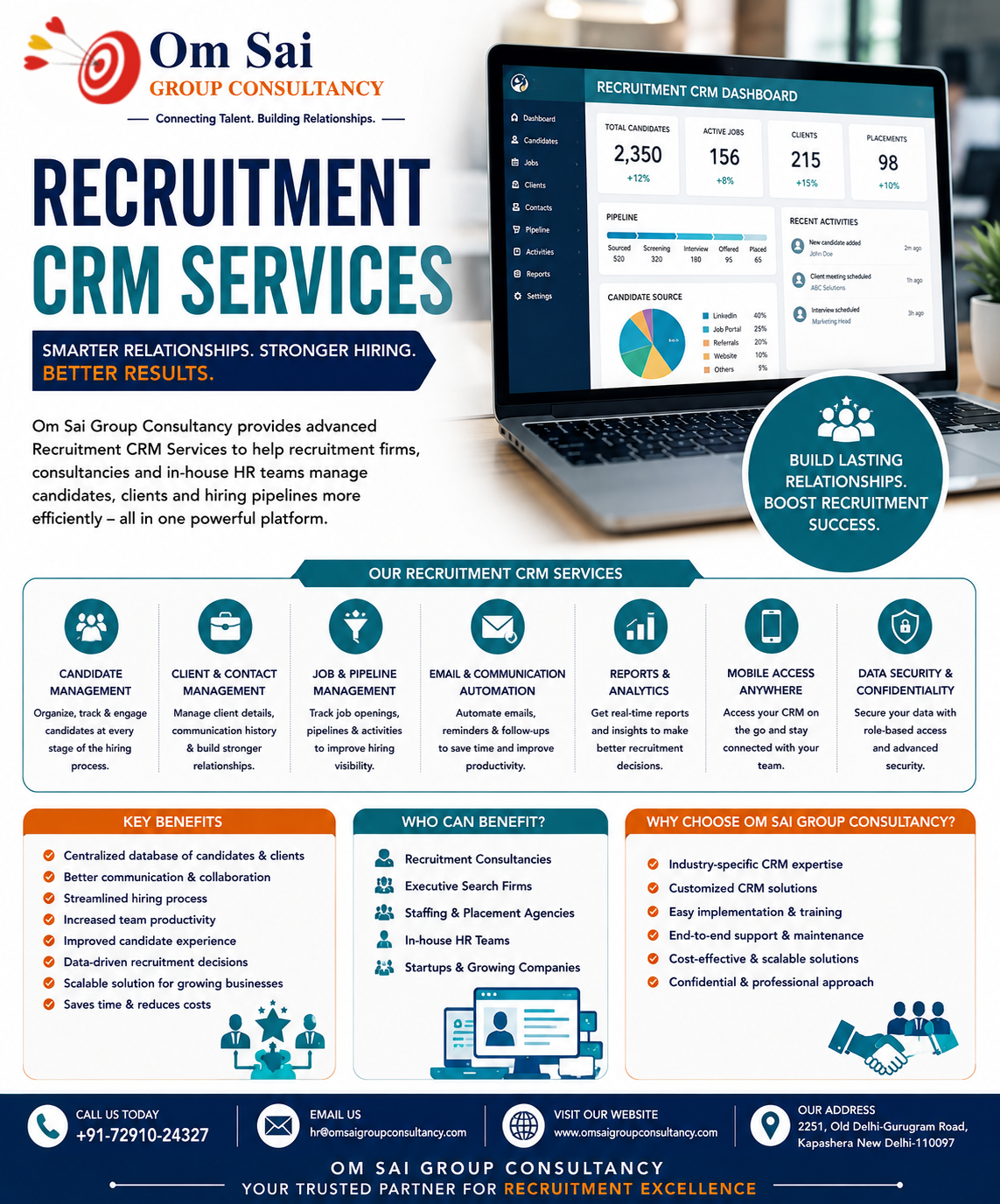
Recruitment today is an entirely different ball game. Collecting resumes and sending candidates to clients is no longer enough. Recruiters are challenged to maintain relationships with candidates, track communications and openings, manage follow-up processes, and shift candidates through the hiring funnel, all while avoiding the loss of opportunities.
This is where the value of CRM system Recruitment comes into play.
Recruitment CRM systems combine the management of relationships with candidates and clients in one space. Recruitment teams can build a workflow for each and every interaction. The result is operation of recruitment in a systematic fashion and improved relationships, speed of follow-up, and hiring process visibility.
The question for staffing firms, recruitment agencies, executive search firms, and recruiting teams is no longer if technology will assist in recruitment, it is how well can technology be utilized in the recruitment process to establish and sustain relationships?
What Is a CRM System in Recruitment?
A recruitment CRM System is technology that helps recruitment teams build and manage relationships with candidates, clients, and stakeholders involved in the recruitment and hiring process.
Most recruitment systems have modules that help manage applications and track candidates. CRM recruitment systems are designed to help organizations manage relationships even before candidates apply for jobs and clients open positions.
Practically speaking, a recruitment CRM allows recruiters to do the following:
-
Keep all important candidate and client data in one space
-
Log communications and meeting engagements
-
Sort candidates by criteria relevant to the job/industry
-
Organize potential clients and sales leads
-
Design recruitment workflows
-
Establish tasks with due dates and reminders
-
Conduct an internal talent search
-
Keep in touch with candidates over time
-
Track and evaluate recruitment progress
-
Streamline and simplify repetitive tasks
This architecture is especially relevant to recruitment with ongoing, repeated hiring demands.
What is the Importance of a CRM System in Recruitment?
Recruitment is a relational business.
It’s common for recruiters to engage with hundreds of potential candidates and dozens of firms in a short span of time. A candidate who isn’t a fit for a role may become a valuable contact. Further, a firm with no current vacancies may have an important need to fill roles in the near future.
Without a system to manage these contacts, relationships become disjointed.
A recruiter may recall that a candidate has strong skills, but forget their geographic preference. Another recruiter may have already engaged this candidate. A potential client may have asked to be contacted, but the request may have gone unfilled due to being lost in an overloaded inbox.
A CRM system Recruitment workflow fills these gaps in the system.
Rather than seeing each interaction with clients and candidates as separate transactions, the system builds a historical record that allows recruiters to see all relevant conversations, activity, preferences, requirements, and even future interactions all in one place.
That kind of context has the potential to drastically improve the clarity of the recruitment process.
CRM System Recruitment vs. Conventional Recruitment Process
Recruitment often relies on a combination of folders, spreadsheets, emails, and text/message exchanges, and databases that are members’ only and require constant maintenance. These systems may operate in a recruitment system that’s very small, but the larger the system, and the greater the volume of recruitment tasks needed, the more complex it becomes.
Consider a recruitment business operating with hundreds or thousands of candidates. It becomes difficult to maintain accurate information. It becomes inevitable to have information be repetitive. The information gets stale. It becomes impossible to recall the history of conversations with the clients.
A recruitment CRM provides more structure.
| Recruitment | CRM Based Recruitment |
| ---------------------------------- | -------------------------------------- |
| Candidate Information is Scattered | Candidate Information is Centralized |
| Follow-Up tasks are Manual | Follow-Up tasks are Automatic |
| Tracking is based on Spreadsheets | Tracking is based on Recruitment Pipelines|
| Communication is a Disorganized | Communication is a Organized |
| History | History |
| Segmentation is Limited | Segmentation is Enhanced |
| Administration is Manual | Administration is Automatic |
| Reporting is Limited | Reporting is Enhanced |
The difference is not only technological, it is operational.
The CRM enables recruiters to shift from a highly reactive mode of hiring to Managing Relationships in a more intentional manner.
Core Abilities of a Recruitment CRM
1. Centralized Candidate information
One of the features that provides a high degree of value to a recruitment CRM is a centralized database.
Recruiters can build profiles on candidates that include:
-
Work history
-
Competencies
-
Qualifications
-
Location preferences
-
Pay targets
-
When they can work
-
Sectors they’ve worked in
-
Past messages
-
Past interviews
-
Current status in the hiring process
They can build a searchable talent pool that can be tapped for future job openings.
Recruiters don’t have to start every search from square one. They can look at candidates they’ve contacted in the past who may qualify for the position.
2. Candidate Relationship Management
The focus of recruitment CRM technology is on relationships.
A candidate isn’t only valuable when they’re seeking employment. A candidate who says no to a job today may be interested in the position a year from now.
A CRM is designed for recruiters to be able to keep these relationships.
Recruiters can classify candidates such as:
-
Candidates in the job market
-
Candidates not in the job market
-
Candidates who have been employed
-
Candidates who can be employed
-
Candidates with unique skills
-
Candidates at the executive level
-
Candidates for potential future employment
This allows for more meaningful relationships.
3. Client Relationship Management
Hiring firms are also valuable relationships for recruitment firms.
A recruitment CRM helps track potential and current clients, job openings, contact history, hiring needs, and opportunities for business development.
The recruitment team can keep track of a company’s hiring needs for software developers.
When that company has a new job opening, the recruiters have the hiring needs and can start the recruitment process.
4. Management of Recruitment Pipelines
A recruitment pipeline shows the progress of a candidate or client through the recruitment stages.
Stages for a candidate pipeline could be:
Sourced → Contacted → Screening → Interview → Shortlisted → Client Interview → Selected → Joined
Stages for a client pipeline could be:
Prospect → Contacted → Meeting → Requirement Received → Proposal → Active Client
Recruitment pipelines show areas of delays.
If a large number of candidates are stuck in the same position, the recruitment team has reason to look into the issue. Similarly, if client prospects are not moving beyond the first point of contact, the business-development may be focused on other improvements.
5. Automated Follow-Ups
Recruitment has many follow-up requirements.
Candidates may need follow-up reminders for interviews. Requirements may need follow-up confirmations for the clients. Hiring managers may need follow-up status updates on candidates. There may be a need for follow-up communication with clients.
Recurring manual follow-up may be time-consuming and inefficient.
With recruitment CRM, repeat follow-ups can be automated and workflows can be created. This does not eliminate the ability to have manual follow-ups for the more important conversations.
Automation ideally helps remove tedious tasks and allows for more time to meaningful conversations.
How a CRM Improves Recruitment Efficiency
Efficiency in recruitment is not simply in being able to do more in a shorter about of time. Rather, it is in being able to do more without losing quality and in minimizing friction.
A recruitment CRM is able to do all of these in multiple ways.
Searching for Candidates
Recruiters can quickly search for candidates using specific criterial in their own database instead of having to look at external job portals multiple times.
A recruiter needing a Java Developer with X years who is currently located in and available to work in Bangalore can filter the existing workforce database on all of these parameters.
This will save time on sourcing.
Improved Follow-Up Management
Failing to follow-up will ruin your relationship with your candidate and client.
With CRM configured alerts and reminders, recruiters will be able to see what steps are pending. This will improve the recruitment process.
Less Redundant Work
With a centralized system and record, recruiters will not be making redundant efforts to screen and source applicants.
This is especially useful for larger recruitment teams.
Improved Collaboration
Most recruitment processes are not done in isolation. One recruiter may source a candidate, another may conduct screening while the account manager may be communicating with the client.
With a shared CRM, everyone can be on the same page.
CRM Automation in Recruitment
One of the most notable recent trends in recruitment is the inclusion of process automation.
CRM solutions can help with automation by removing the burden of routine tasks such as.
-
Follow-up reminders
-
Candidate segmentation
-
Email sequences
-
Notifications for interviews
-
Tasks transference
-
Lead nurturing
-
Updates on the recruitment status
-
Reports generation
-
Data organization
Automation in recruitment must be controlled, and well-placed.
Due to the nature of recruitment, highly generic, frequent, or ill-timed communication can result in losing the relationship with the candidate.
Most automation systems do not take into account the personal touch.
While technology is able to automate the predictable, time-consuming, and repetitive tasks, the most important part of recruitment remains the relationship building and the negotiation.
Benefits of CRM System Recruitment for Recruitment Agencies
For recruitment agencies, the benefits may go beyond individual placement.
Better Relationships with Candidates
Recruitment agencies don’t have to start from scratch by building talent pools.
Increased Client Retention
Agencies can analyze the history of each client in order to track their hiring habits, thus allowing them to serve them better.
Quicker Placements
Recurring placements may take less time due to the internal database of candidates.
Increased Efficiency
Recruiters have to deal with less time consuming manual tasks.
Greater Business Development Certainty
Recruitment agencies can track potential clients to help them pinpoint potential business needs that may turn into placement requests.
Informed Choices
Using the CRM, agencies can generate reports to help them track:
-
How potential candidates respond to placement requests
-
How frequently clients accept candidate placements
-
The status of open placements
-
How frequently agency representatives follow up with clients
-
The duration of the placement process
-
The channels through which candidates were sourced
-
Trends for candidate placements
Using this data helps agency management with operational oversight rather than managing by instinct.
Choosing the Best Recruitment CRM
Not every recruitment organization can benefit from the same CRM.
There are several things recruitment teams can consider prior to selecting a CRM.
Recruitment-Centered Features
A traditional CRM may assist with contact management, but recruitment teams may benefit from candidate pools, recruitment workflows, and tracking placements.
User Friendly
A recruitment-centered CRM may help teams track placements requests, but may become counterproductive if team members find the system cumbersome.
The system may help recruitment teams track placements if the interface is intuitive.
Integration Capabilities
Determine if the CRM integrates with current recruitment tools, email, calendar, job board, communication, and reporting systems.
Automation
Evaluate the available automation in workflows to eliminate repetitive tasks while retaining customization.
Reporting
Recruitment leadership requires substance and not simply a pretty dashboard.
The CRM must deliver reports to improve recruitment.
Scalability
The platform must scale to accommodate expansion of candidates, clients, recruiters, vacancies, and area coverage.
CRM and Applicant Tracking System: Are They the Same?
There is an overlap with a recruitment CRM and an Applicant Tracking System (ATS), however there are distinct primary functions.
An ATS is typically focused on the management of the applicants for a hiring process.
A recruitment CRM is typically more relationship focused.
This can be summed up as:
ATS = Manage the hiring process.
CRM = Manage the relationships of the hiring process.
Many of the modern recruitment organizations utilize both systems.
For instance, one of the systems can maintain relationships with candidates, while the other monitors candidates in a defined recruitment process.
The Future of CRM System Recruitment
Currently, recruitment systems are focused on intelligent seamless systems.
The intersection of AI, automation, prediction, and deep background tools will fundamentally shift the recruitment system.
Recruitment CRMs require a strong focus on:
- Intelligent candidate matching
- Automated talent rediscovery
- Predictive recruitment analytics
- Personalized communication
- AI-assisted sourcing
- Workflow automation
- Candidate engagement
- Client intelligence
- Integrated recruitment ecosystems
However, technology alone does not mean better recruitment.
Combining technology and good recruitment judgment is where the real competitive advantage is.
A sophisticated CRM with inadequate processes is still an ineffective system. However, if the recruitment strategy is well designed and processes are supported by technology, then a significant advantage is gained.
Best Practices for Implementing a Recruitment CRM
The implementation of a Recruitment CRM starts with processes, not with software.
Define Recruitment Workflows
Processes for how candidates and clients will transit during the recruitment lifecycle should be documented before a Recruitment CRM is configured.
Maintain Data Integrity
Records that are outdated, duplicates or incomplete will greatly diminish the value of a Recruitment CRM.
Standardize Candidate Information
Create fields and categories that are the same so that candidates can be segmented and searched with ease.
Recruiter Training
It's not enough to just teach the recruitment team about the software. They must be taught the importance of the Recruitment CRM.
Review Recruitment CRM
Adoption, movement of candidates through the recruitment pipeline, data integrity, response rates and outcome of the recruitment should be assessed and monitored.
Personalize Communication
Automated communication should be designed to streamline processes to facilitate communication, but should not replace the relationship.
Conclusion
Candidates have more choice, employers want faster hiring, and recruitment agencies must provide evidence of their value.
A CRM system Recruitment strategy can simplify the difficulty of managing recruitment processes.
Recruitment CRMs offer the opportunity to structure a previously fragmented recruitment process by helping with the centralization of candidates and clients, the organization of recruitment pipelines, the automation of mundane tasks, the enhancement of follow-up communications, and the retention of relational histories.
The best part of these systems, of course, is not just another piece of software.
It is the right information at the right time.
Recruiters can make recruitment processes much more intentional and much less reactive with the knowledge of who the recruiter has spoken with, what that person's needs are, what opportunities are pertinent, when a follow up is due, and what the history is of the client's relationship.
For sustained recruitment growth, CRM systems can go beyond an administrative solution by acting as the infrastructure to support the integration of talent acquisition, candidate engagement, client development, and recruiting efforts that are aligned to promote the organization's goal of achieving recruitment success.

 English
 Arabic
 French
 Spanish
 Portuguese
 Deutsch
 Turkish
 Dutch
Dutch
 Italiano
 Russian
 Romaian
 Portuguese (Brazil)