


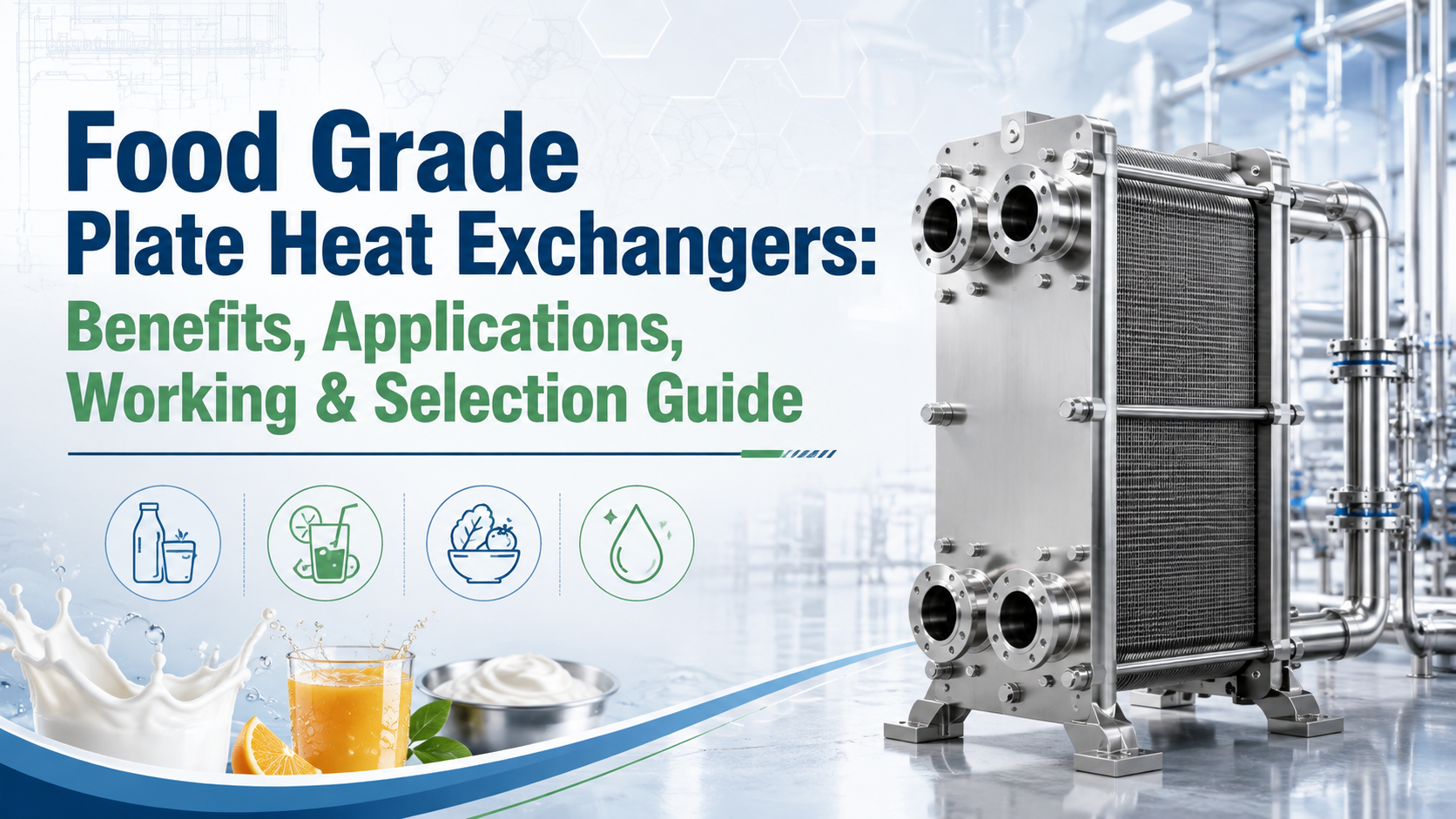
Food Grade Plate Heat Exchangers: Benefits, Applications, Working & Selection Guide
Temperature control is one of the most decisive factors in food, dairy and beverage manufacturing. Whether it is pasteurizing milk, chilling a beverage before filling, or heating a process fluid for a pharmaceutical application, the way heat is added or removed directly affects product safety, product quality, shelf life and process consistency. Get it wrong, and a plant risks microbial growth, inconsistent texture, product loss, or unnecessary energy consumption. Get it right, and the same process runs predictably, batch after batch.
This is where Food Grade Plate Heat Exchangers come in. They are compact, efficient heat-transfer systems built specifically for hygienic processing environments, where the equipment must not only transfer heat effectively but also meet the cleanliness, inspection and material standards that food and pharmaceutical production demand.
This guide walks through how a Food Grade PHE works, where it is used, how to select the right one, and the mistakes plant engineers and procurement teams should avoid when specifying one.
What is a Food Grade Plate Heat Exchanger, in short? It is a heat-transfer device built from thin, corrugated stainless steel plates that keep a product fluid and a heating or cooling medium physically separate while allowing heat to pass between them. It is designed with food-compatible materials, smooth hygienic surfaces and easy-to-open construction so it can be cleaned and inspected regularly.
What is a Food Grade Plate Heat Exchanger?
A Food Grade Plate Heat Exchanger (PHE) is a type of gasketed or brazed heat exchanger built around a pack of thin, corrugated stainless steel plates, arranged so that the product fluid and the service fluid (typically hot water, chilled water or glycol) flow through alternating channels without ever mixing. Heat passes from one fluid to the other through the plate surface itself.
What separates a food grade PHE from a general industrial heat exchanger is not the basic heat-transfer principle — it is the construction philosophy. In hygienic applications, the exchanger has to satisfy requirements that go beyond thermal performance:
-
Hygienic construction — smooth plate surfaces without crevices where product residue can collect
-
Food-compatible gasket materials — elastomers selected for contact with food, dairy, beverage or pharmaceutical fluids
-
Complete separation between product and service fluids — so there is no risk of cross-contamination between the process stream and the heating/cooling medium
-
Compact footprint — a large heat-transfer area packed into a relatively small frame
-
Ease of inspection and cleaning — the plate pack can be opened for visual inspection or manual cleaning, and is compatible with automated cleaning cycles
Material selection plays a central role here. SS304 and SS316L stainless steel are the two grades most commonly considered for food-contact plates, chosen based on the corrosiveness of the product, the cleaning chemicals used, and the operating environment. Neither grade is automatically the “correct” choice for every application — that decision depends on process chemistry, which is discussed in more detail later in this guide.
If you are evaluating equipment for a specific application, PHE INDIA’s Food Grade Plate Heat Exchangers page outlines the construction options available for hygienic processing.
How Does a Food Grade Plate Heat Exchanger Work?
The working principle of a plate heat exchanger is straightforward once you break it into steps, even though the plate geometry itself is engineered with considerable precision.
-
Two fluids enter through separate ports — typically the product (say, milk) on one side and the heating or cooling medium (say, hot water or chilled water/glycol) on the other.
-
Each fluid flows through its own set of channels, formed between adjacent corrugated plates. The plates are arranged so that hot and cold fluid channels alternate — hot, cold, hot, cold — across the plate pack.
-
The fluids never physically mix. Gaskets around the plate ports direct each fluid into its designated channel and seal the edges of the plate pack.
-
Heat transfers through the thin stainless steel plate wall that separates each pair of adjacent channels. Because the plates are thin and made of a good thermal conductor, heat moves efficiently from the warmer fluid to the cooler one.
-
The corrugated (chevron) pattern on each plate creates turbulence in the flow, rather than allowing fluid to move in smooth, undisturbed layers. This turbulence continuously disrupts the boundary layer at the plate surface, which is one of the main reasons plate heat exchangers achieve strong heat-transfer performance for their size.
-
The product reaches the target outlet temperature as it passes through the required number of plates — this could mean heating milk toward a pasteurization temperature or cooling a beverage before filling.
-
Both fluids exit through separate outlet ports, continuing to their respective downstream processes.
Because the plate pack offers a large total heat-transfer surface within a compact frame, a well-designed PHE can achieve efficient heat exchange without occupying the floor space a shell-and-tube exchanger of similar duty might need. The actual performance for any specific duty depends on plate design, flow rates, and the temperature program — which is why sizing should always be based on process-specific calculations rather than assumptions.
Food Grade PHE vs Conventional Heat Exchanger
Plate heat exchangers are not automatically the right choice for every application — but for hygienic liquid-to-liquid processing, they offer a number of practical advantages over conventional shell-and-tube or jacketed designs.
|
Parameter |
Food Grade Plate Heat Exchanger |
Conventional Heat Exchanger |
|
Hygienic suitability |
Designed for food-contact use with hygienic gaskets and smooth plate surfaces |
Often not designed with food-contact hygiene as a primary criterion |
|
Heat-transfer efficiency |
High, due to thin plates and turbulent flow across corrugated surfaces |
Generally lower per unit of surface area, especially in laminar-flow conditions |
|
Footprint |
Compact — large surface area in a small frame |
Typically larger for an equivalent heat-transfer duty |
|
Ease of cleaning |
Plate pack can be opened for inspection; supports CIP |
Cleaning access can be more limited depending on design |
|
Inspection |
Individual plates can be visually inspected |
Internal inspection is often more difficult |
|
Capacity modification |
Plates can sometimes be added or removed within design limits (gasketed types) |
Capacity changes usually require a new or modified unit |
|
Maintenance |
Gasket replacement and plate cleaning are routine, well-understood tasks |
Maintenance procedures vary widely by exchanger type |
|
Suitability for food-contact processes |
High, when constructed with appropriate materials and gaskets |
Depends entirely on specific construction and materials used |
The right choice always depends on the fluid, temperature range, pressure, fouling tendency and hygiene requirement of the specific process — a qualified process engineer should evaluate this before finalizing equipment.
Key Benefits of Food Grade Plate Heat Exchangers
1. High Thermal Efficiency
The thin plate walls, combined with a large effective heat-transfer area and the turbulence generated by the corrugated plate pattern, allow plate heat exchangers to transfer heat efficiently for their physical size. This turbulence continually disturbs the fluid layer nearest the plate surface, which is typically the main resistance to heat transfer in any exchanger.
2. Hygienic Processing
Correct material selection and complete separation of the product stream from the service fluid are central to food safety. A properly built food grade PHE ensures the product never comes into contact with anything other than food-compatible stainless steel and gasket material.
3. Compact Design
Because a large surface area is packed into a relatively small frame, plate heat exchangers typically require significantly less floor space than an equivalent-duty shell-and-tube unit — a practical benefit in plants where processing area is limited.
4. Faster Heating and Cooling
In continuous production lines, the speed at which product reaches its target temperature affects overall line throughput. The efficient heat transfer of a PHE supports rapid, controlled temperature change, which matters in processes like pasteurization where time-temperature relationships are critical.
5. Lower Energy Requirements
Efficient heat exchange, and in many plants the ability to recover heat between process streams (for example, using outgoing hot product to pre-heat incoming cold product), can help reduce the overall energy load on heating and cooling utilities. The actual energy impact depends on the specific process design and utility setup, so it should be evaluated case by case rather than assumed.
6. Easy Cleaning and Maintenance
Gasketed plate packs can be opened, allowing individual plates to be inspected and manually cleaned when required. This accessibility is one of the reasons PHEs are widely used in industries with strict hygiene expectations.
7. CIP Compatibility
Food grade PHEs are commonly designed to work within Clean-In-Place (CIP) systems, allowing internal surfaces to be cleaned using a defined chemical cleaning cycle without dismantling the equipment for every cleaning event. CIP compatibility is discussed in more detail later in this article.
8. Expandable or Modular Design
For suitable gasketed PHE designs, it is sometimes possible to adjust thermal capacity by adding or removing plates from the plate pack, within the mechanical and hydraulic limits of the frame. This should always be assessed by the manufacturer’s engineering team rather than assumed, since frame size, tie-bar length and connection sizing all impose limits.
9. Reliable Temperature Control
Consistent, repeatable temperature control is what allows a food or beverage plant to produce a uniform product batch after batch. A correctly sized PHE, paired with appropriate instrumentation and control, supports this consistency.
Major Applications of Food Grade Plate Heat Exchangers
Dairy Industry
Dairy processing involves multiple heating and cooling steps, and PHEs are used extensively across them: raw milk chilling immediately after collection, heating milk ahead of pasteurization, the pasteurization step itself, temperature control during yogurt fermentation, process heating and cooling in cheese production, and cooling of ice cream mix before further processing. Each of these steps has a different temperature profile and fouling tendency, which affects plate selection.
Beverage Industry
Beverage plants use PHEs for pre-cooling product before further processing, post-cooling before filling, juice pasteurization and cooling, soft drink temperature control, and cooling sugar syrup used in formulation. Because beverages vary widely in viscosity and sugar content, plate spacing and channel design need to match the specific product.
Brewery Applications
Breweries commonly use plate heat exchangers for beer cooling stages and general process temperature control, and in some brewery configurations for wort cooling where the specific process design calls for it. The exact application depends on the brewery’s process layout and should be confirmed with the equipment supplier.
Food Processing Industry
Beyond dairy and beverages, general food processing plants use PHEs to heat or cool suitable liquid process streams — from sauces and liquid ingredients to process water — wherever hygienic, controlled temperature change is required.
Edible Oil Industry
In edible oil processing, PHEs can be used for appropriate heating, cooling and heat-recovery duties within the process line. Oils behave differently from water-based fluids in terms of viscosity and fouling, so plate design for oil applications needs to account for this rather than following a generic dairy-style specification.
Pharmaceutical Industry
Pharmaceutical manufacturing uses PHEs for hot-water generation, process-fluid temperature control, heating of CIP cleaning solutions, and other hygienic heat-transfer duties where product purity and traceable, repeatable temperature control are essential.
In every case, the correct PHE configuration — plate type, number of plates, gasket material and connection size — depends on the specific product properties and process requirements. A generic “off-the-shelf” unit is rarely the right long-term answer for a demanding hygienic process.
Importance of SS304 and SS316L in Food Grade PHEs
Stainless steel is the standard plate material for food grade heat exchangers because it combines corrosion resistance with a smooth, cleanable surface. Two grades dominate the hygienic processing world:
SS304
SS304 is a widely used general-purpose stainless steel in food processing equipment. It offers good corrosion resistance and a hygienic surface finish, and is a common choice where the process fluid and cleaning regime are not particularly aggressive.
SS316L
SS316L contains molybdenum, which gives it enhanced corrosion resistance in more demanding environments — particularly where chloride exposure is a concern. It is commonly selected for applications involving more aggressive product chemistry, higher salt content, or cleaning agents that would be more corrosive to SS304 over time.
Neither grade should be assumed to be the correct choice by default. The right selection depends on the product’s chemical composition, chloride concentration, operating temperature, and the specific cleaning chemicals used in the plant’s CIP or manual cleaning procedure. This is a decision best made jointly with the equipment manufacturer, based on actual process data.
Why Gasket Selection Matters
Gaskets are easy to overlook, but they are one of the most critical components in a plate heat exchanger. Their job is to:
-
Seal each individual flow channel
-
Prevent leakage between the product side and the service side
-
Maintain complete separation between the two fluids
-
Withstand the temperature and pressure conditions of the process
Because gaskets are elastomeric, they age and degrade differently depending on what they are exposed to. Gasket selection should take into account:
-
The process fluid itself (its chemical composition and any solvents or fats present)
-
Operating temperature range
-
Operating pressure
-
The specific CIP cleaning chemicals used (acids, caustics, sanitizers)
-
Food-contact hygiene requirements
-
Expected service life before replacement
There is no single “universal” gasket compound that suits every process. Recommending a specific gasket material without full process information would be guesswork — this is a decision the manufacturer’s engineering team should make together with the buyer, based on actual operating conditions.
Role of CIP in Food Grade Plate Heat Exchangers
Clean-In-Place (CIP) is a cleaning method that circulates cleaning and sanitizing solutions through the internal wetted surfaces of process equipment — including the plate pack of a PHE — without requiring the unit to be dismantled for every cleaning cycle. A typical CIP cycle moves through pre-rinse, caustic wash, intermediate rinse, acid wash (where required) and final rinse/sanitization steps.
For food, dairy, beverage and pharmaceutical plants, CIP compatibility brings several practical benefits:
-
Reduced dependence on manual cleaning labor
-
More consistent, repeatable hygiene outcomes
-
Lower downtime compared with full disassembly cleaning
-
Standardized cleaning procedures that are easier to validate and document
-
Simplified sanitation management across multiple equipment items
That said, CIP effectiveness is not automatic. It depends on correct system design — adequate flow velocity to achieve turbulent cleaning action inside the channels, correct chemical concentration, adequate contact temperature, and a cleaning procedure matched to the specific fouling the product leaves behind. A PHE that is undersized for CIP flow, or paired with an incompatible gasket material, will not clean effectively no matter how well the CIP program is designed.
How to Select the Right Food Grade Plate Heat Exchanger
Selecting a food grade PHE is fundamentally an engineering exercise, not a catalogue purchase. The manufacturer needs accurate process data to size the unit correctly — undersizing leads to poor temperature control, and oversizing wastes capital and can create low-velocity zones that encourage fouling.
1. Product Type
Milk, juice, syrup, water, oil, beverage, pharmaceutical fluid, or another process liquid — the product determines viscosity behavior, fouling tendency and material compatibility requirements.
2. Required Flow Rate
Flow rate directly affects the number and size of plates needed, as well as the resulting pressure drop across the unit.
3. Inlet Temperature
Both the product side and the service (heating/cooling medium) side inlet temperatures are needed to calculate the required heat duty.
4. Required Outlet Temperature
The temperature approach — the difference between the product’s target outlet temperature and the service fluid’s temperature — has a major influence on how many plates and how much surface area the exchanger needs.
5. Heating or Cooling Medium
Common utility fluids include hot water, chilled water or glycol, though the appropriate medium depends on the specific process and utility availability at the plant.
6. Operating Pressure
Pressure on both sides of the exchanger affects plate thickness, gasket selection and the mechanical design of the frame.
7. Allowable Pressure Drop
Every process has a pressure drop budget dictated by the capacity of upstream and downstream pumps. Exceeding this budget can starve the process of flow or overload the pumping system.
8. Product Viscosity
Thicker fluids behave very differently from water-like liquids inside the plate channels — they affect flow distribution, pressure drop and the achievable heat-transfer coefficient, and often call for wider plate gaps.
9. Fouling Characteristics
Products containing solids, proteins, sugars or fats can deposit on plate surfaces over time, reducing thermal performance. Fouling tendency affects plate selection and how frequently CIP cycles are needed.
10. Material Compatibility
Plate and gasket materials need to be matched to the process fluid’s chemistry as well as the cleaning chemicals the plant uses.
11. Cleaning Requirements
The planned CIP procedure and inspection frequency should be factored into the design from the start, not treated as an afterthought.
12. Future Capacity
If the plant expects production volumes to grow, it is worth discussing this with the manufacturer at the selection stage, since some designs allow for later plate-pack expansion within defined limits.
Information to Share With Your PHE Manufacturer — Quick Checklist
-
Product type and its key physical properties
-
Required flow rate
-
Inlet and outlet temperatures (product and service side)
-
Heating/cooling medium available
-
Operating pressure on both sides
-
Allowable pressure drop
-
Product viscosity
-
Fouling tendency / solids content
-
Preferred plate and gasket materials (if known)
-
CIP cleaning procedure and chemicals used
-
Any anticipated future capacity requirements
Sharing this information upfront with a manufacturer’s technical team — rather than after equipment has already been ordered — saves both time and rework.
Common Mistakes When Selecting a Food Grade PHE
-
Selecting equipment only by purchase price — the lowest-cost unit may not meet the actual thermal duty or hygiene requirement, leading to higher long-term costs.
-
Providing incomplete process data — missing flow rates or temperature values force the manufacturer to guess, which risks an incorrectly sized unit.
-
Ignoring product viscosity — treating a viscous product like water during sizing typically results in higher-than-expected pressure drop and poor flow distribution.
-
Ignoring allowable pressure drop — a unit that is thermally correct but hydraulically mismatched can overload pumps or restrict flow.
-
Incorrect plate material selection — choosing SS304 for a process that needs SS316L (or vice versa, unnecessarily) can lead to premature corrosion or unjustified cost.
-
Incorrect gasket selection — gaskets incompatible with the process fluid or CIP chemicals degrade faster, increasing leak risk and maintenance frequency.
-
Ignoring fouling tendency — products prone to fouling need plate designs and cleaning schedules that account for it, or thermal performance drops over time.
-
Not considering cleaning requirements — designing the exchanger without accounting for CIP flow and access needs makes hygienic cleaning difficult later.
-
Undersizing the heat-transfer area — leads to the product not reaching its target temperature, which is a serious issue in processes like pasteurization.
-
Oversizing without engineering justification — increases capital cost and can create low-velocity zones prone to fouling.
-
Failing to consider future production requirements — a unit sized only for today’s volumes may need premature replacement rather than expansion.
Maintenance Tips for Better PHE Performance
-
Monitor inlet and outlet temperatures on both sides regularly to catch performance drift early.
-
Track pressure drop across the unit — a rising trend can indicate fouling.
-
Follow the CIP procedure recommended for the specific product and gasket material, including concentration, temperature and duration.
-
Inspect for external leakage around the plate pack and connection points.
-
Check gasket condition during scheduled maintenance — look for hardening, cracking or compression set.
-
Inspect individual plates during planned shutdowns for scaling, fouling or corrosion.
-
Avoid operating the unit outside its designed temperature and pressure limits.
-
Maintain process records (temperatures, pressure drop, cleaning cycles) to spot long-term trends rather than relying on memory.
-
Investigate any unexpected drop in thermal performance promptly rather than compensating by increasing utility flow or temperature, which can mask an underlying fouling or gasket issue.
For any structural repair, gasket replacement procedure, or plate-pack rework beyond routine cleaning, it is advisable to involve the original manufacturer’s technical team rather than attempting improvised fixes on hygienic process equipment.
Why Customized PHE Design Matters
It is a common misconception that two plants processing a similar product — say, two dairy plants both pasteurizing milk — can use an identical heat exchanger. In practice, they often need different units, because of differences in:
-
Production capacity and required flow rate
-
The specific temperature program used in their process
-
Available utility flow rates and temperatures
-
Allowable operating pressure
-
Product viscosity and composition
-
Fouling tendency based on raw material sourcing and formulation
-
Cleaning procedures and chemical regimes in use
-
Available floor space and installation constraints
Because of this, PHE selection should always be based on actual thermal and hydraulic calculations specific to the plant’s process conditions — not simply picking a “standard model” from a catalogue because a similar-looking plant uses it. For more complex or multi-duty installations, it is worth discussing customized plate heat exchanger solutions with an experienced manufacturer’s engineering team.
Food Grade Plate Heat Exchangers from PHE INDIA™
PHE INDIA™ (Process Engineers And Associates) has been engaged in plate heat exchanger manufacturing since 1995, with experience covering both industrial and food grade applications. For hygienic processing requirements, PHE INDIA™ offers Food Grade Plate Heat Exchangers built with SS304 and SS316L stainless steel plate options and food-grade gasket materials, designed to be compatible with CIP cleaning procedures common in dairy, food, beverage, brewery, edible oil and pharmaceutical processing.
Rather than offering a fixed catalogue product, PHE INDIA™’s approach is to engineer each unit around the customer’s actual operating conditions — product type, flow rate, inlet and outlet temperatures, operating pressure, and cleaning requirements — supported by technical guidance during selection and after-sales support once the equipment is in service.
If you are evaluating equipment for a hygienic heating or cooling application, you can review the Food Grade Plate Heat Exchanger range, or explore PHE INDIA’s broader Industrial Plate Heat Exchangers portfolio for related process needs. Sharing your application details, flow rate, inlet/outlet temperatures and operating pressure with the engineering team is the fastest way to get a configuration suited to your specific process.
Conclusion
A correctly engineered Food Grade Plate Heat Exchanger supports hygienic processing, efficient heating and cooling, dependable temperature control, easier cleaning, a compact installation footprint, reduced unplanned downtime, and consistent production output. The equipment itself is only as good as the process data behind its design — accurate flow rates, temperatures, pressures and product characteristics matter more to long-term performance than any single feature on a spec sheet.
If your plant is evaluating a new PHE or reviewing an existing one that is underperforming, it is worth discussing your specific process conditions with an experienced manufacturer before finalizing a specification. You can reach out to the PHE INDIA™ engineering team with your application details for technical selection guidance or a quotation.
Frequently Asked Questions
1. What is a Food Grade Plate Heat Exchanger?
A Food Grade Plate Heat Exchanger is a heat-transfer device built from corrugated stainless steel plates that heats or cools a product fluid using a separate service fluid, without the two ever mixing. It is constructed with hygienic materials, food-compatible gaskets and easy-to-clean surfaces, making it suitable for dairy, beverage, food and pharmaceutical processing where product safety and cleanliness are essential.
2. How does a Food Grade Plate Heat Exchanger work?
Hot and cold fluids enter through separate ports and flow through alternating channels formed by stacked corrugated plates. Heat passes through the thin plate walls from the warmer fluid to the cooler one, while the corrugation pattern creates turbulence that improves heat transfer. The two fluids remain physically separated throughout and exit through separate outlets once the target temperature is reached.
3. Which material is best for a Food Grade PHE?
There is no single “best” material for every application — SS304 and SS316L stainless steel are the two most common options. SS304 suits many general hygienic applications, while SS316L offers stronger corrosion resistance for more demanding product chemistry or cleaning regimes. The correct choice depends on the specific product, cleaning chemicals and operating conditions involved.
4. What is the difference between SS304 and SS316L plate heat exchangers?
SS304 is a widely used general-purpose stainless steel with good corrosion resistance for standard hygienic applications. SS316L contains molybdenum, which gives it improved resistance to corrosion, particularly in environments involving higher chloride exposure or more aggressive cleaning chemicals. The choice between them should be based on actual process fluid chemistry rather than assumption.
5. Can a plate heat exchanger be used for milk pasteurization?
Yes, plate heat exchangers are widely used across the dairy industry for milk heating and pasteurization, along with chilling and cooling duties. The exact plate configuration, number of plates and gasket material depend on the required temperature program, flow rate and hygiene standards of the specific dairy process, so the unit should be engineered for that application rather than assumed generic.
6. Are Food Grade Plate Heat Exchangers compatible with CIP cleaning?
Food grade PHEs are commonly designed to work within Clean-In-Place (CIP) systems, allowing internal surfaces to be cleaned through a defined chemical cleaning cycle without full disassembly. Effective CIP cleaning depends on correct flow velocity, chemical concentration, temperature and cycle design, so the exchanger and CIP program should be matched to each other during the design stage.
7. Which industries use Food Grade Plate Heat Exchangers?
Food Grade PHEs are used across dairy processing, beverage and juice manufacturing, breweries, general food processing, edible oil processing and pharmaceutical manufacturing. In each industry, the exchanger is applied to heating, cooling or temperature-control duties involving liquid process streams that require hygienic handling and consistent temperature control.
8. How do I calculate the required size of a Food Grade Plate Heat Exchanger?
Sizing requires accurate process data — flow rate, inlet and outlet temperatures on both sides, product viscosity, allowable pressure drop and fouling characteristics. This data is used to calculate the required heat duty and select the number and type of plates needed. Sizing calculations should be performed by the manufacturer’s engineering team based on your specific process conditions.
9. What information is required to select a Food Grade PHE?
Key details include product type, flow rate, inlet and outlet temperatures, the heating or cooling medium available, operating pressure, allowable pressure drop, product viscosity, fouling tendency, material and gasket preferences, and your CIP cleaning procedure. Sharing this information with the manufacturer upfront allows for a properly sized, correctly engineered unit rather than a generic selection.
10. Where can I buy a Food Grade Plate Heat Exchanger in India? PHE INDIA™ (Process Engineers And Associates)
manufactures and supplies Food Grade Plate Heat Exchangers in India, built in SS304 and SS316L stainless steel with food-grade gasket options and CIP-compatible designs for dairy, beverage, food processing and pharmaceutical applications. Sharing your process requirements with their engineering team allows them to recommend a suitably engineered unit for your application.

 Arabic
 French
 Spanish
 Portuguese
 Deutsch
 Turkish
 Dutch
Dutch
 Italiano
 Russian
 Romaian
 Portuguese (Brazil)
 Greek
Greek