


Debonding-on-Demand Adhesives for EV Battery Modules Market Poised for Strong Growth Through 2036
NEWARK, Del., United States, August 28, 2026 — The global Debonding-on-Demand Adhesives for EV Battery Modules Market is entering a high-growth phase as electric vehicle manufacturers shift from permanent structural bonding toward repairable, recyclable, and service-friendly battery architectures. Rising battery passport requirements, extended producer responsibility mandates, increasing warranty costs, and the economics of second-life batteries are encouraging automakers and Tier-1 suppliers to engineer controlled separation pathways for EV battery modules.
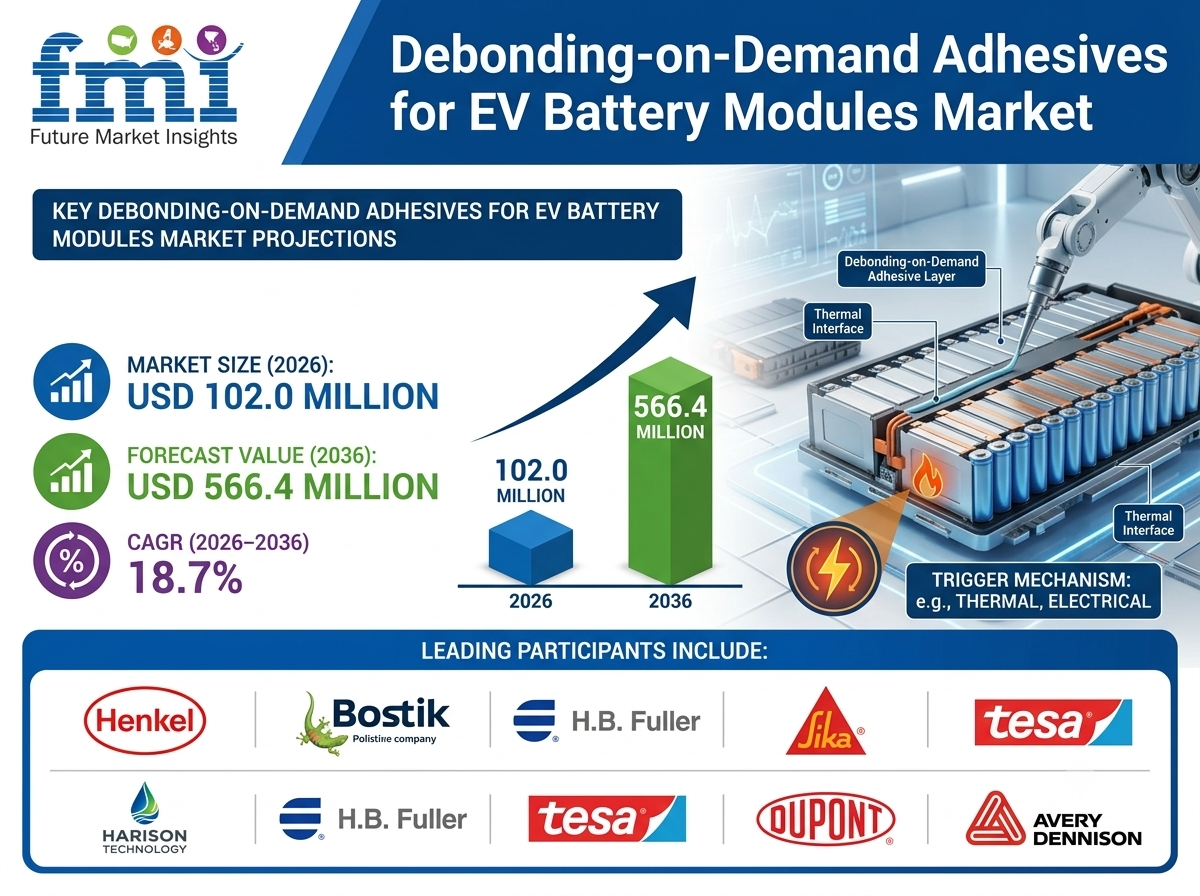
According to Future Market Insights (FMI), the debonding-on-demand adhesives for EV battery modules market was valued at USD 85.9 million in 2025 and is projected to reach USD 102.0 million in 2026. The market is expected to expand at a CAGR of 18.7% from 2026 to 2036, reaching approximately USD 566.4 million by 2036. This rapid expansion reflects growing investment in battery designs that support efficient repair, refurbishment, disassembly, and recycling.
Key Debonding-on-Demand Adhesives for EV Battery Modules Market Projections
- Market Value (2025): USD 85.9 Million
- Market Size (2026): USD 102.0 Million
- Forecast Value (2036): USD 566.4 Million
- CAGR (2026–2036): 18.7%
- Leading Trigger Mechanism: Thermal debonding / heat-activated systems, with 39.0% share in 2026
- Leading Chemistry Family: Epoxy-based debondable systems, with 34.0% share
- Leading Battery Integration Point: Module-to-pack / structural housing bonding, with 36.0% share
- Leading Vehicle Class: Passenger battery electric vehicles, with 71.0% share
- Leading Service Objective: End-of-life disassembly and recycling, with 42.0% share
- Fastest-Growing Country: India, with 21.4% CAGR
Access detailed market forecasts, segment analysis, and competitive insights:
https://www.futuremarketinsights.com/reports/sample/rep-gb-30474
Strategic Market Insights
Debonding-on-demand adhesives are engineered polymer systems that maintain structural integrity during vehicle operation but release their bond when exposed to a specified thermal, electrical, mechanical, or other controlled trigger. Their ability to combine structural performance with commanded release is becoming increasingly important as battery manufacturers address repairability and end-of-life processing requirements.
Battery passport regulations are emerging as a major structural driver. Automakers increasingly need to demonstrate how battery packs can be dismantled and recycled, encouraging design teams to replace irreversible structural bonding with controlled-release systems.
Warranty economics are another major adoption catalyst. Permanently bonded battery modules can make individual cell replacement difficult and expensive, potentially forcing manufacturers to scrap surrounding components when only a localized failure occurs. Reworkable adhesive architectures can reduce these losses by enabling technicians to isolate damaged sections without destroying complete packs.
The secondary-use market is also increasing demand. Battery dismantlers need efficient separation methods to recover intact modules for refurbishment and second-life applications. Automated debonding can reduce labor-intensive dismantling processes while improving recovery yields and preserving valuable battery components.
Analyst Perspective
"Generalist assumptions suggest automakers adopt circular battery adhesive innovations purely to make end-of-life recycling easier for third parties. In reality, procurement directors aggressively secure these formulations to protect their own warranty reserves. Replacing a single defective cell inside a permanently potted pack often costs thousands in scrapped adjacent modules. Triggered debonding changes this math entirely, making warranty risk mitigation a major driver of adoption ahead of formal regulatory deadlines."
— Sudip Saha, Principal Analyst, Automotive and Chemicals, Future Market Insights
Competitive Landscape and Market Share Analysis
The competitive environment is shifting away from conventional adhesive performance toward predictable, precisely controlled release behavior. Suppliers must demonstrate that their formulations remain stable throughout high-temperature driving, fast charging, crash events, and long service lives while still separating rapidly under controlled dismantling conditions.
Leading participants include Henkel AG & Co. KGaA, Arkema S.A. (Bostik), H.B. Fuller Company, Sika AG, tesa SE, DuPont de Nemours, Inc., and Avery Dennison Corporation.
Competitive differentiation increasingly depends on trigger reliability, dispensing compatibility, curing performance, thermal stability, chemical resistance, automation readiness, and the ability to integrate debonding functions into established battery production lines.
Segmental Market Insights
Thermal debonding / heat-activated systems are projected to account for 39.0% share in 2026, supported by compatibility with existing heat-based dismantling processes. However, precise release-temperature control remains critical because triggers set too low could create safety risks, while thresholds set too high may increase dismantling energy requirements.
Epoxy-based debondable systems are expected to hold 34.0% share, benefiting from their ability to maintain high structural and torsional strength while incorporating cleavable chemical structures. These systems can also support compatibility with established automated dispensing technologies.
By battery integration point, module-to-pack / structural housing bonding is projected to account for 36.0% share. Reversible structural interfaces allow damaged modules to be extracted without destroying complete battery housings.
By vehicle class, passenger battery electric vehicles lead with 71.0% share, reflecting high production volumes and increasing consumer expectations for affordable battery servicing.
By service objective, end-of-life disassembly and recycling captures 42.0% share, driven by regulatory pressure and the growing economics of recovering valuable battery materials and reusable modules.
Explore customized insights for your EV battery materials strategy:
https://www.futuremarketinsights.com/reports/brochure/rep-gb-30474
Regional Opportunity Assessment
Asia Pacific represents a major growth center due to rapid EV manufacturing expansion, localized battery production, and emerging recycling ecosystems.
India is projected to record the fastest growth at 21.4% CAGR, supported by domestic battery manufacturing targets, recycling infrastructure development, and growing design-for-recycling requirements.
China is expected to expand at 19.8% CAGR, supported by large-scale battery production and state-backed secondary-use ecosystems.
In Europe, Germany is forecast to grow at 18.9% CAGR, while France is projected to register 17.8% CAGR. Regulatory developments surrounding battery traceability, circularity, and end-of-life management are increasing demand for controlled separation technologies.
The United States is expected to expand at 17.1% CAGR, driven by warranty-cost containment, growing domestic EV production, and evolving extended producer responsibility frameworks.
Meanwhile, South Korea is projected to advance at 16.8% CAGR, supported by battery-material standardization and export-oriented EV manufacturing. Japan is expected to grow at 15.9% CAGR, with innovation focused on advanced battery chemistries and cleaner dismantling methods.
Market Drivers, Restraints, and Opportunities
The strongest market driver is the financial pressure created by permanent battery bonding. Replacing a defective cell can otherwise result in costly module and enclosure disposal. Debondable systems provide manufacturers with an alternative that supports repair, refurbishment, and improved asset utilization.
The primary restraint remains the challenge of preventing accidental activation. Adhesive developers must ensure that thermal, electrical, or mechanical triggers remain dormant during extreme operating conditions, including fast charging and thermal events.
Significant opportunities exist in low-voltage electrical triggering, primer-assisted release layers, and automated dismantling integration. Electrical release systems can provide localized separation without heating adjacent cells, while automated dismantling platforms could substantially reduce labor requirements and improve recovery throughput.
Technology and Innovation Outlook
Innovation is increasingly focused on creating adhesives that balance crashworthiness, durability, chemical resistance, and rapid release. Key developments include:
- Heat-activated debonding systems
- Low-voltage electrical release technologies
- Induction and infrared-triggered systems
- Cleavable epoxy architectures
- Primer-assisted release layers
- Mechanically stretch-release systems
- Repairable structural battery seals
- Automated robotic dismantling integration
Manufacturers are also prioritizing compatibility with existing dispensing equipment to reduce capital expenditure and accelerate production-line adoption.
Future Industry Outlook
The Debonding-on-Demand Adhesives for EV Battery Modules Market is expected to maintain strong growth through 2036 as automakers increasingly design batteries around repairability, recyclability, and lifecycle economics.
The transition from permanent structural bonding toward reversible architectures is being driven not only by environmental objectives but also by warranty protection, secondary-use economics, compliance requirements, and the need to reduce costly battery scrap.
India and China are expected to remain important growth markets, while Germany, France, the United States, South Korea, and Japan generate strong demand through regulatory, manufacturing, and technology-development initiatives. Suppliers capable of delivering reliable trigger mechanisms without compromising structural safety will be positioned to capture the next phase of EV battery architecture development.
Purchase the Full Report for Comprehensive Market Intelligence:
https://www.futuremarketinsights.com/reports/debonding-on-demand-adhesives-for-ev-battery-modules-market
Why Choose Future Market Insights?
✔ 250+ Pages of Actionable Market Intelligence
✔ Comprehensive Country-Level Forecasts
✔ Competitive Benchmarking & Market Share Analysis
✔ Expert Analyst Support
✔ Customized Research Solutions
✔ Strategic Growth Recommendations
Contact Us
Future Market Insights Inc.
Christiana Corporate, 200 Continental Drive,
Suite 401, Newark, Delaware – 19713, USA
Phone: +1-347-918-3531
Email: sales@futuremarketinsights.com
Website: https://www.futuremarketinsights.com
About Future Market Insights (FMI)
Future Market Insights (FMI) is an ESOMAR-certified market research and consulting firm delivering trusted intelligence across more than 1,200 global markets. Through comprehensive market analysis, competitive intelligence, technology forecasting, and strategic consulting, FMI empowers organizations to identify growth opportunities, optimize investments, and make informed business decisions. With a strong presence across North America, Europe, Asia-Pacific, and the Middle East, FMI continues to support Fortune 500 companies, technology innovators, manufacturers, and institutional investors with actionable market intelligence.

 English
 Arabic
 Spanish
 Portuguese
 Deutsch
 Turkish
 Dutch
Dutch
 Italiano
 Russian
 Romaian
 Portuguese (Brazil)
 Greek
Greek