


Motorcycle Racing Boots vs Riding Shoes: Which Level of Protection Do You Actually Need?
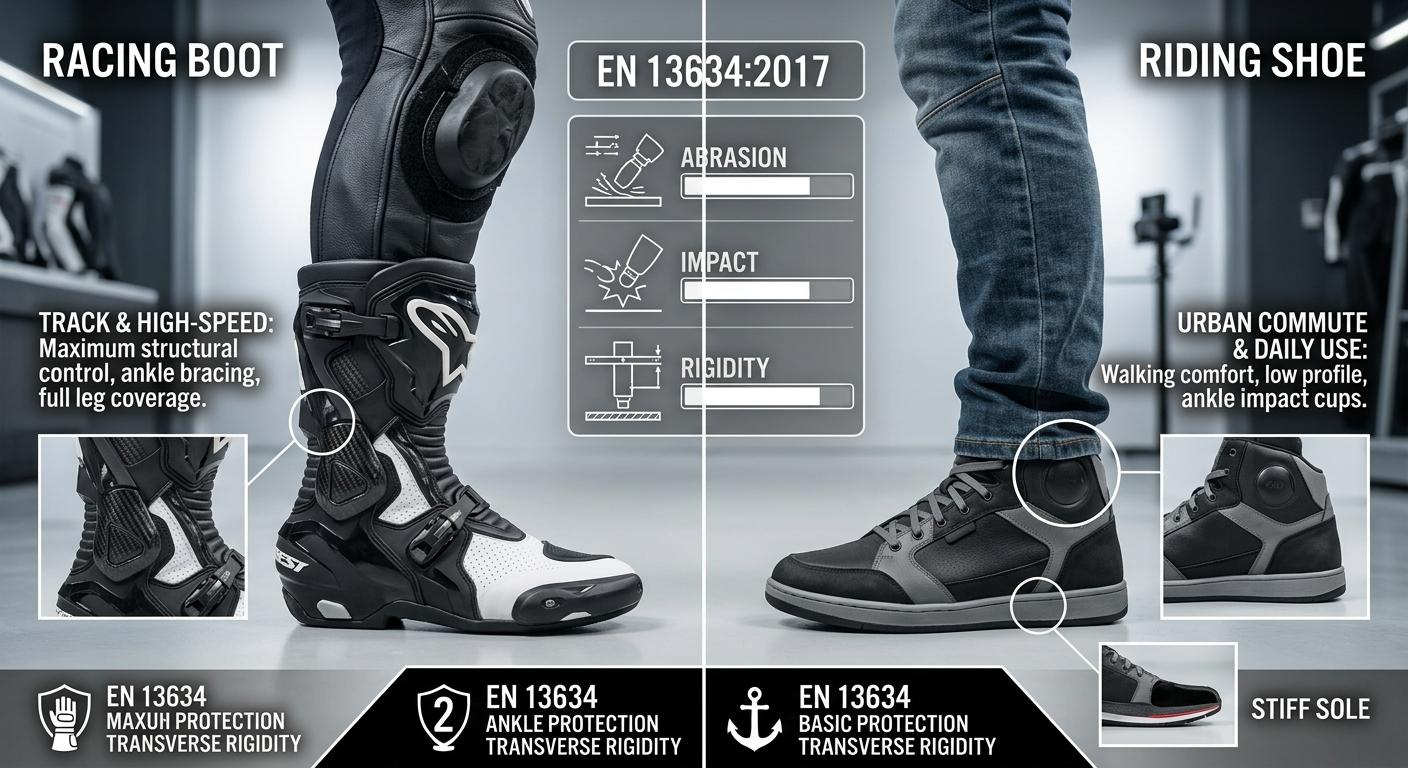
Motorcycle footwear is easy to underestimate because both racing boots and riding shoes can look purpose-built, reinforced, and far more substantial than ordinary sneakers. The difference is not simply style. Each category makes a different compromise between protection, mobility, and off-bike comfort.
A short urban commute does not create the same footwear demands as high-speed riding or track use. The right choice starts with understanding what extra structure a racing boot adds and what a riding shoe gives up to remain wearable off the bike.
Racing Boots and Riding Shoes Solve Different Protection Problems
A racing boot is generally built to protect more of the lower leg and to limit damaging movement around the ankle, heel, and foot. A riding shoe usually stops around or slightly above the ankle and is designed to feel closer to normal footwear during walking.
That distinction affects far more than coverage. Purpose-built protective motorcycle racing boots commonly use a taller upper, reinforced heel and toe structures, a stiffer sole, ankle bracing or restraint systems, shin protection, secure closures, and external wear components such as sliders. Those features prioritize resistance to abrasion, impact, crushing, twisting, and contact with the motorcycle or road surface.
Riding shoes usually remove some of that bulk. They can still use abrasion-resistant uppers, reinforced toe and heel areas, ankle cups, shift pads, and rigid inserts, but the design has to preserve enough flex for normal walking. That creates the central trade-off: greater everyday usability usually means less coverage and less structural control than a full-height racing boot.
Which Option Offers Better Crash Protection?
For pure protection, a well-designed racing boot has the advantage. It covers more of the leg and has more physical space for protective structures. That does not mean every racing boot is automatically superior to every riding shoe, because construction quality and certification matter, but the format itself allows a higher level of protection.
Coverage and Impact Management
A taller boot can protect areas that a riding shoe simply does not cover, especially the lower shin and the region above the ankle. Many racing designs also use hard or semi-rigid components around the heel, ankle, and shin to spread impact loads and reduce direct contact with hard surfaces.
Ankle movement is another important difference. In a crash, the foot can be trapped, rotated, bent, or pulled in a direction that exceeds its normal range. Racing boots often use braces, hinges, internal supports, or reinforced panels to resist excessive lateral movement while still allowing enough controlled flex to operate the motorcycle.
A riding shoe may include ankle protectors, but its shorter and more flexible construction usually provides less leverage against severe twisting. Ankle coverage is therefore a useful minimum, not a complete measure of protection. The U.S. National Highway Traffic Safety Administration advises riders to use boots or shoes high enough to cover the ankles, along with clothing that covers the arms and legs.
Abrasion, Cut Resistance, and Sole Rigidity
Sliding is only one part of motorcycle-footwear protection. The upper also has to resist tearing or cutting, while the sole needs enough integrity to remain attached and resist excessive deformation.
The EN 13634:2017 standard for protective motorcycle footwear tests areas including abrasion resistance of the upper, impact-cut resistance, bond strength between the upper and outsole, and transverse rigidity of the complete footwear. Outsoles are also assessed for abrasion resistance, and polyurethane soles are tested for hydrolysis resistance.
That transverse-rigidity test is especially relevant to the racing-boot versus riding-shoe decision. A very soft shoe may feel excellent while walking, but more sole and chassis rigidity can help the footwear resist folding or crushing forces. Racing boots typically accept the walking penalty because riding protection is the main design priority.
What EN 13634 Can Tell You Before You Buy
Terms such as “reinforced,” “race-inspired,” or “protective” are not precise enough by themselves. A certification marking gives the buyer a more useful way to judge what has actually been tested.
EN 13634:2017 uses a motorcycle-footwear pictogram followed by performance information. The marking reports the height category of the upper and performance levels for abrasion resistance, impact-cut resistance, and transverse rigidity. The standard also allows optional claims for properties such as ankle impact protection, shin impact protection, water resistance, fuel-oil resistance, slip resistance, and water-vapour permeability. The marking lets riders compare tested performance instead of relying on product appearance or marketing language.
This matters because two products that look similar may not offer the same tested performance. It also prevents a common buying mistake: assuming that a tall boot automatically includes every form of impact protection. A rider should check the actual certification label and optional markings rather than infer protection from appearance.
Certification does not make footwear invincible. It shows that specified tests were passed under defined conditions, while real crashes combine forces no single laboratory test can reproduce.
Protection Versus Everyday Usability
The strongest racing boot is not automatically the best choice for every ride. Protective equipment only works if the rider is willing to wear it consistently, and footwear that is excessively awkward for the intended use can create its own practical problems.
Why Riding Shoes Work Better Off the Bike
Riding shoes are easier to live with because they are usually lighter, shorter, and more flexible. That can make a meaningful difference for riders who commute, walk through an office, use public spaces after parking, or spend hours off the motorcycle during a trip.
They may also provide better airflow and less shin restriction than a tall racing boot. For low-speed city riding, a certified motorcycle shoe with ankle coverage can be a sensible compromise.
The compromise should still be deliberate. A casual-looking motorcycle shoe is not the same thing as a normal sneaker. Look for real protective construction, secure retention, reinforced impact zones, and motorcycle-specific certification where available.
Where Convenience Creates a Protection Trade-Off
Shorter footwear exposes more of the lower leg. Greater flexibility can also mean less resistance to severe bending, torsion, or crushing. A low-profile design has less room for shin armor, large ankle bracing systems, and extended reinforcement.
This becomes more important as speed, lean angle, and crash energy increase. Track riding is the clearest example. Riders may drag a toe or boot slider, experience repeated high-load cornering, or crash at speeds where abrasion and impact protection become much more demanding. In that environment, the bulk of a racing boot is not wasted equipment. It is part of the protection strategy.
Road riders who regularly travel at highway speeds or ride aggressively may also decide that the extra structure is worth the inconvenience.
What Crash Research Says About Protective Footwear
Research does not support the idea that footwear can prevent every ankle or foot injury. It does, however, show that protective or higher-coverage footwear can matter.
A study of 951 crash-involved motorized two-wheeler riders found that 47 percent sustained lower-limb injuries, while only 37 percent had been wearing knee-high or ankle boots. In that study, knee-high or ankle boots were associated with a lower risk of ankle or foot fracture, with a relative risk of 0.43 and a 95 percent confidence interval of 0.24 to 0.75. The authors also found that combining motorcycle trousers and boots was associated with a lower risk of soft-tissue injury to the lower limbs.
The limitation is important: observational crash research cannot prove that a specific racing boot will prevent a fracture or that every tall boot is safer than every certified riding shoe. It does reinforce the value of purpose-built footwear with ankle coverage and protective construction.
How to Match Footwear to the Way You Ride
The easiest way to choose is to match the footwear to the most demanding riding you do regularly, not the easiest part of your routine.
Choose a full racing boot when your riding commonly involves:
-
Track days, racing, or closed-course training
-
High-speed sport riding
-
Aggressive lean angles and frequent cornering
-
A strong preference for maximum ankle, shin, heel, and foot structure
-
Situations where walking comfort is secondary
-
One-piece or two-piece leather suits designed to integrate with tall boots
A riding shoe can make more sense when your normal use involves:
-
Urban commuting and lower-speed trips
-
Frequent walking after parking
-
Office, campus, or mixed on-foot use
-
Short rides where convenience strongly affects how consistently you wear protective footwear
-
Riders who want motorcycle-specific reinforcement without the bulk of a race boot
Touring and sport-touring boots also occupy a useful middle ground, offering more height and weather protection than riding shoes with less rigidity than race-focused footwear.
Fit and Construction Matter More Than Styling
A highly protective design can lose much of its value if the boot does not stay correctly positioned. Fit should therefore be evaluated as part of the protection system.
Check the following before buying:
-
Heel retention: The heel should not lift excessively when walking or moving the ankle.
-
Closure security: Zippers, buckles, laces, hook-and-loop panels, or retention systems should keep the footwear closed without creating pressure points.
-
Ankle placement: Protective cups or reinforcement should sit over the intended area rather than shifting away from it.
-
Toe-box control: There should be enough room for comfort and lever operation without excessive internal movement.
-
Sole feel: The sole should provide stable contact with the peg and enough stiffness for the intended level of protection.
-
Shift and brake operation: The footwear should allow clean control inputs without forcing the rider to reposition the entire leg.
-
Compatibility with riding gear: Tall boots should work correctly with the rider's trousers or suit, including any intended over-boot or in-boot arrangement.
-
Replaceable wear parts: On race-focused boots, sliders and other replaceable contact pieces can extend usable life when they are designed to be serviced.
Try footwear with the socks and riding gear you normally use. Short fitting sessions can hide pressure or restricted movement that becomes obvious on a longer ride.
The Right Protection Level Is the One That Matches Your Real Exposure
Racing boots provide the stronger protective platform because they can cover more of the lower leg, control ankle movement more aggressively, use stiffer structures, and accommodate larger impact-protection components. For track use and high-performance riding, those advantages are difficult for a short riding shoe to replicate.
Riding shoes earn their place by solving a different problem. A well-constructed, certified motorcycle shoe can provide meaningful ankle coverage, abrasion resistance, reinforcement, and secure retention while remaining practical enough for commuting and everyday movement.
The decision should not be based on appearance or on the assumption that more armor is always necessary. Look at riding speed, environment, time spent walking, crash exposure, certification, fit, and the consequences you are most concerned about. If your riding regularly pushes into higher speeds or more aggressive conditions, moving toward a full-height boot is the safer direction. If most of your riding is urban and practicality determines whether you wear motorcycle-specific footwear at all, a properly certified riding shoe can be the more realistic choice.

 English
 Arabic
 French
 Spanish
 Portuguese
 Turkish
 Dutch
Dutch
 Italiano
 Russian
 Romaian
 Portuguese (Brazil)
 Greek
Greek