


What Are Drone Swarms And Why Do They Matter Today?
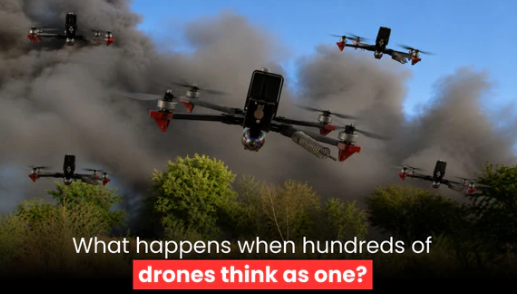
Unmanned aerial technology has changed how organisations approach observation, mapping, emergency response, infrastructure assessment, and defence planning. As individual drones become more capable, researchers and defence organisations are also exploring systems in which multiple aircraft can operate as a coordinated group. If you are asking What Are Drone Swarms, the simplest explanation is that they are groups of unmanned aircraft designed to cooperate through shared communication, coordination, and software-based decision-making.
A drone swarm is different from simply operating several drones at the same time. The defining concept is cooperation. Instead of treating every aircraft as an isolated platform, a swarm can allow participating drones to exchange information and coordinate their behaviour according to predefined rules.
This approach has attracted attention because distributed systems may provide greater coverage, resilience, and flexibility than a single aircraft. At the same time, swarm technology raises important questions about communication security, reliability, regulation, human oversight, and responsible use.
What Is A Drone Swarm?
A drone swarm is a group of unmanned aircraft designed to coordinate their activities as a connected system.
In a conventional multi-drone operation, each aircraft may be controlled or managed separately. A swarm introduces a higher level of coordination, allowing aircraft to share information and respond to changes within their operating environment.
Depending on the design, a swarm system may involve:
- Multiple unmanned aircraft
- Communication links
- Shared environmental information
- Distributed computing
- Coordination software
- Navigation systems
- Human supervision
- Predefined operating rules
The purpose is not simply to increase the number of aircraft in the air. The objective is to make the group function more efficiently as a coordinated system.
How Are Drone Swarms Different From Multiple Drones?
The distinction is important.
Operating ten drones independently does not necessarily create a swarm. Each aircraft may have its own operator, route, and objective.
A swarm is designed around cooperation.
For example, participating aircraft may share information about their surroundings and adjust their positions according to a common objective. This can reduce duplication and allow the group to respond collectively to changes.
The level of autonomy can vary considerably between systems. Some may depend heavily on human control, while others may automate selected coordination functions.
How Drone Swarm Coordination Works
Swarm coordination generally depends on communication, software, sensors, and predefined rules.
A simplified system may involve several stages.
Environmental Sensing
Individual aircraft collect information using cameras, positioning systems, and other appropriate sensors.
Information Sharing
Relevant information can be communicated across the network, depending on the system architecture.
Collective Assessment
Software can process information from multiple aircraft to establish a broader understanding of the environment.
Coordinated Response
The system can then assign or adjust activities according to predefined rules and human-authorised objectives.
This process can allow a group of relatively small aircraft to work together rather than functioning as completely separate machines.
Why Drone Swarms Are Receiving Attention
The main attraction of swarm technology is scalability.
A single drone can only observe a limited area at a particular moment. A coordinated group can potentially distribute observation across a wider region.
This may provide advantages such as:
- Broader coverage
- Greater redundancy
- Flexible task allocation
- Faster information sharing
- Reduced dependence on a single platform
- Greater resilience when individual aircraft become unavailable
These characteristics have potential applications in both civilian and defence-related environments.
The Importance Of Distributed Systems
A major concept behind drone swarms is distribution.
A conventional system may depend heavily on one aircraft or one central control point. A distributed system can spread sensing and processing responsibilities across several aircraft.
This can make the overall system more resilient in certain circumstances.
If one aircraft experiences a technical problem, other aircraft may continue operating, depending on the system's design.
However, distribution also creates new technical challenges. Communication, synchronisation, cybersecurity, and reliable coordination become increasingly important as the number of connected aircraft increases.
Communication Is A Critical Component
A swarm depends on reliable communication.
Aircraft may need to exchange information regarding their position, status, environmental observations, or other authorised data.
Communication systems therefore need to consider:
- Reliability
- Latency
- Coverage
- Security
- Interference
- Network resilience
- Data integrity
A failure in communication can affect coordination, particularly when several aircraft depend on shared information.
For this reason, communication architecture is one of the most important parts of swarm research.
The Role Of Artificial Intelligence
Artificial intelligence and machine learning are often discussed alongside swarm technology because they can help systems process large amounts of information.
AI-based systems may assist with tasks such as:
- Object classification
- Environmental interpretation
- Route assessment
- Image analysis
- Pattern recognition
- Resource allocation
However, AI does not automatically make a drone swarm fully autonomous.
Different systems can have different levels of automation, and important applications may still require human supervision and approval.
Human Oversight Remains Important
Autonomy should not be confused with independence from human responsibility.
Responsible swarm systems should be designed with appropriate human oversight, particularly when their actions can affect people, property, or public safety.
Human involvement can provide:
- Accountability
- Decision review
- Safety supervision
- Operational boundaries
- Emergency intervention
- Regulatory compliance
The appropriate balance between automation and human control depends on the application.
Drone Swarms In Defence Research
Defence organisations are studying swarm concepts because distributed unmanned systems could provide new approaches to surveillance, communications, reconnaissance, and other authorised activities.
A coordinated group can potentially observe different areas simultaneously and share information across the network.
The technology may therefore support broad situational awareness while distributing capability across multiple platforms.
However, defence applications also introduce significant ethical, legal, cybersecurity, and safety considerations.
Any military deployment must operate within applicable laws and established rules governing the use of force.
Drone Swarms For Search And Rescue
One of the most constructive applications of swarm technology is emergency response.
Large areas can be difficult to search after disasters, particularly when roads are blocked or terrain is dangerous.
A coordinated group of drones could potentially help search teams observe different sections of an area simultaneously.
Potential applications include:
- Flood assessment
- Search and rescue
- Disaster mapping
- Wildfire monitoring
- Damage assessment
- Missing-person searches
- Emergency communications
In these applications, distributed aerial observation may help emergency teams develop a clearer understanding of changing conditions.
Environmental Monitoring
Swarm technology may also support environmental research.
A group of drones could potentially collect observations from different locations while reducing the need for repeated manual flights.
Possible applications include:
- Wildlife observation
- Forest monitoring
- Coastal assessment
- Agricultural research
- Environmental mapping
- Disaster-related monitoring
Such applications can benefit from the ability to gather information across larger areas in a coordinated manner.
Agriculture And Large-Area Observation
Agriculture is another field where coordinated drone systems may have potential.
Different aircraft could collect information from separate areas of a large agricultural site.
Depending on the sensors and software involved, this could support:
- Crop observation
- Field mapping
- Irrigation assessment
- Plant health monitoring
- Environmental measurements
The exact use should be based on the agricultural objective and appropriate regulatory requirements.
The Role Of Multirotor Aircraft
Multirotor drones are particularly flexible because they can generally take off vertically and hover in place.
This makes them useful for applications where controlled positioning is important.
A multirotor drone for inspection can provide close aerial observation of structures, buildings, construction areas, and other locations where stable positioning is valuable.
Multirotor aircraft can therefore form part of broader unmanned systems research, although the appropriate aircraft depends on the size, duration, environment, and purpose of the assignment.
Multirotor Versus Fixed-Wing Swarm Platforms
Swarm systems can potentially use different aircraft designs.
Multirotor Systems
Multirotors are generally suited to:
- Hovering
- Close observation
- Compact launch areas
- Controlled movement
- Low-speed aerial work
Fixed-Wing Systems
Fixed-wing aircraft are generally suited to:
- Longer flights
- Wider coverage
- Efficient forward movement
- Large-area mapping
A swarm could theoretically combine different capabilities, although such systems become more complex to design and manage.
The appropriate platform should always be determined by the specific application.
Advantages Of Drone Swarm Technology
Several potential advantages explain the growing interest in swarm systems.
Greater Coverage
Multiple aircraft can observe different areas simultaneously.
Redundancy
The system may remain useful even if individual aircraft become unavailable.
Flexible Coordination
Tasks can potentially be distributed among participating aircraft.
Shared Information
Aircraft can contribute information to a common operational picture.
Scalability
The number of participating aircraft can potentially be adjusted according to the application.
These advantages must be balanced against technical complexity and operational risks.
Challenges Facing Drone Swarms
Swarm technology is promising, but it is not simple.
Several challenges require continued research.
Communication Reliability
Large networks need dependable communication between participating systems.
Cybersecurity
Connected aircraft can create additional security considerations.
Navigation
Multiple aircraft must maintain safe separation and accurate positioning.
Computing Requirements
Collective coordination can require significant processing capability.
Energy Management
Aircraft remain limited by battery capacity and flight endurance.
Regulatory Compliance
Multiple aircraft operating together can create additional regulatory considerations.
Human Oversight
Organisations must determine appropriate levels of supervision and accountability.
These challenges demonstrate why swarm technology requires more than simply connecting several drones.
Safety And Collision Avoidance
When multiple aircraft operate in the same area, safe separation becomes particularly important.
A swarm system must account for the positions and movements of participating aircraft while also considering external obstacles.
This may involve:
- Position awareness
- Collision avoidance
- Flight boundaries
- Communication between aircraft
- Emergency procedures
- Human supervision
Safety should remain a fundamental design consideration for both civilian and defence-related systems.
Cybersecurity And Data Protection
The connected nature of a swarm introduces cybersecurity considerations that may not exist to the same extent in isolated aircraft.
A secure system should consider:
- Authentication
- Communication security
- Data integrity
- Access control
- Software protection
- Secure updates
Data protection is also important when drones collect imagery involving people, private property, or sensitive infrastructure.
Energy And Endurance Challenges
Every aircraft in a swarm has physical limitations.
Battery-powered drones must manage available energy carefully, particularly when carrying cameras or other equipment.
Large-scale swarm systems therefore need to account for:
- Battery capacity
- Flight duration
- Payload
- Weather
- Distance
- Charging
- Replacement aircraft
Efficient energy management can influence the practical usefulness of a swarm.
The Future Of Drone Swarms
The future of swarm technology is likely to involve improvements in autonomy, communication, navigation, sensing, and computing.
Researchers are working toward systems that can coordinate more effectively while maintaining appropriate human supervision.
Potential future developments may include:
- Better distributed computing
- More reliable communication
- Improved navigation
- Greater energy efficiency
- More capable sensors
- Better collision avoidance
- Improved human-machine interfaces
However, technical progress will need to develop alongside regulation, safety standards, cybersecurity, and ethical frameworks.
Responsible Development Matters
Drone swarms represent a powerful technological concept, but capability should not be separated from responsibility.
Developers and organisations should consider how systems will behave under unexpected conditions and how human operators can intervene when necessary.
Responsible development should address:
- Safety
- Privacy
- Security
- Accountability
- Human oversight
- Regulatory compliance
- Environmental impact
These principles can help ensure that swarm technology is developed for beneficial and lawful applications.
Conclusion
Understanding What Are Drone Swarms begins with recognising the difference between several independent drones and a coordinated network of unmanned aircraft. A swarm is designed to allow multiple platforms to cooperate by sharing information and following coordinated rules.
The technology has potential across search and rescue, environmental monitoring, agriculture, infrastructure assessment, disaster response, and defence research. Multirotor aircraft can be particularly useful where hovering and precise positioning are required, making a multirotor drone for inspection a practical example of how individual drone capabilities can support broader aerial technology applications.
The future of drone swarms will depend not only on better aircraft but also on reliable communication, cybersecurity, safe navigation, responsible automation, and effective human oversight. As these systems develop, careful design and responsible use will be essential to ensuring that their capabilities provide genuine value without creating unnecessary risks.
Frequently Asked Questions
What are drone swarms?
Drone swarms are groups of unmanned aircraft designed to coordinate their activities through communication, software, sensors, and predefined rules.
How are drone swarms different from multiple drones?
Multiple drones can operate independently, while a swarm is designed around cooperation and coordinated behaviour among participating aircraft.
Do drone swarms always operate autonomously?
No. The level of autonomy varies. Some systems may automate selected coordination functions while maintaining substantial human supervision.
Why are drone swarms useful?
They can potentially provide wider coverage, information sharing, redundancy, and coordinated observation compared with a single aircraft.
Can drone swarms be used for civilian applications?
Yes. Potential civilian applications include search and rescue, disaster assessment, environmental monitoring, agriculture, mapping, and infrastructure observation.
Can multirotor drones be part of a swarm?
Yes. Multirotor aircraft can be used in coordinated systems, particularly when hovering, vertical takeoff, and controlled positioning are important.
What is a multirotor drone for inspection?
It is a multirotor aircraft used to capture aerial information while examining structures, buildings, construction sites, or other locations that may require controlled aerial observation.
What are the biggest challenges with drone swarms?
Important challenges include communication reliability, cybersecurity, navigation, collision avoidance, energy management, data protection, regulation, and human oversight.
Does artificial intelligence make a swarm fully autonomous?
No. AI can assist with information processing and coordination, but autonomy depends on the complete system architecture and the level of human control established by its designers and operators.
What is the future of drone swarm technology?
Future developments are likely to focus on improved communication, navigation, sensing, energy efficiency, computing, safety, and responsible coordination.

 English
 Arabic
 French
 Spanish
 Portuguese
 Deutsch
 Turkish
 Dutch
Dutch
 Italiano
 Russian
 Romaian
 Greek
Greek