


Reflective Fabrics Market Growth to Drive $1.50 Billion Valuation by 2036
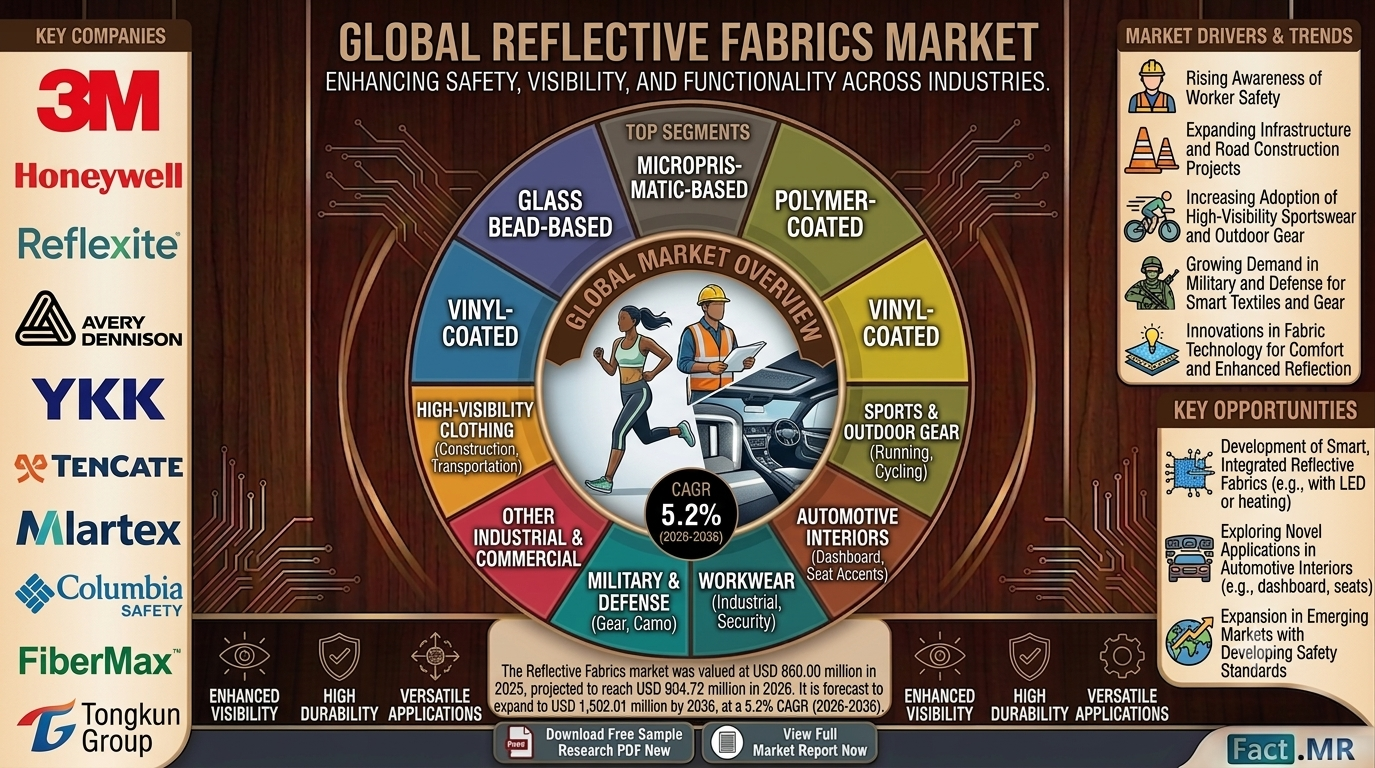
August 31, 2026 — The global Reflective Fabrics Market is projected to grow from USD 904.72 million in 2026 to USD 1,502.01 million by 2036, registering a 5.2% CAGR, according to Fact.MR. The market was valued at USD 860.00 million in 2025. Tightening occupational safety regulations and growing use of reflective materials in consumer activewear are expanding demand across PPE, sportswear, and automotive trim applications.
The market's growth is being supported by two distinct buyer groups. Industrial buyers require certified visibility and wash durability, while sportswear brands increasingly integrate retroreflective materials into running, cycling, and outdoor apparel. Workwear specifications now include requirements for certified retroreflective performance retention through 75 or more industrial wash cycles, concentrating procurement among technically qualified fabric producers.
Get detailed market forecasts, competitive benchmarking, and pricing trends: https://www.factmr.com/connectus/sample?flag=S&rep_id=2020
Reflective Fabrics Market Demand Expands Across Safety Applications
Reflective fabrics are textile materials containing retroreflective elements such as glass beads, microprismatic films, or tapes. These materials return incident light toward its source, improving visibility during nighttime and low-light conditions.
PPE & Workwear accounted for 48.0% of end-use demand in 2026, making it the largest application segment. Construction, mining, logistics, transportation, and other safety-critical sectors use reflective fabrics to meet high-visibility requirements.
Consumer demand is creating another route to market. Running, cycling, and outdoor apparel brands are incorporating reflective elements into garment designs as urban safety awareness grows. This gives producers access to a consumer segment alongside established industrial PPE demand.
Glass-Bead Coatings Hold 44% Share
Glass-Bead Coatings accounted for 44.0% of the market by type in 2026, maintaining its position as the leading reflective technology. The segment benefits from established use in high-visibility workwear and cost-focused industrial applications.
Microprismatic materials serve applications requiring higher candela-per-lux performance. Retroreflective tapes provide another product format for garment and trim applications.
By form, woven reflective fabrics held a 52.0% share in 2026. Woven substrates are used where manufacturers require durability, fabric stability, and suitable drape characteristics during garment construction.
The market is forecast to create an incremental opportunity of USD 597.29 million between 2026 and 2036. This opportunity reflects demand from mandatory workplace safety procurement and voluntary consumer adoption.
Industrial Wash Durability Becomes a Procurement Factor
Workwear manufacturers serving construction, mining, and logistics sectors face specifications requiring reflective performance to remain certified after 75 or more industrial wash cycles. This requirement creates a qualification barrier for suppliers that lack documented durability performance.
Shambhu Nath Jha, Principal Consultant for Chemicals and Materials at Fact.MR, said: “In my analysis, I have observed that the true growth driver for reflective fabrics is the convergence of mandatory occupational safety procurement and voluntary consumer activewear adoption.”
Jha also highlights a divide in purchasing criteria. PPE procurement managers assess certified performance retention after industrial laundering, while sportswear buyers focus more heavily on aesthetic integration and consumer wash durability.
Fact block: Fact.MR is a market research company that provides market sizing, forecasting, segmentation, regional analysis, and competitive positioning across global industries.
India and China Show Faster Growth
India is identified as the fastest-growing key country in the market, with a 7.5% CAGR from 2026 to 2036, followed by China at 6.8% and South Korea at 5.5%. The United States is forecast at 4.5%, Germany at 4.2%, the UK at 4.0%, and Japan at 3.8%.
A separate country comparison in the supplied report lists the USA at 5.8% CAGR, Mexico at 5.6%, Germany at 5.1%, France at 5.0%, the UK at 4.9%, South Korea at 4.8%, and Japan at 4.6%. These figures are presented in the source's country growth comparison and reflect a different country-analysis view.
In Europe, the reflective fabrics market is projected to increase from USD 245.0 million in 2026 to USD 405.0 million by 2036, representing a 5.1% CAGR. Germany held a 27.2% share in 2026, followed by France at 21.6% and the UK at 19.4%.
Competitive Landscape
Competition includes 3M, Honeywell, Reflexite, Columbia Safety, FiberMax, Tencate, Avery Dennison, Mlartex, YKK, and Tongkun Group.
3M leads the competitive landscape with a 15.0% market share, supported by reflective material solutions, optical technologies, and safety applications. Honeywell focuses on industrial safety solutions, while Reflexite supplies specialized reflective products for high-visibility applications.
Columbia Safety, FiberMax, and Tencate also participate across reflective textile and safety material applications. Avery Dennison, Mlartex, YKK, and Tongkun Group contribute through textile manufacturing and reflective material capabilities.
Competition is shaped by three measurable requirements: retroreflective performance, wash durability certification, and multi-standard regulatory approval portfolios.
Smart Textiles Create New Product Opportunities
Smart textile adoption is creating demand for reflective materials that can support connected safety systems, real-time monitoring, worker tracking, and communication functions.
Manufacturers are also developing multi-functional reflective textiles that combine visibility with durability, comfort, and specialized performance properties. Advanced retroreflective technologies are being developed for applications requiring higher light return and precision visibility.
For industrial buyers, certified performance remains central. For consumer brands, reflective integration must also meet garment design expectations.
Top Reports:
https://adamaamresearch.blogspot.com/2026/08/geothermal-heat-pumps-market-to-reach.html
https://zeuspage.org/blogs/46311/Geothermal-Heat-Pumps-Market-Set-to-Hit-USD-35-1
https://kaamkaaziclub.com/read-blog/44040
https://net-pals.com/blogs/27488/Geothermal-Heat-Pumps-Industry-to-Grow-to-USD-35-1
About Fact.MR
Fact.MR is a market research and consulting company providing market sizing, forecasting, competitive analysis, and strategic intelligence across global industries. Its Reflective Fabrics Market study covers product types, end uses, forms, regional markets, country-level growth, competitive positioning, and market opportunities through 2036.

 English
 Arabic
 French
 Spanish
 Portuguese
 Deutsch
 Turkish
 Dutch
Dutch
 Italiano
 Russian
 Romaian
 Greek
Greek