


Calcium Chloride Market Set to Hit USD 3.9 Billion by 2036
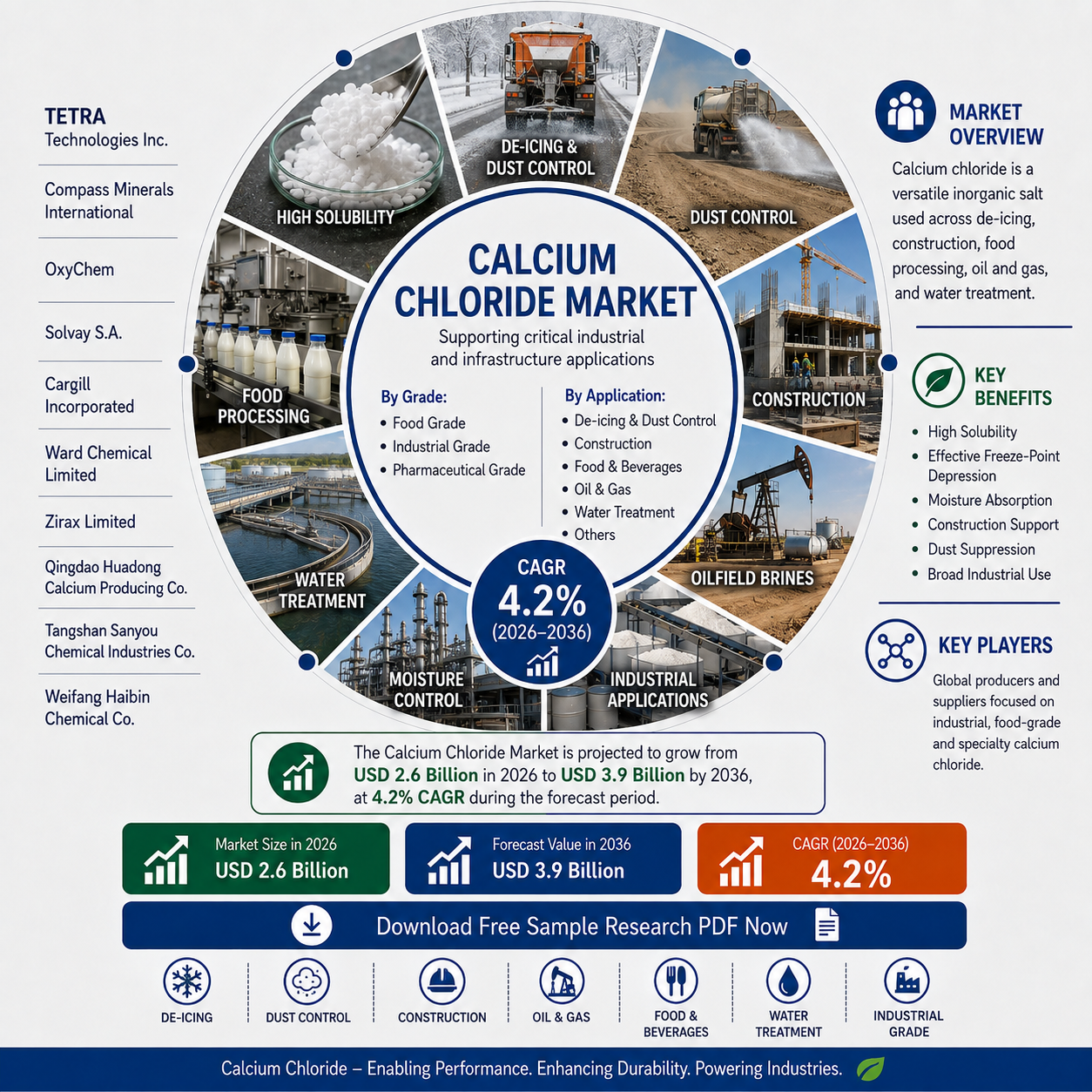
The global Calcium Chloride Market is estimated at USD 2.6 billion in 2026 and is forecast to reach USD 3.9 billion by 2036, creating an absolute dollar opportunity of approximately USD 1.3 billion, according to Fact.MR. The forecast represents a CAGR of 4.2% during 2026-2036.
The answer to why growth is continuing is tied to end-use demand. Infrastructure development across Asia Pacific and the Middle East is increasing consumption in construction and soil stabilization, while oil and gas activity supports demand for completion fluids. Food processing is also creating demand for certified calcium chloride products.
Fact.MR estimates that the market crossed USD 2.5 billion in 2025. By 2036, the market is expected to be USD 1.3 billion larger than its estimated 2026 value.
Get detailed market forecasts, competitive benchmarking, and pricing trends: https://www.factmr.com/connectus/sample?flag=S&rep_id=13860
Fact.MR is a market research and consulting organization that provides market forecasts and industry analysis across global sectors.
The calcium chloride industry covers anhydrous, dihydrate, and hexahydrate products sold as solids and liquid solutions. Calcium chloride is used in road de-icing, dust control, concrete acceleration, soil stabilization, oil well fluids, food processing, and water treatment.
Infrastructure and Industrial Demand Support the Calcium Chloride Market
China is expected to post the fastest growth among the countries highlighted in the Fact.MR analysis, with a projected CAGR of 5.8% through 2036. India follows at 5.3%, supported by infrastructure development and food processing demand.
The United States is forecast to expand at 5.1%, while Canada is expected to grow at 4.9%. Germany is projected to register a 4.2% CAGR.
India's National Infrastructure Pipeline includes USD 1.4 trillion in investment through 2030, according to the information provided by Fact.MR. Infrastructure activity is increasing the use of calcium chloride in concrete acceleration, dust control, and soil stabilization.
North America remains the largest market by value, according to Fact.MR. Winter road maintenance and oil and gas completion activity continue to support regional consumption.
The United States also relies on calcium chloride during severe winter conditions. Fact.MR states that annual de-icing usage exceeds 22 million tonnes of materials across federal, state, and municipal road networks.
Industrial Grade Holds About 57% Share in 2026
Industrial-grade calcium chloride is expected to account for approximately 57% of market share in 2026, according to Fact.MR. Its cost efficiency supports broad use in de-icing, construction, dust control, and oilfield applications.
De-icing and dust control together account for roughly 45% of total market value. Municipalities and government agencies represent a major procurement base through road maintenance tenders and related programmes.
Dihydrate calcium chloride is projected to lead the form segment in 2026. Fact.MR attributes this position to its cost efficiency, balanced concentration, and ease of handling.
One notable industry detail comes from TETRA Technologies. Brady Murphy, CEO of TETRA Technologies, said its calcium chloride business achieved record revenue driven by chip manufacturing demand.
“Our completion fluids segment revenue surged... as our calcium chloride business achieved record revenue driven by chip manufacturing demand,” said Brady Murphy, CEO of TETRA Technologies. “We are focusing on operational excellence and strategic progress toward our 2030 targets.”
That specific demand signal highlights the diverse customer base for calcium chloride beyond traditional winter maintenance and construction applications.
Food-Grade and Oilfield Applications Create New Opportunities
Fact.MR identifies food processing as an important source of demand, particularly in Asia Pacific. Calcium chloride is used in applications including cheese and tofu production, beverage processing, and food ingredients.
In February 2025, Solvay S.A. confirmed the commercial launch of its expanded food-grade and pharmaceutical-grade calcium chloride product line from its Rheinberg, Germany facility. The products targeted European dairy processors and pharmaceutical excipient buyers.
Oil and gas applications also remain important. Fact.MR cites the U.S. Energy Information Administration figure of 580 active rigs in North America in January 2025. Deepwater and unconventional well completions support demand for high-density calcium chloride brines used in completion and workover fluids.
Shambhu Nath Jha, Principal Consultant at Fact.MR, said the market presents opportunities for producers that can meet more specialized customer requirements.
“Companies investing in multi-grade production and food or pharmaceutical certifications can capture higher margins,” said Shambhu Nath Jha, Principal Consultant at Fact.MR. “Especially in food processing and oilfield fluid markets.”
Producers Face Feedstock and Substitution Challenges
The market also faces cost and regulatory pressures. Price volatility in natural gas feedstocks used in synthetic calcium chloride production may affect cost stability.
Alternative de-icing materials, including magnesium chloride and potassium acetate, could create substitution pressure in environmentally regulated municipalities. Minnesota's 2024 Chloride Reduction Plan targets a 20% road salt reduction by 2030, according to the supplied market analysis.
Competition remains moderately fragmented. Fact.MR estimates that the top five companies account for approximately 40% to 45% of total market revenue.
Key companies include Tetra Technologies Inc., Compass Minerals International, Occidental Petroleum Corporation through OxyChem, Solvay S.A., Cargill Incorporated, Ward Chemical Limited, Zirax Limited, Qingdao Huadong Calcium Producing Co., Tangshan Sanyou Chemical Industries Co., and Weifang Haibin Chemical Co.
Integrated production remains an advantage for producers linked to soda ash or chlor-alkali operations. These structures can provide lower production costs compared with standalone manufacturing.
To View Top Market
https://www.foundersclick.com/blogs/57849/Global-Iodine-Market-Set-to-Hit-USD-4-53-Billion
https://www.pikumil.com/blogs/161216/Iodine-Market-Poised-to-Reach-USD-4-53-Billion-by
https://sierra-le.com/blogs/18528/Iodine-Market-Growth-Outlook-Targets-USD-4-53-Billion-by
https://ikofficial.com/blogs/38987/Iodine-Market-Likely-to-Reach-USD-4-53-Billion-by
About Fact.MR
Fact.MR provides market intelligence and consulting services covering global industries and business sectors. Its research combines primary interviews, company information, government records, trade statistics, industry publications, and proprietary forecasting models.

 English
 Arabic
 French
 Spanish
 Portuguese
 Deutsch
 Turkish
 Dutch
Dutch
 Italiano
 Russian
 Romaian
 Greek
Greek