


How Businesses Can Identify Risk and Protect Their Portfolios
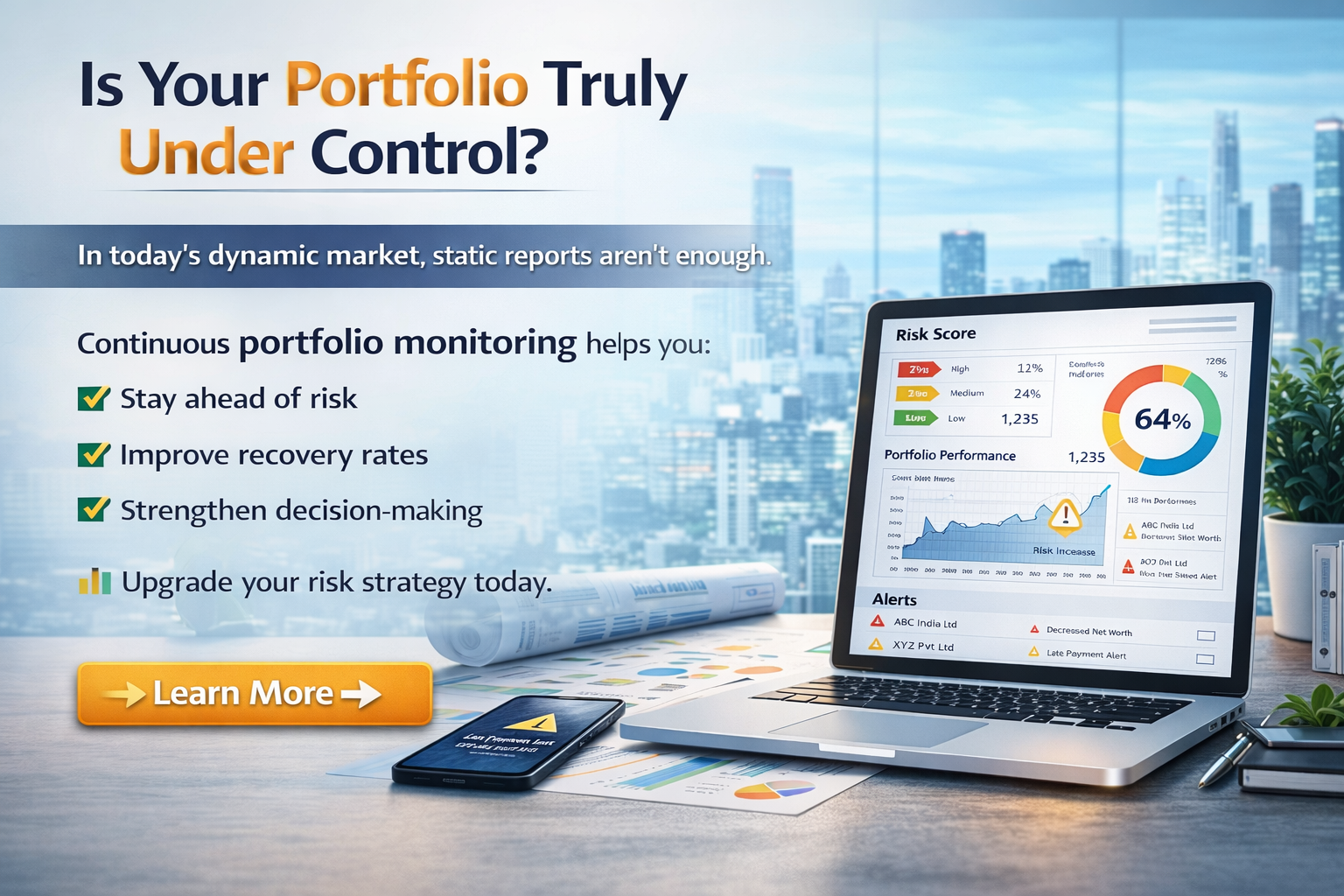
Lending and investment decisions do not end when a transaction is completed. Financial institutions need to continuously understand how borrowers, customers, investments, and counterparties are performing. A business that appears financially stable today can experience significant changes in its financial position, ownership, compliance status, or operating environment over time.
Portfolio Monitoring provides a structured approach to tracking these changes. For banks, NBFCs, fintech companies, lenders, insurers, and enterprises, effective monitoring can help identify emerging risks, improve portfolio visibility, and support timely financial decisions.
Rather than relying only on periodic reviews, organizations can use Portfolio Monitoring to maintain an ongoing view of the entities and exposures that matter most.
What Is Portfolio Monitoring?
Portfolio Monitoring is the continuous process of tracking the financial, business, legal, compliance, and risk-related developments associated with a portfolio.
A portfolio may consist of borrowers, customers, suppliers, investments, distributors, or other counterparties.
Depending on the organization and use case, monitoring may include:
- Financial performance changes
- Credit-related indicators
- Litigation and legal events
- Director and ownership changes
- Compliance developments
- Business status changes
- Industry-related risks
- Significant corporate events
- Early warning signals
The objective is not simply to collect information. It is to identify meaningful changes that may require investigation, escalation, or a change in risk strategy.
Why Is Portfolio Monitoring Important?
Risk Does Not Stay Static
A credit assessment reflects a particular point in time.
Consider an SME that receives a business loan after demonstrating healthy revenue and stable operations. Six months later, its profitability may decline, debt may increase, or a key promoter may exit the business.
The original underwriting decision may still have been appropriate, but the borrower's current risk profile may be different.
Portfolio Monitoring helps organizations recognize these changes.
Early Identification Creates More Options
When a potential problem is identified early, risk teams generally have more time to investigate and respond.
Depending on the circumstances, a lender may request updated financial information, increase monitoring frequency, reassess exposure, or engage with the borrower.
The purpose is proactive risk management—not automatically predicting default.
Key Areas of Portfolio Monitoring
1. Financial Performance
Financial information provides important insight into business health.
Lenders may monitor changes in revenue, profitability, debt, liquidity, and other available financial indicators.
A single negative movement may not be significant. However, persistent deterioration or multiple related indicators may justify a closer review.
2. Litigation and Legal Events
Legal disputes can create financial and operational consequences.
Monitoring relevant litigation events can help risk teams identify developments that could affect a borrower's or counterparty's financial position.
The importance of a legal case depends on its nature, status, potential impact, and relationship to the monitored entity.
3. Ownership and Management Changes
Changes involving directors, promoters, shareholders, or ownership can affect business strategy and governance.
A significant management or ownership change may therefore become an important monitoring event, particularly when combined with other risk indicators.
4. Compliance Indicators
Compliance developments can create regulatory, financial, and reputational exposure.
Monitoring relevant compliance signals helps organizations determine whether an updated review or additional due diligence may be appropriate.
5. Business Status Changes
Changes in corporate or business status can provide valuable context.
Keeping entity information updated helps lenders and enterprises avoid making decisions based solely on outdated onboarding information.
Portfolio Monitoring for Banks
Banks manage large and diversified portfolios across industries and borrower segments.
Manual monitoring of every relationship can require substantial resources.
A technology-enabled Portfolio Monitoring process can help banks prioritize accounts based on exposure, risk profile, and relevant developments.
For example, a bank may classify borrowers into standard, enhanced, and priority monitoring categories.
Accounts showing significant changes can receive additional attention while stable relationships continue through standard monitoring.
Portfolio Monitoring for NBFCs
NBFCs often manage high-volume lending portfolios, including SME and commercial borrowers.
A monitoring platform can reduce repetitive manual checks by automatically tracking selected risk indicators.
Suppose an NBFC identifies three developments for an existing borrower:
- Declining financial performance
- A major director change
- New litigation
Individually, each event may require context. Together, they may justify an enhanced review.
The system can flag the borrower, while the credit team evaluates the significance and determines the next action.
Portfolio Monitoring for Fintech Lenders
Digital lending platforms operate at scale and often rely on automated processes.
Integrating Portfolio Monitoring with underwriting and credit decisioning can create a more complete credit lifecycle:
Application → Underwriting → Credit Decision → Disbursement → Monitoring → Early Warning → Review
This helps lenders continue assessing risk after the initial approval instead of treating underwriting as the end of the risk process.
Portfolio Monitoring for Enterprises
Portfolio Monitoring is not limited to lending.
Enterprises can monitor suppliers, distributors, vendors, channel partners, and other counterparties.
For example, if a critical supplier experiences financial deterioration or becomes involved in significant litigation, the enterprise may need to assess potential supply or operational disruption.
Monitoring can provide an opportunity to investigate the situation and consider appropriate contingency measures.
Role of Early Warning Signals
An important component of Portfolio Monitoring is the identification of early warning signals.
These may include:
- Sustained financial deterioration
- New litigation
- Significant ownership changes
- Compliance concerns
- Management changes
- Business status changes
- Other material corporate events
Effective monitoring should prioritize relevant signals instead of generating large volumes of low-value alerts.
Technology and Automated Portfolio Monitoring
Modern Portfolio Monitoring platforms can help organizations centralize and automate parts of the monitoring process.
Important capabilities may include:
- Automated data collection
- Business profile monitoring
- Event-based alerts
- Risk categorization
- Portfolio segmentation
- Early warning indicators
- Historical event tracking
- Workflow management
- Review and escalation tracking
Technology can reduce manual effort, but material risk decisions should still involve appropriate professional judgment.
Best Practices for Effective Portfolio Monitoring
Define Relevant Monitoring Parameters
Organizations should identify indicators that align with their risk appetite, products, industries, and exposure.
Use Risk-Based Monitoring
Higher-risk or higher-value relationships may require more frequent or detailed monitoring.
Avoid Alert Fatigue
Too many irrelevant alerts can make important signals harder to identify.
Validate Important Information
Material findings should be reviewed against appropriate and reliable sources before significant decisions are taken.
Connect Alerts to Actions
Monitoring becomes more useful when every significant alert has a defined process for investigation, escalation, documentation, or review.
Frequently Asked Questions
What is Portfolio Monitoring?
Portfolio Monitoring is the ongoing process of tracking financial, business, legal, compliance, and risk-related changes across borrowers, customers, investments, suppliers, or other counterparties.
Why is Portfolio Monitoring important for lenders?
It helps lenders maintain updated visibility into borrower risk and identify developments that may require additional assessment after the initial credit decision.
What does Portfolio Monitoring typically track?
It can track financial performance, litigation, ownership changes, directors, compliance indicators, business status, and other relevant risk events.
How does Portfolio Monitoring help identify credit risk?
It highlights meaningful changes in a borrower's profile that may indicate emerging risk, allowing credit teams to investigate and take appropriate action earlier.
Can enterprises use Portfolio Monitoring?
Yes. Enterprises can monitor suppliers, distributors, vendors, and business partners to identify changes that could create financial, operational, or counterparty risk.
Conclusion
Portfolio Monitoring is an important part of modern risk management because business conditions can change significantly after an initial credit or commercial decision.
By continuously tracking financial performance, legal developments, ownership changes, compliance indicators, and other relevant events, organizations can maintain better visibility into their portfolios.
For banks, NBFCs, fintech lenders, insurers, and enterprises, combining Portfolio Monitoring with early warning signals, business intelligence, and clear review workflows can support more proactive risk management and better-informed financial decisions.

 English
 Arabic
 French
 Spanish
 Portuguese
 Deutsch
 Turkish
 Dutch
Dutch
 Russian
 Romaian
 Portuguese (Brazil)
 Greek
Greek