


Fused Deposition Modeling 3D Printing Market: Faster Production Cycles and Customization Strengthen Industrial FDM Demand
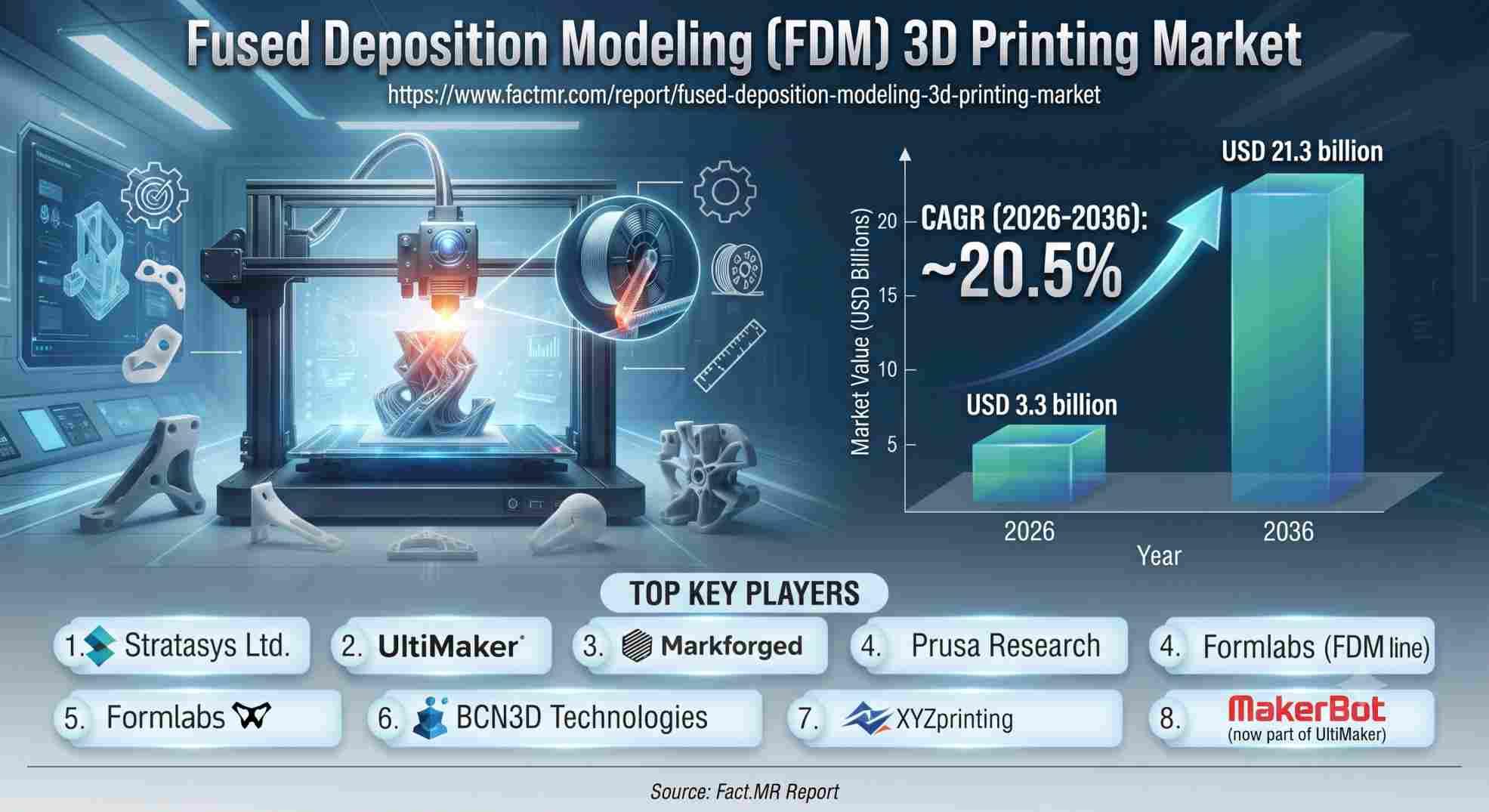
The global Fused Deposition Modeling 3D Printing Market is projected to reach USD 21.3 billion by 2036, rising from USD 3.3 billion in 2026 at a 20.5% CAGR, according to FactMR. The market is shifting from basic prototyping toward industrial tooling and certified end-use part production across aerospace, automotive, healthcare, and consumer goods.
The opportunity is substantial. Between 2026 and 2036, the market is expected to add approximately USD 18.0 billion in value. Industrial buyers are increasingly evaluating FDM systems based on material qualification, production reliability, traceability, and workflow integration rather than printer price alone.
Get Detailed Market Forecasts, Competitive Benchmarking, and Pricing Trends: https://www.factmr.com/connectus/sample?flag=S&rep_id=15045
FDM 3D Printing Market Growth Moves Beyond Prototyping
Fused deposition modeling, or FDM, uses thermoplastic filament that is extruded layer by layer to create three-dimensional components. The technology is used for prototypes, production tooling, jigs, fixtures, and increasingly certified end-use components.
Demand is expanding as manufacturers look for shorter development cycles, lower tooling costs, design flexibility, and localized production. Aerospace and defense manufacturers are particularly important because qualified FDM systems can produce lightweight tooling and selected aircraft components without relying entirely on conventional subtractive manufacturing.
Automotive manufacturers are also increasing FDM use for assembly fixtures and body tooling. Healthcare applications are creating another opportunity through surgical guides, medical-device prototypes, and customized components.
Industrial FDM Printers Hold 66% Market Share
The industrial FDM printer segment accounts for approximately 66% of the market in 2026, making it the leading printer category. Industrial systems are gaining ground because aerospace, automotive, and healthcare customers require higher reliability, material traceability, repeatability, and production capabilities.
Industrial printers command higher selling prices than desktop systems because they support advanced thermoplastics, larger build volumes, controlled production environments, and qualified materials.
The desktop segment remains important in education, consumer applications, small businesses, and engineering prototyping. However, increasing competition among desktop printer manufacturers is putting pressure on average selling prices.
Prototyping Remains the Largest Application
Prototyping represents approximately 50% of the market in 2026. Engineers use FDM systems to create functional prototypes quickly before committing to expensive tooling or production processes. The technology allows design teams to identify dimensional, ergonomic, and assembly issues at an earlier stage.
Tooling is another major application, particularly across automotive and industrial manufacturing. FDM-produced jigs, fixtures, and assembly aids can reduce lead times compared with traditionally machined tooling.
The end-use parts segment is expected to record the fastest expansion as aerospace and medical applications move through material qualification and certification processes. FactMR identifies the transition from prototype production toward certified components as a key commercial frontier for the industry.
Aerospace and Automotive Create High-Value Demand
Aerospace and defense together with automotive account for approximately 40% of the market in 2026, according to FactMR.
Aerospace companies are adopting FDM for tooling, brackets, ducts, fixtures, and selected production components. Certification remains critical because suppliers must demonstrate material performance and process consistency before parts can enter regulated production programs.
Automotive manufacturers are using FDM technology to produce assembly jigs, body fixtures, production aids, and prototype components. The technology is particularly useful when vehicle programs require rapid tooling changes or frequent design iterations.
Healthcare is another emerging opportunity. Medical-device manufacturers can use FDM to accelerate product development and support customized component production, although regulatory validation remains an important consideration.
India Leads Country-Level Growth
India is projected to record the fastest country-level growth, reaching a 24.0% CAGR through 2036. Manufacturing incentives, industrial expansion, aerospace development, and increasing adoption of additive manufacturing are supporting demand.
China follows with a 23.7% CAGR, supported by domestic printer manufacturing, automotive production, and new-energy vehicle tooling requirements.
The United States is projected to expand at 22.3% CAGR, driven largely by aerospace and defense applications and demand for qualified additive manufacturing processes.
Germany is expected to grow at 22.0% CAGR, supported by automotive end-use qualification and industrial tooling applications.
France follows with a 21.5% CAGR, while Japan is projected to grow at 19.0% through 2036.
Material Qualification Becomes a Competitive Advantage
The market is increasingly divided between low-cost desktop printing and premium industrial systems. Desktop printers face pricing pressure as manufacturers compete on hardware performance and accessibility.
Industrial suppliers, however, can protect margins through proprietary materials, validated production processes, workflow software, and certification capabilities.
Material qualification is particularly important in aerospace, healthcare, and other regulated industries. Manufacturers that can provide repeatable production processes and documented material performance are better positioned to win specification-driven procurement contracts.
Operator skills also remain a constraint. Industrial FDM requires trained personnel who understand material handling, printer calibration, process control, post-processing, and quality assurance.
A Growing Opportunity for Certified End-Use Parts
The commercial opportunity is shifting from selling printers toward providing complete additive manufacturing ecosystems.
FDM manufacturers can strengthen their positions by developing high-performance filament portfolios, integrating workflow software, providing local technical support, and working directly with OEM engineering teams.
FactMR identifies India and China as particularly important expansion markets because of their rapid manufacturing growth and increasing adoption of additive tooling. Aerospace certification in the United States and automotive qualification programs in Europe provide additional opportunities for premium industrial systems.
Competitive Landscape
The FDM 3D printing market includes industrial additive manufacturing companies as well as rapidly growing desktop printer manufacturers. Competition is increasingly based on printer performance, material availability, certification, software integration, application expertise, and customer support.
Key companies profiled by FactMR include:
- Stratasys Ltd.
- Markforged Holding Corporation
- Bambu Lab
- Shenzhen Creality 3D Technology Co., Ltd.
- Ultimaker B.V.
- MakerBot Industries LLC
- Prusa Research a.s.
- INTAMSYS Technology Co., Ltd.
Industrial suppliers such as Stratasys and Markforged are positioned around production-grade applications, while desktop manufacturers compete through affordability, print performance, and ease of use.
Analyst Perspective
FactMR Principal Consultant Shambhu Nath Jha notes that competition is increasingly moving beyond printer hardware and price. Vendors with certified materials and production-grade processes have an advantage as the industry moves toward end-use manufacturing.
Other Related Reports:
https://www.openpr.com/news/4512733/driver-monitoring-camera-and-sensor-systems-industry-projected
https://www.openpr.com/news/4517049/omni-channel-fulfillment-and-inventory-orchestration
https://www.openpr.com/news/4517185/hydrogen-fuel-cell-control-unit-platforms-for-vehicles-market
https://www.openpr.com/news/4517195/over-the-air-updatable-vehicle-control-unit-platforms-market
About FactMR
FactMR provides market research and industry analysis covering market size, segmentation, growth forecasts, competitive developments, regional trends, and strategic opportunities. Its research methodology combines primary interviews with manufacturing engineers and procurement executives with desk research covering company disclosures, industry benchmarks, certification frameworks, and market adoption trends.

 English
 Arabic
 French
 Spanish
 Portuguese
 Deutsch
 Turkish
 Dutch
Dutch
 Russian
 Romaian
 Portuguese (Brazil)
 Greek
Greek