


US Vessel Monitoring System Market Growth Driven by Fisheries Compliance and Surveillance
Vessel monitoring technologies are becoming increasingly important across North America's maritime and fisheries ecosystem. These systems combine GPS, satellite communications, onboard transceivers, sensors, and digital platforms to provide authorities and vessel operators with reliable information on vessel location and activity. In the US, the technology plays a particularly important role in fisheries management, enforcement, closed-area monitoring, and compliance with federal fishing regulations. NOAA Fisheries operates regional VMS programs covering Alaska, the Northeast, Southeast, Pacific Islands, and West Coast fisheries, demonstrating the extensive role of vessel tracking infrastructure across US waters.
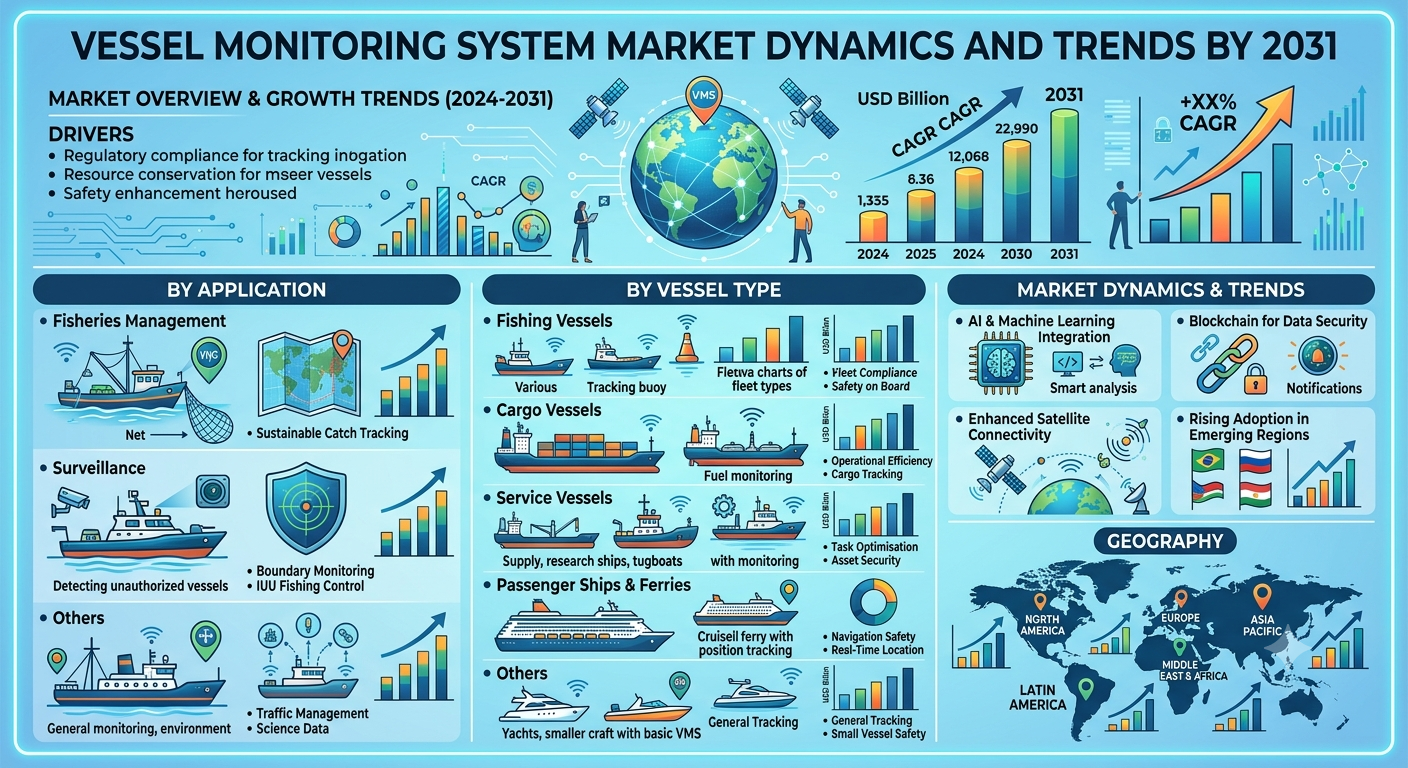
The Vessel Monitoring System Market Size was valued at US$1.03 billion in 2023 and is projected to reach US$2.43 billion by 2031, registering a CAGR of 11.2% from 2023 to 2031. With an estimated addressable market of US$13.68 billion during 2024–2031, the industry presents substantial opportunities for technology providers. North America, particularly the US, is expected to remain an important region because of stringent fisheries regulations, extensive coastlines, large exclusive economic zones, and increasing demand for real-time maritime monitoring.
Download Sample PDF Link:https://www.theinsightpartners.com/sample/TIPRE00013168
US Regulatory Requirements Drive Technology Adoption
Regulatory compliance is one of the strongest factors supporting vessel monitoring system adoption in the US. NOAA Fisheries requires VMS equipment for vessels participating in numerous federally managed fisheries. Requirements vary by region and fishery, with vessels in Alaska, the Northeast/Mid-Atlantic, Southeast, Pacific Islands, and West Coast subject to specific VMS provisions.
For example, in the Northeast, VMS requirements apply to several fisheries, including scallop, monkfish, multispecies, surfclam, ocean quahog, herring, mackerel, squid, and other regulated fisheries. Depending on the fishery, systems may be required to transmit vessel positions hourly or more frequently. Such regulatory requirements create a recurring need for approved hardware, communications services, software, installation, maintenance, and monitoring solutions.
This regulatory environment provides a strong foundation for the North American vessel monitoring system industry. As fisheries authorities continue strengthening monitoring and reporting procedures, demand for reliable and compliant VMS solutions is expected to increase.
Combating Illegal Fishing and Protecting Marine Resources
Illegal, unreported, and unregulated fishing remains a significant concern for maritime authorities. Vessel monitoring systems provide a digital mechanism for observing vessel movements and identifying activity that may violate fishing restrictions or conservation measures.
For US fisheries, this capability is particularly valuable because NOAA Fisheries and its enforcement programs oversee extensive marine areas. VMS automatically transmits position information, helping authorities determine where fishing activity occurs and whether vessels are operating within permitted zones. NOAA has highlighted VMS as an important tool for monitoring US fisheries across millions of square miles of exclusive economic zone and extensive coastline.
As governments place greater emphasis on sustainable fisheries and marine conservation, VMS adoption is likely to expand beyond basic tracking toward advanced surveillance, analytics, and automated compliance monitoring.
Alaska Creates Significant Demand for VMS
Alaska represents one of the most important US regions for vessel monitoring technology because of its large commercial fishing industry and extensive marine territory. NOAA requires VMS in several federally managed Alaska fisheries and under specific operating conditions.
For example, vessels involved in certain pollock, Pacific cod, and Atka mackerel fisheries, as well as vessels using specified trawl or dredge gear in the Gulf of Alaska and Aleutian Islands, are subject to VMS requirements. Some operations require particularly frequent position transmissions.
The geographical scale of Alaska's fisheries creates a strong requirement for dependable satellite and communications infrastructure. This is also encouraging technology providers to develop solutions capable of delivering accurate tracking under challenging offshore operating conditions.
West Coast Fisheries Support Market Expansion
California, Oregon, and Washington are also important contributors to US demand. NOAA requires VMS for certain commercial fishing vessels operating under Pacific Coast groundfish permits and for other specified fisheries and gear types.
On the West Coast, VMS uses a type-approved transmitter to determine vessel position and transmit information through a communications provider to NOAA Fisheries. Position information is used primarily to monitor fishing activity relative to closed areas.
These requirements encourage continued investment in VMS hardware, satellite communications, software platforms, and monitoring services across the Pacific Coast fishing industry.
Technology Innovation Creates New Opportunities
The North American industry is moving toward more sophisticated monitoring platforms that integrate GPS, satellite communications, cellular connectivity, cloud computing, data analytics, and automated reporting. The US has also taken steps to accommodate newer communication technologies. NOAA's regulations have allowed type-approval processes for cellular-based enhanced mobile transceiver units in addition to satellite-only models.
This transition can help providers develop flexible hybrid communication systems that select appropriate connectivity based on vessel location and operating conditions. Integration with AI and analytics can further enable anomaly detection, route analysis, automated alerts, and more efficient enforcement workflows.
Growing Importance of Real-Time Maritime Intelligence
Beyond regulatory compliance, vessel monitoring technology can provide operational benefits to commercial operators. Real-time information can improve fleet visibility, support voyage management, strengthen communication, and help organizations maintain better records of vessel activity.
The broader US maritime ecosystem is also increasingly adopting advanced digital technologies for tracking, analytics, security, and operational efficiency. This creates opportunities for VMS providers to expand from standalone tracking devices toward integrated maritime intelligence platforms.
Top Players in the Vessel Monitoring System Market
Leading companies profiled in the industry include Applied Satellite Technology Ltd., Addvalue Technologies, Beijing Highlander Digital Technology Co., Ltd., BlueTraker, CLS, ORBCOMM, Trackwell, Orolia Maritime, Remora, and VISMA. These companies compete through innovations in vessel tracking, satellite connectivity, communications, monitoring software, reporting capabilities, and regulatory compliance solutions.
In North America, vendor capabilities related to regulatory approval, connectivity reliability, data security, installation support, and compatibility with regional fisheries requirements are particularly important competitive factors.
Future Outlook for North America and the US
The outlook for the North American vessel monitoring system industry remains positive as the US continues strengthening fisheries management, maritime surveillance, and regulatory compliance. The global industry is expected to grow from US$1.03 billion in 2023 to US$2.43 billion by 2031, reflecting an 11.2% CAGR. North American demand is expected to benefit from established regulatory frameworks and continued investment in maritime technology.
Future VMS platforms are likely to emphasize AI-driven analytics, cloud connectivity, hybrid satellite-cellular communications, automated compliance reporting, and real-time alerts. These capabilities can help US authorities monitor larger maritime areas more efficiently while enabling vessel operators to meet increasingly sophisticated reporting requirements.
About The Insight Partners
The Insight Partners is a global market research and consulting company providing syndicated and customized research across technology, industrial, healthcare, semiconductor, energy, aerospace, and other sectors. Its research combines industry analysis, secondary research, expert insights, company information, and quantitative assessment to identify market trends, growth drivers, opportunities, and competitive developments.
Contact Us
The Insight Partners
Email: sales@theinsightpartners.com
Phone: +1-646-491-9876
Website: https://www.theinsightpartners.com
Related Reports -
Submarine Fiber Cable Market Demand, Share & Growth by 2034
Aircraft Wiring Harness Market Dynamics and Trends by 2030
SCADA Oil and Gas Market Size, Trends & Growth by 2034

 English
 French
 Spanish
 Portuguese
 Deutsch
 Turkish
 Dutch
Dutch
 Italiano
 Russian
 Romaian
 Portuguese (Brazil)
 Greek
Greek