


Global Carbon Steel Market Projected to Reach USD 1.89 Trillion by 2036
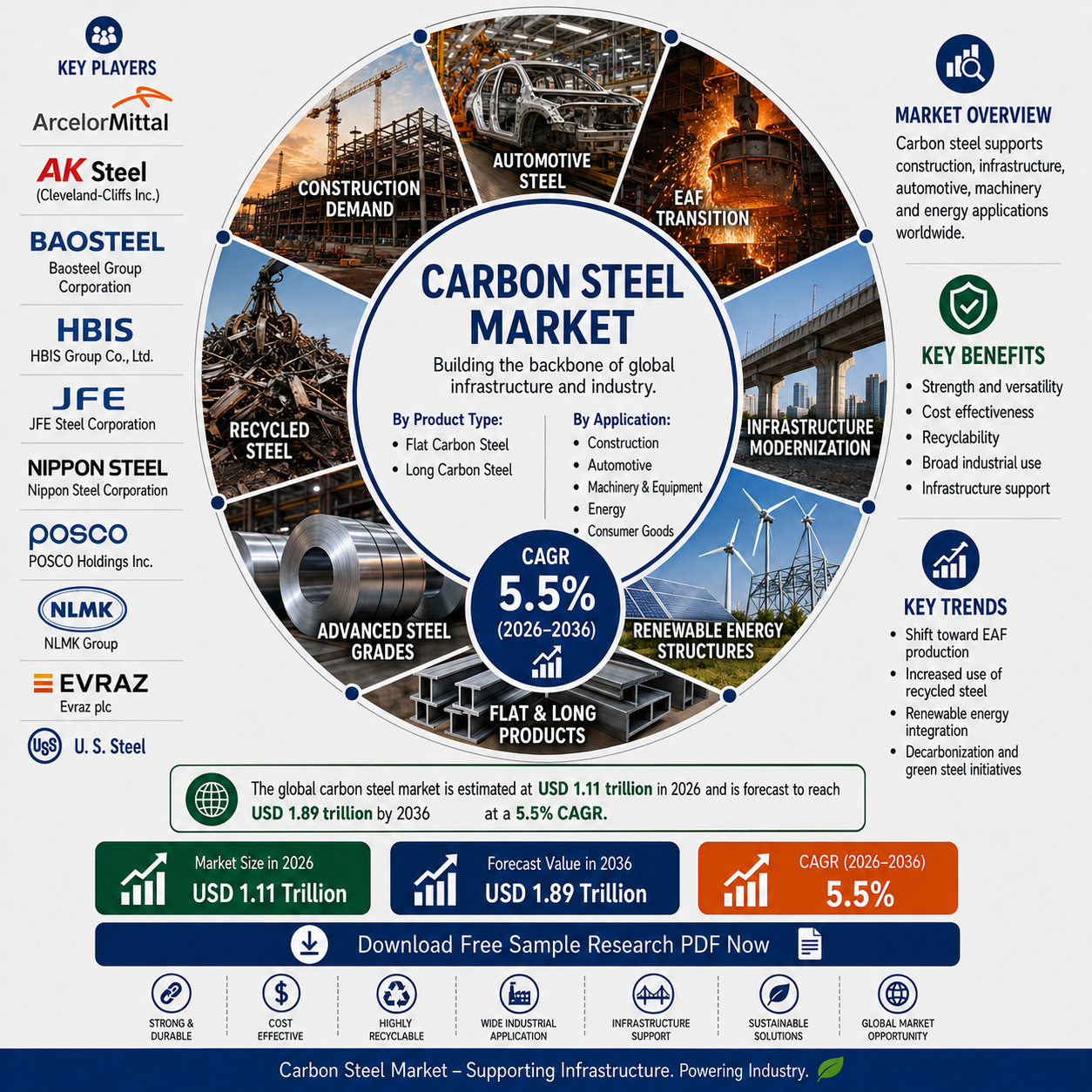
The global Carbon Steel Market is estimated at USD 1.11 trillion in 2026 and is forecast by Fact.MR to reach USD 1.89 trillion by 2036, expanding at a CAGR of 5.5% during the forecast period.
The forecast represents an absolute dollar opportunity of USD 0.78 trillion between 2026 and 2036. Demand is being shaped by construction activity, infrastructure modernization, automotive production, energy infrastructure, and the transition toward electric arc furnace steelmaking. India is projected to grow at 6.8%, while China follows at 6.6%, making these two countries the fastest-growing major markets identified in the analysis.
Carbon steel includes flat and long steel products manufactured through basic oxygen furnace (BOF) and electric arc furnace (EAF) processes across low, medium, and high carbon grades.
Fact.MR is a market research and consulting organization that provides market forecasts and analysis across industries and regions.
Get detailed market forecasts, competitive benchmarking, and pricing trends:https://www.factmr.com/connectus/sample?flag=S&rep_id=12224
Construction Holds 40% Application Share in 2026
Construction accounts for 40% of the application segment in 2026, according to Fact.MR. Residential, commercial, and infrastructure projects consume carbon steel in structural frameworks, reinforcement bar, roofing sheets, and building envelope materials.
Infrastructure programs are also supporting demand for structural sections, plates, rails, and reinforcement products. India, China, Southeast Asia, the Middle East, and Africa are identified as important construction-driven markets.
The automotive sector remains the second-largest application. Vehicle lightweighting, electric vehicle platform development, and demand for advanced high-strength steel are changing steel specifications and procurement requirements.
Energy applications are the fastest-growing application category, supported by wind tower fabrication, solar mounting structures, and grid infrastructure expansion.
Flat Carbon Steel Leads Product Demand
Flat carbon steel accounts for 55% of the product type segment in 2026. Hot rolled coils, cold rolled sheets, and coated steel serve construction, automotive, appliance, packaging, and energy applications.
Low carbon steel, also known as mild steel, accounts for 60% of the carbon content segment in 2026. Its position reflects demand from construction, general engineering, and automotive body applications where formability and weldability are required.
Sheets and strips account for 40% of the form segment. These products are used across automotive, appliances, packaging, and general manufacturing.
BOF remains the dominant manufacturing process, accounting for 65% of the segment in 2026. Integrated steel plants continue to support large-scale production, particularly across China, Japan, and South Korea.
EAF production, however, is expanding as producers respond to decarbonization targets and recycled steel availability.
EAF Investment Is Reshaping Production Economics
The transition from BOF to EAF production is one of the central structural changes identified in the Carbon Steel Market.
ArcelorMittal announced a EUR 1.3 billion investment in a 2 million tonne EAF at Dunkirk, France, in February 2026. Commissioning is targeted for 2029, and the project is expected to reduce emissions at the site by approximately 25%.
ArcelorMittal also reported 5.4 million tonnes of additional EAF capacity across its global operations. New EAF facilities at Sestao and Gijon in Spain are operational, while the Calvert, Alabama mill is ramping up.
One specific operating detail stands out: ArcelorMittal's North American output increased 18.3% quarter-on-quarter in Q1 2026, according to the information provided in the Fact.MR analysis.
The company has also commissioned 1.9 GW of solar, wind, and hybrid capacity across India, Brazil, and Argentina. A further 1.4 GW is under development for commissioning by 2028.
India Leads Forecast Growth at 6.8%
India is projected to record a CAGR of 6.8% through 2036. Construction expansion, infrastructure modernization, automotive production growth, and domestic capacity additions are supporting demand.
AMNS India is expanding capacity to 15 Mtpa. In March 2026, the ArcelorMittal-Nippon Steel joint venture also announced plans for a greenfield integrated steel plant in Rajayyapeta, Andhra Pradesh, with Phase 1 capacity of 8.2 Mtpa.
China follows with a projected CAGR of 6.6%. Brazil is expected to grow at 6.2%, while the USA is forecast at 5.8%.
Germany is projected at 5.6%, followed by the UK at 5.3%, Japan at 4.9%, and Mexico at 4.5%.
“The carbon steel market is undergoing its most significant structural transformation in decades, driven by the simultaneous convergence of decarbonization mandates, trade policy recalibration, and energy transition demand,” said Shambhu Nath Jha, Principal Consultant at Fact.MR.
Jha added: “Companies investing in EAF capacity, renewable energy integration, and low-carbon steel certification are positioning for premium pricing and specification advantages, while producers dependent on conventional BOF without decarbonization roadmaps face growing regulatory and market access risks.”
Competitive Positioning Centers on Capacity and Technology
The competitive landscape is moderately consolidated globally and fragmented across regional markets.
ArcelorMittal holds approximately 15% market share, according to the Fact.MR analysis. The company produced 55.6 million tonnes of crude steel and generated USD 61.4 billion in revenue in 2025.
Nippon Steel Corporation, POSCO Holdings Inc., Baosteel Group Corporation, JFE Steel Corporation, HBIS Group Co., Ltd., Cleveland-Cliffs through AK Steel, NLMK Group, Evraz plc, and U.S. Steel are also identified as key participants.
Competitive positioning is increasingly tied to production scale, product mix, decarbonization planning, geographic exposure, automotive steel technology, and access to lower-carbon production capacity.
Policy developments are also influencing regional economics. The EU's Carbon Border Adjustment Mechanism and the tariff rate quota framework expected from July 2026 are identified in the analysis as factors affecting European steel competitiveness.
The Fact.MR research methodology combines secondary research, primary interviews, and forecast modelling. The analysis draws on more than 100 secondary sources, benchmarks 30+ producer capacity and production datasets, covers 30+ countries, and includes 25+ primary interviews across producers, distributors, automotive OEMs, construction firms, and trade analysts.
To View Top Reports
https://social.mytamam.com/blogs/36140/Biological-Safety-Cabinets-Market-Set-to-Reach-USD-6-8
https://net-pals.com/blogs/28464/Biological-Safety-Cabinets-Market-Projected-to-Hit-USD-6-8
https://uddokta64.com/blogs/6263/Global-Biological-Safety-Cabinets-Market-to-Reach-USD-6-8
https://acmingle.com/blogs/16306/Biological-Safety-Cabinets-Industry-Expected-to-Reach-USD-6-8
About Fact.MR
Fact.MR is a market research and consulting organization providing market intelligence, industry analysis, and forecasting across global industries. Its research methodology combines secondary data, primary interviews, demand-side analysis, production-capacity checks, trade-flow analysis, and forecast modelling.

 English
 Arabic
 French
 Spanish
 Portuguese
 Turkish
 Dutch
Dutch
 Italiano
 Russian
 Romaian
 Portuguese (Brazil)
 Greek
Greek