


Global Anti-Counterfeit Packaging Market to Reach USD 621.96 Billion
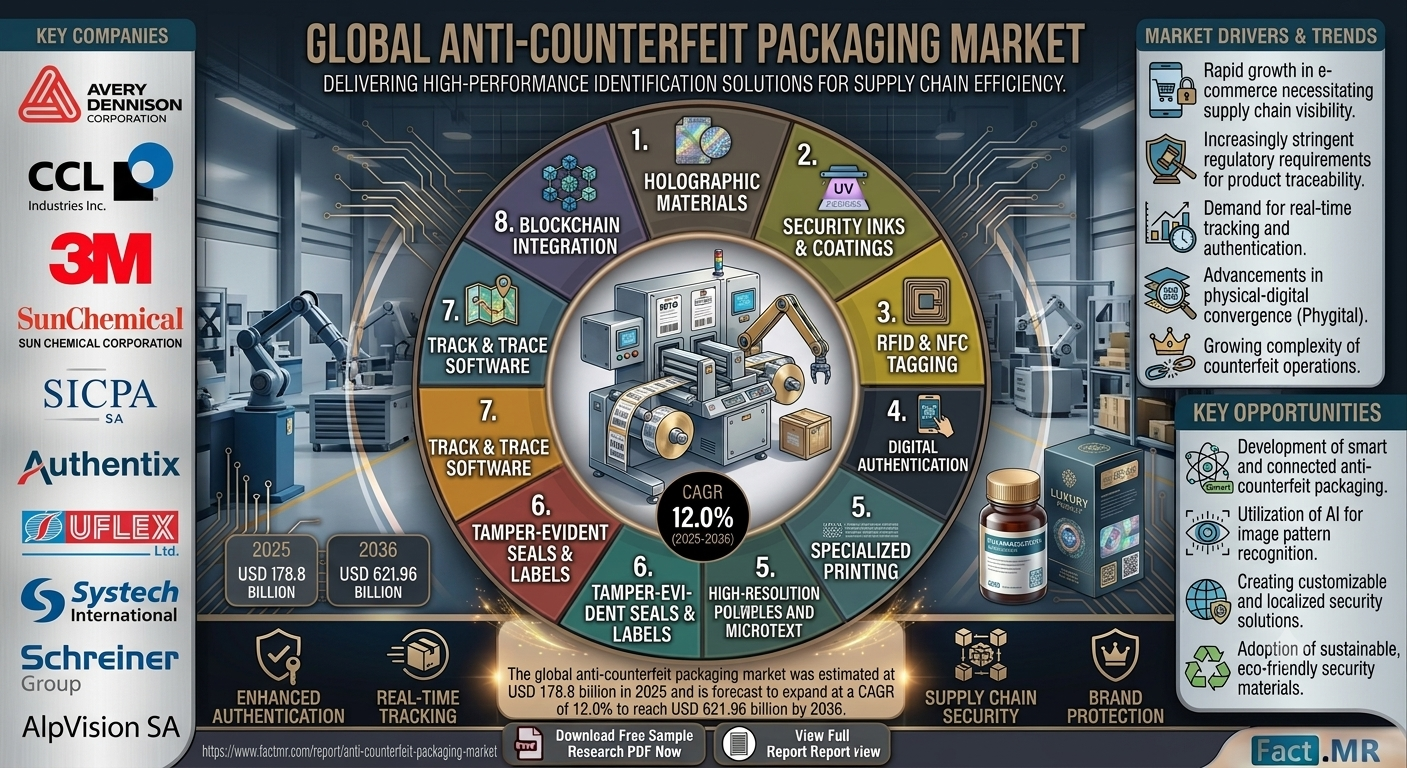
September 2, 2026 — The global Anti-Counterfeit Packaging Market is estimated to reach USD 200.26 billion in 2026 and is forecast to expand to USD 621.96 billion by 2036, registering a 12.0% CAGR, according to Fact.MR. The market was valued at USD 178.8 billion in 2025 and is expected to create an absolute dollar opportunity of USD 421.7 billion between 2026 and 2036.
The growth is being driven by pharmaceutical serialization mandates, expanding e-commerce channels, food traceability requirements, and increasing investment in digital product authentication. These factors are affecting pharmaceutical manufacturers, consumer goods companies, food producers, luxury brands, and industrial product suppliers.
The Anti-Counterfeit Packaging Market is a packaging technology market that integrates authentication features to verify product origin, detect tampering, protect supply chains, and prevent counterfeiting.
Anti-counterfeit packaging includes tamper-evident closures, holograms, RFID tags, QR codes, serialization systems, digital watermarks, color-shifting inks, and blockchain-backed traceability. These technologies allow manufacturers, supply chain participants, and consumers to verify products at different stages of distribution.
Get detailed market forecasts, competitive benchmarking, and pricing trends: https://www.factmr.com/connectus/sample?flag=S&rep_id=11741
Digital Authentication Reshapes the Anti-Counterfeit Packaging Market
Digital authentication packaging is projected to account for 37.8% of the authentication technology segment in 2026. Serialized QR codes, NFC tags, encrypted digital watermarks, and blockchain-backed verification systems are supporting the transition toward digitally connected packaging.
Pharmaceutical serialization has helped establish digital identification infrastructure at scale. According to Fact.MR, this infrastructure is now extending into food, cosmetics, luxury goods, and industrial products.
Consumer smartphone access also changes how authentication can be deployed. A customer can scan a QR code or interact with an NFC-enabled package to verify authenticity without specialized equipment.
This creates a broader role for packaging.
Connected packaging can combine authentication with product information, consumer engagement, loyalty programs, and supply chain analytics. The same scan used to verify a product can also create an interaction between a brand and its customer.
Tamper-Evident Packaging Maintains a Strong Position
While digital systems are expanding, physical security features remain widely used. Tamper-evident packaging is expected to hold 29.4% of the product segment in 2026, making it the leading product category identified in the Fact.MR analysis.
Shrink bands, breakable closures, void labels, and security seals can provide visible evidence of product interference. These features can be inspected without digital devices.
Labels and stickers are also a major part of the market. They are projected to account for 31.6% of the packaging format segment in 2026 and serve as carriers for holograms, QR codes, security inks, and other authentication features.
Visible security features are expected to represent 35.2% of the security feature segment in 2026, allowing consumers and supply chain participants to inspect products directly.
India and China Lead Market Growth
India is forecast to be the fastest-growing country market, expanding at a 13.2% CAGR through 2036. Pharmaceutical serialization, e-commerce growth, brand protection requirements, and food traceability regulation are supporting demand.
China follows with a projected 12.7% CAGR, driven by pharmaceutical track-and-trace requirements, luxury goods authentication, and e-commerce platform anti-counterfeiting efforts.
The United States is forecast to grow at 10.9% CAGR, supported by DSCSA pharmaceutical serialization compliance, consumer goods brand protection, and FDA food traceability requirements.
Germany is expected to expand at 9.8% CAGR, while the United Kingdom and Japan are projected to record 9.5% and 9.2% CAGR, respectively.
|
Country |
CAGR, 2026–2036 |
|
India |
13.2% |
|
China |
12.7% |
|
USA |
10.9% |
|
Germany |
9.8% |
|
UK |
9.5% |
|
Japan |
9.2% |
|
Brazil |
8.8% |
Connected Packaging Creates New Value
One notable detail in the Fact.MR analysis is Avery Dennison Corporation's approximately 15% market share and its investment in the atma.io Connected Product Cloud.
The platform links physical products with digital identities. This allows packaging to support authentication while also connecting products with supply chain analytics and consumer interaction data.
The shift is changing how brand owners evaluate anti-counterfeit investments. Authentication is no longer limited to fraud prevention when the same packaging feature can also support consumer engagement and product-level data collection.
“Avery Dennison, SICPA, and Authentix are investing in digital platforms that combine authentication with supply chain analytics and consumer interaction data,” said Shambhu Nath Jha, Principal Consultant at Fact.MR.
Shambhu Nath Jha added, “The next growth phase extends this capability to food, beverage, cosmetics, and industrial products where consumer-level smartphone verification creates both brand protection and consumer engagement opportunities.”
Competitive Focus Moves Toward Digital Platforms
The market includes companies operating across security labels, digital authentication, forensic technologies, serialization, and connected packaging.
Key participants include Avery Dennison Corporation, CCL Industries, 3M, Sun Chemical Corporation, SICPA SA, Authentix, Uflex Ltd., Systech International, Schreiner Group, and AlpVision SA.
Avery Dennison Corporation maintains a leading position through its authentication portfolio, atma.io platform, and RFID and NFC manufacturing capabilities. CCL Industries and 3M compete through security labels and authentication technologies.
SICPA SA and Authentix hold specialized positions in government and brand authentication programs, including covert markers and forensic verification.
According to Fact.MR, competition is increasingly influenced by digital platform capability rather than physical security feature manufacturing alone.
SICPA expanded digital tax stamp and authentication programs with government agencies in 2025. Uflex Ltd. also expanded its holographic security packaging range during 2025 for pharmaceutical and FMCG applications in South Asian and Middle Eastern markets.
Key Market Numbers
|
Metric |
Value |
|
Market Value, 2025 |
USD 178.8 billion |
|
Market Value, 2026 |
USD 200.26 billion |
|
Market Value, 2036 |
USD 621.96 billion |
|
CAGR, 2026–2036 |
12.0% |
|
Absolute Dollar Opportunity |
USD 421.7 billion |
|
Digital Authentication Share, 2026 |
37.8% |
|
Tamper-Evident Packaging Share, 2026 |
29.4% |
|
Labels and Stickers Share, 2026 |
31.6% |
|
Visible Security Features Share, 2026 |
35.2% |
|
India CAGR |
13.2% |
About the Anti-Counterfeit Packaging Market Report
Fact.MR's Anti-Counterfeit Packaging Market report analyzes authentication technologies integrated into packaging across pharmaceutical, food, luxury, consumer goods, electronics, and industrial supply chains.
The study covers tamper-evident packaging, holographic packaging, track-and-trace packaging, smart packaging, and covert security packaging. It also examines digital, physical, and chemical authentication technologies across more than 30 countries.
The research methodology combines secondary research, primary interviews, demand-side modeling, technology deployment analysis, pricing validation, and sensitivity testing.
Top Reports:
https://adamaamresearch.blogspot.com/2026/09/propane-industry-value-to-reach-15410.html
https://social.mytamam.com/blogs/36175/Propane-Industry-to-Reach-154-10-Billion-by-2036
https://zeuspage.org/blogs/47408/Global-Propane-Demand-to-Drive-154-10-Billion-by-2036
https://kaamkaaziclub.com/read-blog/45230
About Fact.MR
Fact.MR is a market research and consulting firm that provides market intelligence, industry forecasts, competitive analysis, and strategic insights. Its research methodology combines primary interviews, secondary research, company benchmarking, supplier analysis, and market modeling.

 English
 Arabic
 French
 Spanish
 Portuguese
 Turkish
 Dutch
Dutch
 Italiano
 Russian
 Romaian
 Portuguese (Brazil)
 Greek
Greek