


Heat Pump Market Growth Opportunities From Sustainable Infrastructure
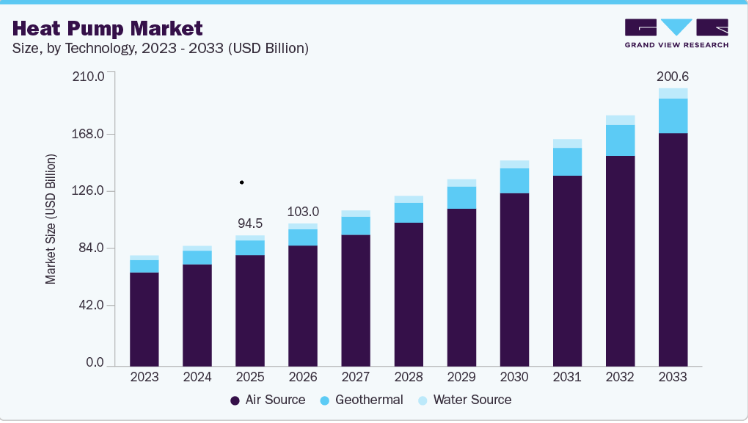
The global Heat Pump Market is entering a strong growth phase as governments, businesses, and households increasingly shift toward energy-efficient and low-carbon heating and cooling systems. The global market was valued at USD 94.5 billion in 2025 and is projected to reach USD 200.7 billion by 2033, expanding at a CAGR of 10.0% from 2026 to 2033. Asia Pacific accounted for the largest share at 58.0% in 2025, while North America is projected to record the fastest regional growth.
Why Is the Heat Pump Market Growing?
The central market shift is straightforward:
Fossil-fuel heating → Electrification → Higher energy efficiency → Lower operating costs → Lower-carbon buildings
Heat pumps transfer heat rather than generating it directly, allowing them to deliver higher efficiency than conventional boilers and furnaces. This advantage is encouraging adoption across new construction and retrofit projects.
Government incentives, rebates, stricter emission standards, and building-efficiency regulations are further supporting the transition away from fossil-fuel-based heating systems.
Download a free sample report or claim your copy of this full market intelligence report
Rising electricity generation from renewable sources is another important factor. As solar and wind power become increasingly integrated into electricity grids, electric heat pumps can provide a cleaner heating and cooling option.
The Market at a Glance
- 2025 market size: USD 94.5 billion
- 2026 estimated size: USD 103.0 billion
- 2033 projected size: USD 200.7 billion
- 2026–2033 CAGR: 10.0%
- Largest technology: Air source, 84.9% share
- Largest operation: Electric, 83.6% share
- Largest capacity: 10–20 kW, 36.5% share
- Largest application: Residential, 81.3% share
- Largest region: Asia Pacific, 58.0% share
Technology Is Defining the Next Stage of Adoption
Air-source heat pumps remain the market's leading technology, accounting for 84.9% of revenue in 2025. Their lower installation costs, easier integration, lower space requirements, and suitability for residential and small commercial applications support their dominant position.
The next growth opportunity is geothermal heat pumps. Their high efficiency and stable year-round performance make them attractive for commercial and institutional applications, despite higher installation costs.
Innovation is also widening the addressable market. Manufacturers are investing in:
- Advanced compressors
- Smart controls
- Low-GWP refrigerants
- Cold-climate heat pumps
- High-capacity systems
- Digital monitoring
- Renewable-energy integration
These developments are improving efficiency while expanding heat pump applications across different climate conditions.
Capacity and Operation Trends
The 10–20 kW segment represented the largest capacity category, with a 36.5% share in 2025. Its balance between heating capacity, efficiency, and cost makes it suitable for multi-family housing and small commercial buildings.
Meanwhile, systems with up to 10 kW capacity are projected to experience the fastest growth, supported by demand from single-family homes and compact apartments.
The operating landscape is also changing.
Electric heat pumps → 83.6% market share
Electric systems dominate because of their energy efficiency, compatibility with renewable electricity, and support from policies aimed at reducing fossil-fuel dependence.
Hybrid heat pumps → 9.1% CAGR
Hybrid systems combine electric operation with conventional heating, providing flexibility where complete electrification is difficult. Their role is particularly relevant in colder climates, older buildings, and retrofit projects.
Residential Demand Remains the Market Anchor
The residential segment accounted for 81.3% of the global market in 2025.
Why?
Homeowners are increasingly looking for systems that can provide efficient heating and cooling while reducing long-term operating costs. Government subsidies and incentives are improving the attractiveness of household electrification.
New housing construction and renovation projects are also creating additional installation opportunities.
Beyond residential buildings, industrial demand is increasing as companies use heat pumps for process heating, waste heat recovery, and space conditioning. High-capacity and high-temperature technologies are helping extend the market into industrial applications.
Regional Growth Story
Asia Pacific: Current market leader
Asia Pacific accounted for 58.0% of global revenue in 2025. Rapid urbanization, construction activity, rising energy demand, manufacturing capabilities, and supportive policies are supporting regional adoption.
China led the Asia Pacific market in 2025, supported by its large construction sector, manufacturing base, clean-heating initiatives, and adoption across residential, commercial, and district heating applications.
India is also seeing steady demand as urbanization, commercial infrastructure development, energy efficiency, and electrification gain importance.
North America: Fastest-growing region
North America is projected to record the highest CAGR, reaching 10.5% from 2026 to 2033. Policy support, replacement of gas- and oil-based heating systems, financial incentives, and cold-climate technology improvements are driving installations.
The U.S. led the regional market in 2025, supported by residential adoption, tax incentives, replacement demand for aging HVAC equipment, and technological innovation.
Europe: Regulation-driven transition
European demand is being shaped by emission regulations, climate targets, fossil-fuel boiler phaseouts, high energy prices, and residential retrofit activity. France led the European market in 2025, while Germany is experiencing rapid growth as households and buildings transition away from fossil-fuel heating.
Middle East & Africa: Emerging opportunity
Construction activity, demand for efficient heating and cooling, and growing government emphasis on energy efficiency are supporting adoption. Saudi Arabia represents an emerging opportunity through large-scale infrastructure, commercial, and residential development.
Latin America: Gradual expansion
Urban development, increasing electricity access, residential construction, and demand for efficient water heating are supporting market growth. Brazil is emerging as an important market across residential, hotel, commercial, and industrial applications.
What Could Limit Market Expansion?
The biggest barrier remains high upfront costs and installation complexity.
Older buildings may require additional insulation, space, or system modifications, increasing retrofit expenses. Performance concerns in extremely cold regions and shortages of skilled installers can also slow adoption.
However, long-term energy savings, government incentives, technology improvements, and the global movement toward building electrification continue to create a favorable market environment.
Competitive Landscape
The heat pump industry is moderately fragmented, with multinational manufacturers competing alongside regional companies and specialized geothermal and industrial-system providers.
Competition is centered on efficiency, technology innovation, climate suitability, integrated heating and cooling, pricing, and smart-system capabilities.
Key Companies
- Carrier
- Daikin Industries, Ltd
- Robert Bosch GmbH
- Lennox International
- Johnson Controls, Inc.
- Midea Group
The overall market trajectory points toward continued expansion as energy efficiency, electrification, renewable power integration, and decarbonization increasingly influence heating and cooling decisions worldwide.
About us:
Grand View Research, a market research and consulting company, provides syndicated research reports, customized research reports, and consulting services. Grand View Research database is used by the world's renowned academic institutions and Fortune 500 companies to understand the global and regional business environment. Our database features thousands of statistics and in-depth analysis on 46 industries in 25 major countries worldwide.

 English
 Arabic
 French
 Portuguese
 Deutsch
 Turkish
 Dutch
Dutch
 Italiano
 Russian
 Romaian
 Portuguese (Brazil)
 Greek
Greek