


Split HVAC Systems Market Growth Opens New Industry Opportunities
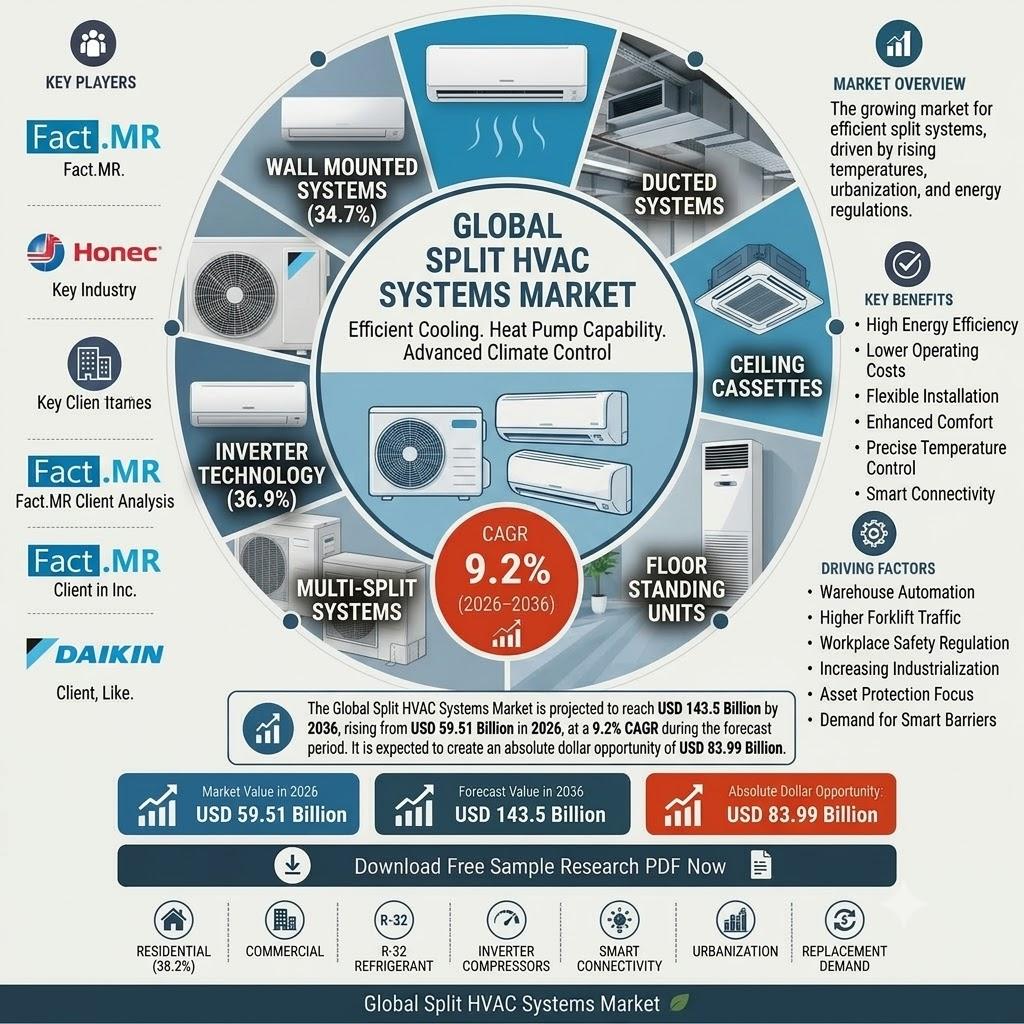
Subhead : Split HVAC Systems Market to grow from $59.51 billion in 2026 to $143.5 billion by 2036 at a 9.2% CAGR.
NEW DELHI, INDIA — September 4, 2026 — The global Split HVAC Systems Market is projected to reach USD 143.5 billion by 2036, rising from USD 59.51 billion in 2026 at a 9.2% CAGR, according to Fact.MR analysis. The market is expected to create an absolute dollar opportunity of USD 83.99 billion during the 2026–2036 forecast period.
Demand is being shaped by higher temperatures, wider air conditioning adoption in developing economies, energy efficiency rules, and the shift toward lower global warming potential refrigerants. India and China are projected to be the fastest-growing country markets, with CAGRs of 9.4% and 9.1%, respectively.
Market growth follows rising cooling demand
Split HVAC systems use separate indoor and outdoor units connected by refrigerant lines. They serve residential, commercial, and light industrial climate control applications. The category covers wall mounted, floor standing, ceiling cassette, ducted, and multi split configurations.
Fact.MR reported that the market was valued at approximately USD 54.5 billion in 2025 before reaching the estimated 2026 value of USD 59.51 billion. The forecast indicates continued expansion through 2036 as households and businesses invest in cooling and heating equipment.
One direct question for buyers is how much room remains for new installations. Fact.MR points to India as a major volume opportunity because household air conditioning penetration remains below 15%. Urban income growth and increasingly frequent extreme heat events are supporting first-time purchases, particularly in residential markets.
Get detailed market forecasts, competitive benchmarking, and pricing trends: https://www.factmr.com/connectus/sample?flag=S&rep_id=11582
Wall mounted systems hold the largest product share
Wall mounted split HVAC systems account for 34.7% of product segment value in 2026, making them the leading product category. Fact.MR attributes this position to compact installation, broad residential use, competitive price points, and a wide range of capacity options.
Wall mounted units are used in homes and smaller commercial locations such as offices, retail shops, and hospitality rooms. Ceiling cassette and ducted systems serve commercial and institutional applications where concealed installation and multi-zone climate control are required. Multi split systems are also gaining share in larger residential and light commercial applications.
Residential climate management represents 38.2% of application segment share in 2026. Residential consumers account for 41.5% of end-use demand, supported by first-time purchases in emerging economies and efficiency upgrades in developed markets.
Inverter technology changes purchasing priorities
Inverter compressor technology represents 36.9% of the technology segment in 2026. Unlike fixed-speed systems, inverter compressors provide variable capacity operation, allowing systems to adjust output according to cooling or heating requirements.
Energy efficiency regulations are also influencing replacement demand. Fact.MR states that updated SEER2 standards in the USA and EU Ecodesign requirements are encouraging replacement of older fixed-speed systems with inverter units. These inverter systems command selling prices that are 20% to 40% higher than fixed-speed alternatives.
Smart connectivity is another developing product trend. Smart connected systems can use occupancy sensors, weather data, and learning algorithms to manage compressor operation and energy consumption. Fact.MR also identifies integration with Google Home, Amazon Alexa, and Apple HomeKit as part of the expanding smart HVAC ecosystem.
Browse Top Reports :
https://www.foundersclick.com/blogs/59650/Battery-Technology-Shapes-the-Future-of-Electric-Boats
https://www.panchit.com/blogs/82218/RF-Measurement-Equipment-Market-Outlook-for-the-Next-Decade
Refrigerant transition creates new product cycles
The move from R 410A toward lower-GWP refrigerants such as R 32 and R 290 is affecting product development. Fact.MR identifies this transition as a source of redesign and replacement activity across split HVAC product lines.
A specific industry development highlighted by Fact.MR is Daikin Industries Ltd.'s continued expansion of its R 32 refrigerant portfolio in 2025. Fact.MR states that R 32 has approximately one-third the global warming potential of R 410A.
The market still faces barriers. High upfront prices for inverter systems can restrict adoption in price-sensitive residential markets. Skilled installer shortages may also slow deployment, while refrigerant transition costs can create pricing uncertainty.
India leads country-level growth
India is projected to record the highest CAGR among the countries covered, at 9.4% through 2036. China follows at 9.1%, while Brazil, the USA, Germany, the UK, and Japan are forecast to grow at 8.5%, 8.4%, 8.0%, 7.7%, and 7.5%, respectively.
India's opportunity is supported by low household AC penetration, urban income growth, e-commerce expansion, and organized retail growth in tier 2 and tier 3 cities. Fact.MR also points to Production Linked Incentive schemes and domestic manufacturing investment as factors supporting local split AC production.
Shambhu Nath Jha, Principal Consultant at Fact.MR, said, “The split HVAC systems market is being shaped by two parallel growth forces: first time air conditioning purchase in emerging economies where penetration remains below 30%, and efficiency driven replacement in developed markets where inverter technology and heat pump capability are becoming regulatory requirements.”
He added, “India alone represents one of the largest unit volume growth opportunities in the global HVAC market,” pointing to rising urban and semi-urban household demand alongside increasing heat stress.
Fact.MR's research covers more than 30 countries, uses 130+ secondary sources, benchmarks 70+ company product portfolios, and includes 30+ primary interviews with manufacturers, distributors, installers, builders, and end users.
For detailed market estimates and segmentation, see [LINK: Split HVAC Systems Market report]. For supporting global energy and air-conditioning research, see
About Fact.MR
Fact.MR is a market research and consulting firm providing industry analysis, forecasts, and strategic intelligence across global markets. Its Split HVAC Systems Market study covers product type, application, end use, technology, deployment, and regional demand for the 2026–2036 forecast period

 English
 Arabic
 French
 Spanish
 Portuguese
 Deutsch
 Dutch
Dutch
 Italiano
 Russian
 Romaian
 Portuguese (Brazil)
 Greek
Greek