


Smoke Detector Market Projected to Reach $8.1 Billion by 2036
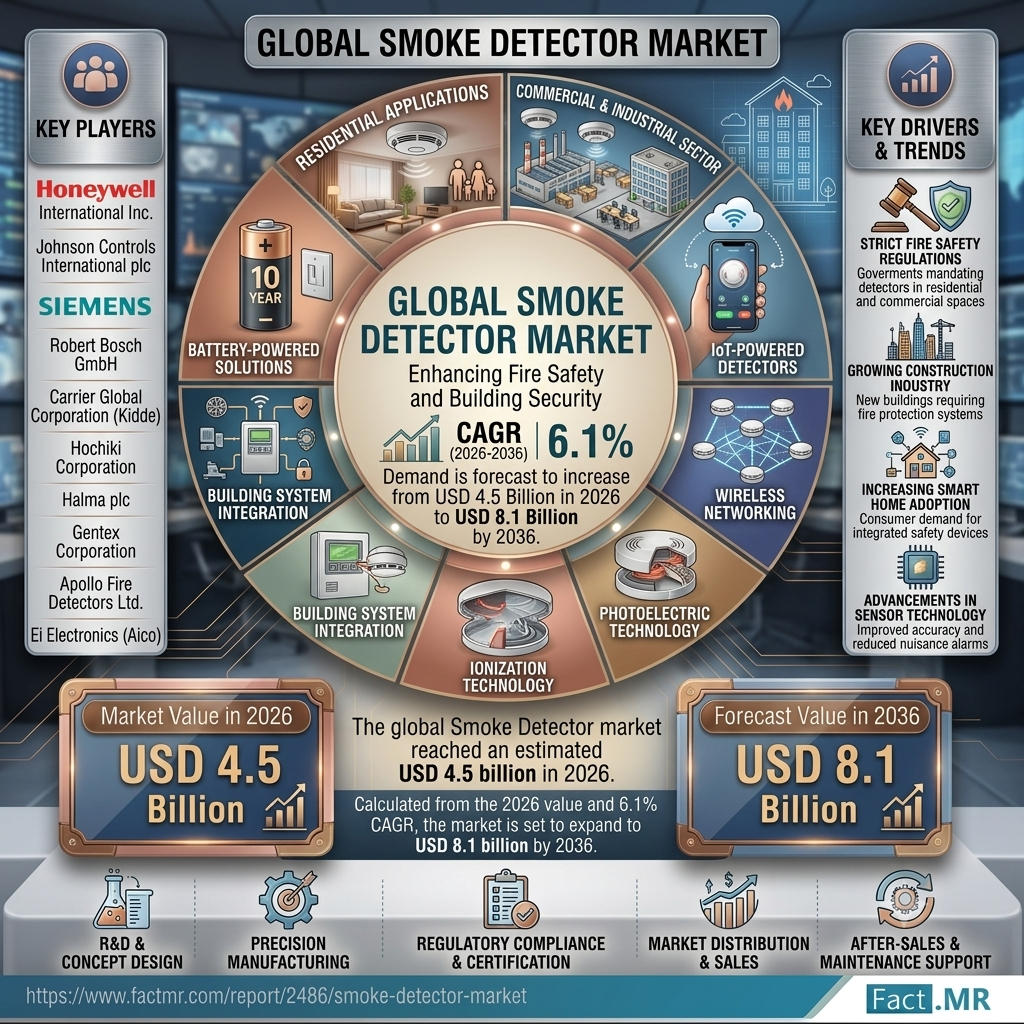
September 4, 2026 — The global Smoke Detector Market is projected to reach USD 8.1 billion by 2036, rising from USD 4.5 billion in 2026 at a 6.1% CAGR, according to Fact.MR. The market was valued at approximately USD 4.2 billion in 2025 and is expected to create an absolute dollar opportunity of USD 3.6 billion between 2026 and 2036.
Stricter fire-safety codes, smart-home adoption, and construction activity are expanding demand for smoke detection systems. The shift is also changing what buyers expect from detectors, with app-based alerts, remote monitoring, interconnected alarms, and multi-sensor technologies becoming more relevant across residential and commercial buildings.
Get detailed market forecasts, competitive benchmarking, and pricing trends: https://www.factmr.com/connectus/sample?flag=S&rep_id=2486
Smoke Detector Market Benefits From Smart-Home Adoption
Building regulations are widening the installed base of interconnected smoke alarms. Fact.MR reports that stricter fire-safety codes and retrofit mandates are increasing detector requirements across residential and commercial properties.
Smart-home technology is adding another demand channel. Connected smoke detectors can provide app-based alerts and remote monitoring while integrating with broader home-security ecosystems. Subscription monitoring services can also create recurring revenue beyond the initial hardware sale.
Construction remains a direct source of new demand. Ongoing residential, commercial, and public infrastructure activity supports new installations and code-upgrade projects, while replacement cycles expand demand within existing building stock.
Shambhu Nath Jha, Principal Consultant at Fact.MR, said:
“Smoke detector demand is driven by building codes, construction activity, and the smart-home shift that is pulling detectors into connected ecosystems.”
Jha also identifies a technology shift within the installed base. Fact.MR states that ionization detectors continue to lead by installed base, while photoelectric and dual-sensor models gain ground as false-alarm reduction becomes a buying criterion.
Ionization Detectors Hold 32.4% Product Share
Ionization Smoke Detectors account for 32.4% of the product segment in 2026, making them the leading product category. Fact.MR links this position to their established installed base, widespread residential use, and procurement scale.
The segment is expected to face gradual share pressure from photoelectric and dual-sensor systems. Fact.MR states that false-alarm performance and evolving building codes are supporting optical and multi-sensor technologies.
Photoelectric Smoke Detectors, Dual Sensor Smoke Detectors, and Aspirating Smoke Detection Systems form the other major product categories covered in the report.
Fact.MR defines the Smoke Detector Market as covering ionization, photoelectric, dual-sensor, and aspirating smoke detection systems used across residential, commercial, industrial, and public infrastructure applications.
Residential Applications Account for 72.9%
Residential Applications represent 72.9% of the application segment in 2026, making residential buildings the largest demand pool. Fact.MR attributes this position to building-code mandates, homeowner safety awareness, and smart-home integration.
The residential segment is expected to retain its dominant position as code mandates expand and smart-home penetration rises. Commercial buildings, industrial facilities, and public infrastructure are also covered within the market scope.
Standalone detector units remain a major formulation category, while smart connected systems are gaining attention as builders and homeowners adopt data-enabled fire-safety products. Wi-Fi connectivity, app-based monitoring, and integration with home-security ecosystems are reshaping the product proposition.
China and India Show Fastest Country Growth
China is projected to record an 8.2% CAGR through 2036, while India is expected to expand at a 7.6% CAGR. Germany follows at 7.0%, Brazil at 6.4%, the United States at 5.8%, the United Kingdom at 5.2%, and Japan at 4.6%.
In China, national fire-safety requirements, including GB 55037-2022 retrofit requirements, are widening the installed base across residential and commercial buildings. Smart connected systems are gaining traction in new urban developments.
India's market is being shaped by rapid urbanization, commercial construction growth, and tighter fire-safety regulation. Fact.MR also identifies smart-city projects as a source of connected smoke detector demand in new developments.
In the United States, NFPA standards mandating smoke alarm installations in homes support the country's large installed base. Replacement cycles and smart-home integration are supporting connected-alarm growth.
False Alarms and Retrofit Costs Remain Constraints
Price sensitivity can limit adoption of premium smart and dual-sensor models in some residential markets. Fact.MR also identifies false-alarm rates with ionization detectors in certain environments as a factor encouraging replacement rather than category expansion.
Older building stock presents another challenge. Fragmented installation and maintenance practices can slow retrofit compliance, creating an opportunity for suppliers that combine easier installation with connected monitoring and service capabilities.
Recent industry activity illustrates this technology shift. In February 2025, Honeywell introduced the NOTIFIER INSPIRE series with EN-approved self-testing smoke detectors. In March 2025, Carrier Global's Kidde Commercial launched its EXCELLENCE Series optical smoke detectors using multi-wave, multi-angle optical detection.
In July 2025, Honeywell acquired the Li-ion Tamer business from Nexceris to strengthen fire detection capabilities for lithium-ion battery energy-storage systems.
Major Companies Compete on Detection and Connectivity
The competitive landscape includes Honeywell International Inc., Johnson Controls International plc, Siemens AG, Robert Bosch GmbH, Carrier Global Corporation (Kidde), Hochiki Corporation, Halma plc, Gentex Corporation, Apollo Fire Detectors Ltd., and Ei Electronics (Aico).
Honeywell, Johnson Controls, Siemens, and Bosch maintain leading positions through broad fire-safety portfolios, global distribution, and code-compliance expertise. Kidde, Hochiki, and Halma compete across residential, commercial, and industrial formats, while specialists such as Apollo Fire Detectors and Ei Electronics maintain focused positions.
Fact.MR identifies smart connected systems as the competitive frontier. Partnerships that connect smoke detection with home-security ecosystems and subscription monitoring services can create recurring revenue while strengthening customer relationships.
Fact.MR's research combines secondary research, primary interviews, and demand-side modeling. The study draws on 110+ secondary sources, benchmarks 50+ product and system portfolios, covers 30+ countries, and includes 20+ primary interviews with fire-safety engineers, building managers, distributors, and installers.
Top Reports:
https://adamaamresearch.blogspot.com/2026/09/rack-safety-products-market-set-for-20x.html
https://social.mytamam.com/blogs/37053/Rack-Safety-Products-Market-to-Reach-USD-4-6-Billion
https://zeuspage.org/blogs/48834/Rack-Safety-Products-Market-Set-to-Hit-USD-4-6
https://kaamkaaziclub.com/read-blog/46157
About Fact.MR
Fact.MR is a market research and consulting company providing market intelligence, forecasting, competitive analysis, and strategic research across global industries. Fact.MR uses primary research, secondary sources, market modeling, and data validation to develop its market assessments.

 English
 Arabic
 French
 Spanish
 Portuguese
 Deutsch
 Turkish
 Dutch
Dutch
 Italiano
 Romaian
 Portuguese (Brazil)
 Greek
Greek