


Composite Cans Market: Food and Beverage Packaging Creates Opportunities
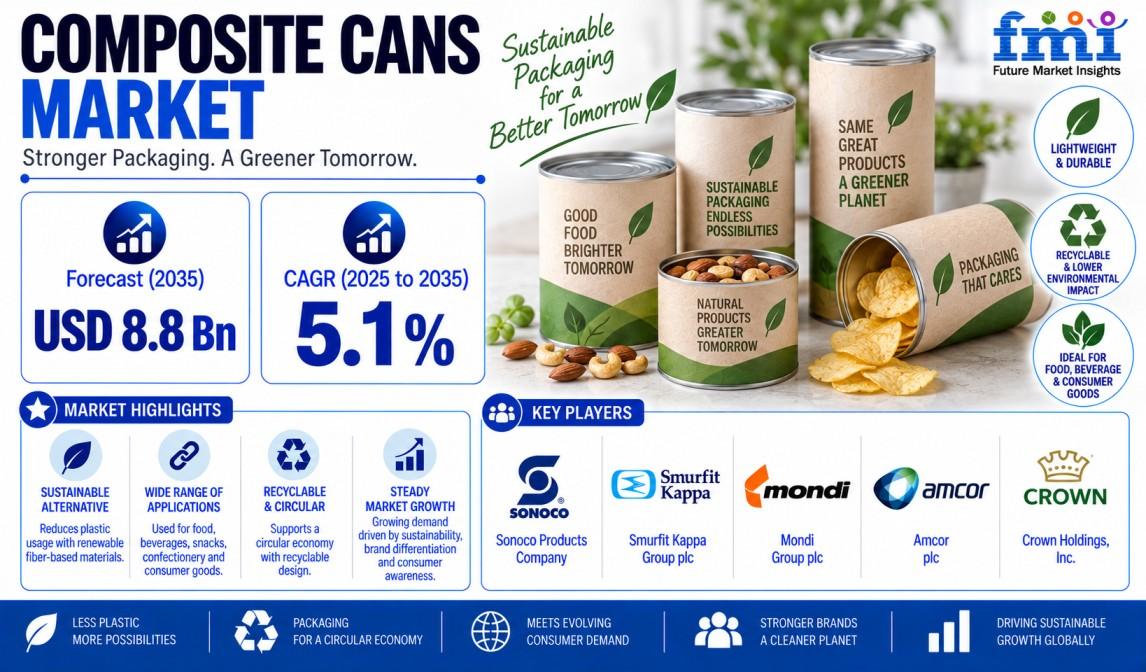
The global composite cans market is projected to grow from USD 5.4 billion in 2025 to USD 8.8 billion by 2035, advancing at a 5.1% CAGR, as food, beverage, personal care and industrial packaging applications increasingly seek lightweight formats that combine structural strength, product protection and branding flexibility.
Paperboard is expected to remain the dominant material, accounting for 60.0% of market revenue in 2025. Composite construction allows paperboard to be combined with aluminum, plastic or other components to provide the barrier and mechanical properties required for products such as snacks, powdered beverages, coffee and specialty food products.
The competitive landscape includes Sonoco Products Company, Smurfit Kappa Group, Mondi Group, Amcor, Crown Holdings, WestRock, Irwin Packaging and Ace Paper Tube, with competition spanning large-scale packaging platforms and specialized composite-container manufacturers.
Why is paperboard driving composite-can adoption?
Paperboard provides the structural foundation for many composite cans while supporting relatively lightweight packaging and high-quality graphics.
Its projected 60.0% market share in 2025 reflects demand for packaging that can combine structural performance with branding and handling advantages. Barrier layers can be incorporated where products require protection from moisture, oxygen or aroma migration.
This construction gives composite cans a position between conventional rigid containers and more flexible formats. For food and beverage manufacturers, the format can provide cylindrical geometry, stacking capability and strong shelf visibility while avoiding the weight associated with some alternative rigid packages.
The opportunity is particularly relevant in applications where packaging performance and visual differentiation need to coexist.
Get Access of Report Sample: https://www.futuremarketinsights.com/reports/sample/rep-gb-24686
How are closures and capacity influencing packaging design?
Caps are projected to account for 54.0% of market revenue in 2025, making them the leading closure type. Resealable caps can support consumer convenience and product protection, particularly for products consumed over multiple occasions.
The 250 ml to 500 ml capacity range is projected to capture 28.0% of market revenue in 2025, reflecting demand for portable and portion-oriented formats across food and beverage applications.
Together, these trends show that composite cans are evolving beyond basic containment. Closure design, serving size and pack geometry are increasingly being used to address consumer convenience while supporting shelf presentation.
Analyst Perspective
“Composite cans are gaining relevance where brands need lightweight cylindrical formats without giving up barrier protection or shelf visibility. The qualification challenge is ensuring that paperboard, barrier layers and closures deliver the required performance while remaining economically viable within the intended recovery system.”
— Nandini Roy Choudhury, Principal Consultant, Future Market Insights
Composite Cans Market Snapshot
- 2025 market value: USD 5.4 billion
- 2035 projected value: USD 8.8 billion
- Forecast CAGR: 5.1%
- Leading material: Paperboard — 60.0% share in 2025
- Leading closure: Caps — 54.0% share in 2025
- Leading capacity: 250 ml to 500 ml — 28.0% share in 2025
- Fastest profiled country: China — 6.9% CAGR
What is driving demand for composite cans?
Lightweight packaging requirements remain a major growth factor. Composite construction can reduce packaging weight while retaining the rigidity required for stacking, transport and retail handling.
Food and beverage applications provide an important demand base, particularly across snacks, powdered beverages, coffee, dairy products and specialty foods. Product protection and extended shelf life remain important where moisture or oxygen exposure can affect contents.
Brand differentiation is another advantage. Cylindrical surfaces provide substantial printable area, allowing manufacturers to use graphics, decorative treatments and customized designs to distinguish products at retail.
However, the market faces a fundamental challenge: composite construction can complicate recycling when paperboard is combined with materials that are difficult to separate during recovery.
This creates an increasingly important design question. The market's sustainability opportunity depends not only on the quantity of paperboard used but also on how the complete can behaves within the intended recovery infrastructure.
Which countries offer the strongest growth opportunities?
China is forecast to record the fastest CAGR among the profiled countries at 6.9% through 2035, followed by India at 6.4% and Germany at 5.9%.
France is projected to grow at 5.4%, the UK at 4.8%, the USA at 4.3% and Brazil at 3.8%.
The higher growth rates in China and India reflect expanding packaged-food consumption, modern retail penetration and demand for convenient packaging. Germany's position reflects established packaging manufacturing and stronger emphasis on recyclable materials and advanced barrier technologies.
Mature markets such as the USA and UK are expected to progress more gradually, with opportunities increasingly linked to premiumization, closure innovation and sustainability-oriented packaging redesign.
What is shaping competition in composite cans?
Competition spans integrated packaging groups and specialized manufacturers.
Sonoco has longstanding composite-can expertise, while Mondi, Smurfit Kappa and WestRock bring extensive paper and fiber-packaging capabilities. Amcor and Crown Holdings add broad food and beverage packaging portfolios, while Irwin Packaging and Ace Paper Tube provide more specialized composite-container capabilities.
The competitive advantage increasingly depends on combining material engineering, barrier performance, closure design, manufacturing scale and application-specific customization.
Large packaging groups can leverage broader customer relationships and production networks, while specialized producers can compete through customized dimensions, niche applications and shorter production requirements.
Get Access of Report Sample: https://www.futuremarketinsights.com/reports/sample/rep-gb-24686
What remains the biggest challenge for composite-can adoption?
Recycling is the central structural challenge. A composite can may contain paperboard alongside aluminum, plastic or other materials, making recovery more complex than a container constructed from a single material.
This creates pressure for manufacturers to reduce unnecessary material complexity and improve compatibility between component materials and established recovery systems.
At the same time, composite cans compete with flexible pouches, rigid plastic containers and metal cans. These alternatives can offer advantages in cost, weight, barrier performance or established recycling infrastructure.
Consequently, future growth is likely to depend on whether composite-can manufacturers can demonstrate a clear performance or branding advantage while improving end-of-life compatibility.
About the Composite Cans Market Report
The Composite Cans Market study evaluates the market by material, closure type, capacity, industry vertical and region. The research covers North America, Europe, Asia-Pacific, Latin America and the Middle East & Africa, with country-level analysis across major markets.
FMI Research Methodology: https://www.futuremarketinsights.com/methodology
Composite Cans Market: https://www.futuremarketinsights.com/reports/composite-cans-market
Toy Packaging Market: https://www.futuremarketinsights.com/reports/toy-packaging-market
Transport Packaging Market: https://www.futuremarketinsights.com/reports/transport-packaging-market
Tea Packaging Market: https://www.futuremarketinsights.com/reports/tea-packaging-market
About Future Market Insights, Inc.
Future Market Insights, Inc. is a global market research and consulting organization registered in Delaware as Future Market Insights, Inc., Christiana Corporate, 200 Continental Drive, Suite 401, Newark, Delaware 19713, United States.
FMI maintains additional offices and delivery operations across the United States, United Kingdom, United Arab Emirates and India and serves clients across international markets.
Media Contact
Future Market Insights, Inc.
Christiana Corporate
200 Continental Drive, Suite 401
Newark, Delaware 19713, United States
Email: sales@futuremarketinsights.com
Disclosure
This release summarizes findings from FMI syndicated research and is intended for informational and media purposes. Market estimates, forecasts and segment shares reflect FMI's defined market scope and research methodology. Company names are included for competitive context and do not constitute endorsements.

 English
 Arabic
 French
 Spanish
 Deutsch
 Turkish
 Dutch
Dutch
 Italiano
 Russian
 Romaian
 Portuguese (Brazil)
 Greek
Greek