


DGCA Pariksha: A Guide to Pilot Training in India
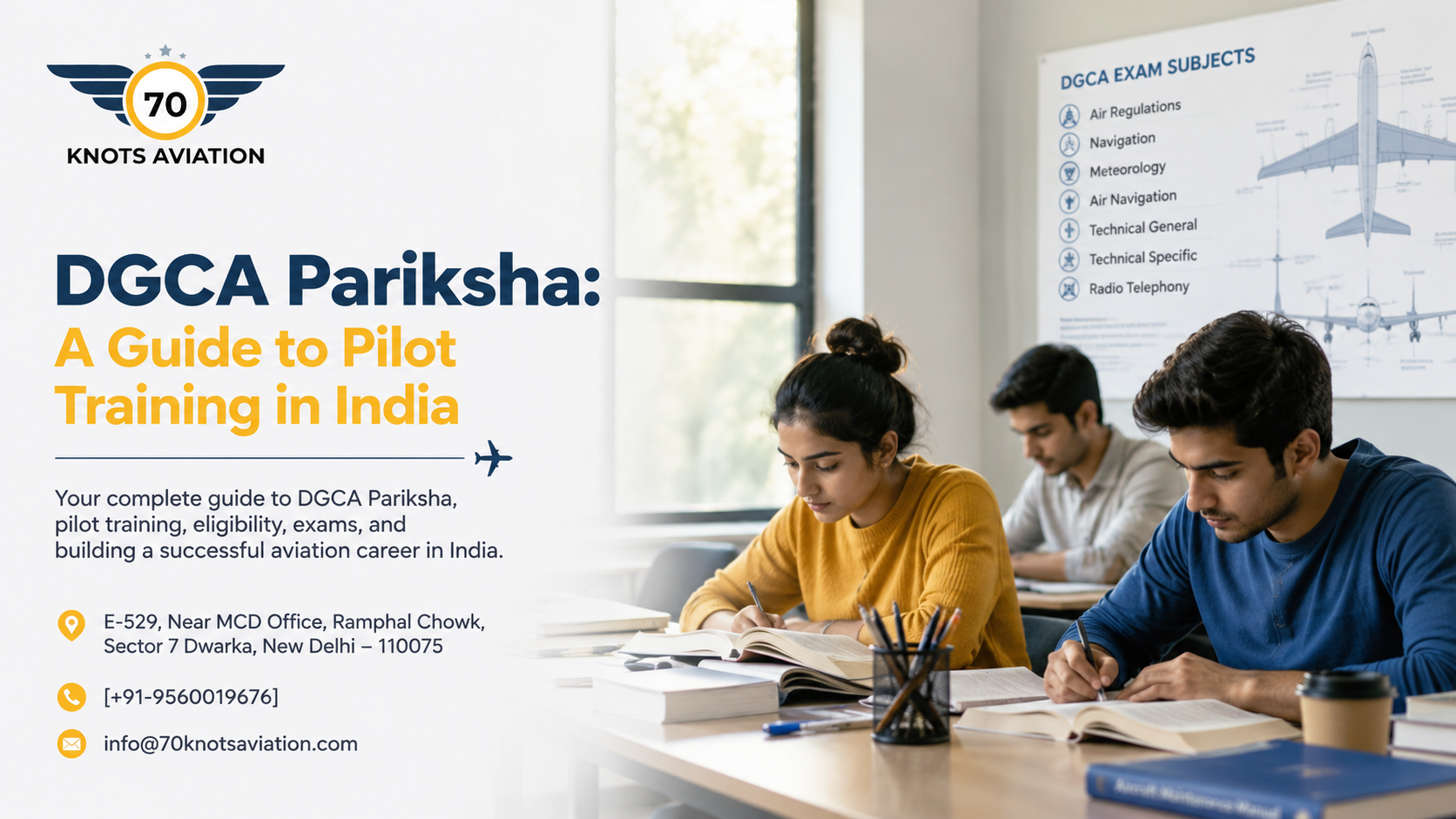
Becoming a commercial pilot is an exciting career goal, but the journey involves much more than learning how to fly an aircraft. Before a student reaches the cockpit, there are several stages of preparation, examinations, documentation, theoretical subjects, and practical flight training that need to be understood properly.
For many aspiring pilots, one of the first terms they come across is DGCA Pariksha. Understanding what it means, how to prepare for it, and how ground training fits into the overall pilot-training journey can make the entire process much easier to manage.
At 70Knots Aviation, located at E-529, Near MCD Office, Ramphal Chowk, Sector 7, Dwarka, New Delhi – 110075, students can focus on building a strong aviation foundation through structured ground training and guidance.
Whether you are beginning your research about becoming a pilot or already preparing for your examinations, having a clear plan can help you move forward with greater confidence.
Understanding the DGCA Pariksha
The Directorate General of Civil Aviation (DGCA) plays an important role in regulating civil aviation in India. Students pursuing a Commercial Pilot Licence (CPL) need to understand the theoretical requirements and examinations associated with their licensing journey.
This is where DGCA Pariksha becomes an important part of a student's preparation.
For someone entering aviation for the first time, subjects such as Air Navigation, Aviation Meteorology, Air Regulations and technical areas can initially appear complicated. However, these subjects become considerably easier when students understand the concepts rather than simply attempting to memorise answers.
A good preparation strategy usually involves three things:
- Understanding the syllabus and examination requirements
- Building strong conceptual knowledge
- Practising questions regularly
Students should also develop a consistent study routine. Aviation examinations require accuracy, attention to detail and a good understanding of technical concepts, so last-minute preparation is rarely the best approach.
Why Ground Training Matters Before Flight Training
Many students naturally become more interested in the flying portion of pilot training. Sitting inside a cockpit and eventually handling an aircraft is undoubtedly one of the most exciting aspects of the profession.
However, theoretical knowledge is equally important.
Before a pilot can make sound decisions in the cockpit, they need to understand navigation, weather, regulations, aircraft-related concepts, communication procedures and several other aspects of aviation.
Ground training provides this foundation.
For example, a student may learn how weather systems affect flight operations in Aviation Meteorology. In Air Navigation, they learn how pilots determine position, direction and route information. Air Regulations help students understand the rules and procedures under which aviation operations take place.
The objective should therefore not be to treat ground classes as simply an examination requirement. Instead, students should look at them as preparation for becoming knowledgeable and responsible aviation professionals.
How Should a Student Start Preparing for a Pilot Career?
This is one of the most common questions asked by students who are just beginning their aviation journey.
The first step is to understand the complete pathway instead of immediately choosing a flight school or focusing only on fees.
A student should research:
- The eligibility requirements for pilot training
- The theoretical examination requirements
- Ground training
- Flight training
- Medical requirements
- Documentation and licensing procedures
- The overall financial and time commitment
Once these areas are clear, it becomes much easier to create a realistic training plan.
Students should also understand that becoming a pilot is a process rather than a single course. Every stage contributes to the final objective.
Choosing the Best Pilot Training Institute in India
Another question students often ask is: How do I identify the best pilot training institute in India?
There is no single answer based only on a name, advertisement or location.
Instead, students should evaluate an institute according to the quality of its academic environment, faculty guidance, study material, teaching methodology, doubt-solving support and overall approach to aviation education.
A good institute should help students understand what they are studying and why it matters.
Students should also ask practical questions before enrolling:
- What subjects are covered?
- How are difficult topics explained?
- Is there regular practice?
- How are students guided during examination preparation?
- Is there a structured study schedule?
- Can students ask questions and clarify doubts?
These questions can provide a much better understanding of an institute than simply looking at promotional claims.
At 70Knots Aviation, the focus is on helping aspiring pilots develop their aviation knowledge through structured ground preparation. The institute is situated near Ramphal Chowk in Sector 7, Dwarka, New Delhi, making it accessible to students looking for aviation ground training in Delhi.
What About Students from Hyderabad and Chennai?
Pilot training is not limited to students from one city. Aviation aspirants from different parts of India often research institutes and compare training options before making a decision.
For example, a student searching online for Best DGCA CPL Classes in Hyderabad may be comparing academic support, course structure, faculty experience and preparation methods before deciding where to study.
Similarly, students researching the Best Pilot Training Institute in Chennai may have questions about the difference between ground training and flight training, examination preparation and the overall licensing process.
The important point is that students should look beyond the location mentioned in a search query.
If an institute provides strong academic preparation and the student is comfortable travelling or relocating for training, location does not necessarily have to be the only deciding factor.
For students considering ground preparation in Delhi, 70Knots Aviation offers an aviation-focused learning environment in Dwarka where students can concentrate on the theoretical side of their pilot-training journey.
Five Questions Students Commonly Ask
1. Is DGCA Pariksha difficult?
The difficulty level can vary from student to student. Aviation subjects contain technical concepts, calculations, rules and terminology that may initially feel unfamiliar.
The best approach is to study consistently, understand the concepts and practise regularly rather than relying entirely on memorisation.
2. Should I complete ground training before starting flight training?
Ground training provides essential theoretical knowledge, while flight training develops practical flying skills. The two complement each other.
Students should understand the requirements of their chosen training pathway and plan their academic and flying stages accordingly. Strong theoretical preparation can also make it easier to understand what is happening during practical flight training.
3. How much time should I spend studying every day?
There is no universal number of hours that works for every student. Consistency is generally more important than simply counting study hours.
A student who studies regularly, revises previous topics and practises questions can often make better progress than someone who studies for long hours only occasionally.
4. Do I need to be exceptionally good at mathematics to become a pilot?
Students do need to be comfortable with mathematical concepts used in aviation, particularly where navigation and calculations are involved. However, being a pilot is not about being a mathematical genius.
With proper explanation and regular practice, students can develop the required skills.
5. How should I choose my ground training institute?
Start by looking at the academic support rather than choosing solely based on location or advertisements.
Compare the teaching approach, faculty, course coverage, study material, practice methodology, doubt-solving support and overall learning environment. It is also useful to speak directly with the institute and understand how students are guided throughout their preparation.
Building the Right Study Routine
One of the biggest mistakes students make is treating pilot-training examinations like ordinary school or college examinations.
Aviation requires regular revision because students have to retain technical information over a longer period.
A practical routine could include:
Concept learning: Spend time understanding a new topic instead of immediately trying to memorise it.
Revision: Revisit previously studied chapters at regular intervals.
Question practice: Attempt examination-style questions to identify weak areas.
Doubt solving: Do not allow confusing concepts to remain unresolved for weeks.
Mock practice: Use practice tests to become comfortable with examination pressure and time management.
This approach can gradually improve both knowledge and confidence.
Learning Beyond the Examination
It is important to remember that the purpose of aviation education extends beyond passing an examination.
A future pilot needs to understand why regulations exist, how weather affects flight operations, how navigation works and how different factors influence decisions in aviation.
For this reason, students should try to connect classroom concepts with real-world aviation.
When studying meteorology, think about how weather influences aircraft operations. When learning navigation, understand how pilots use information to plan and monitor a route. When studying regulations, consider how those rules contribute to safety.
This makes learning more meaningful and can help students retain information for longer.
Why a Structured Approach Can Make a Difference
The pilot-training journey can sometimes feel overwhelming because students encounter many new terms and requirements at once.
A structured approach breaks the process into manageable stages.
Instead of thinking, “I have to become a commercial pilot,” students can focus on the next objective: understand the syllabus, attend ground classes, prepare the subjects, practise questions, complete the required examinations and then progress through the relevant stages of training.
This mindset can reduce unnecessary pressure.
At 70Knots Aviation, the aim is to provide students with an environment where they can focus on aviation education and develop the knowledge required for their professional journey.
Start Your Aviation Journey with the Right Foundation
Choosing a career as a commercial pilot requires commitment, discipline and preparation. From understanding DGCA Pariksha to developing strong theoretical knowledge, every stage matters.
Students researching the Best pilot training institute in India, comparing Best DGCA CPL Classes in Hyderabad, or looking for the Best Pilot Training Institute in Chennai should take time to understand what their training actually requires before making a decision.
The right institute is not simply the one with the most impressive claims. It is the one that helps students understand aviation, prepare systematically and approach their career journey with clarity.
For students looking for aviation ground training in Delhi, 70Knots Aviation is located at:
E-529, Near MCD Office, Ramphal Chowk, Sector 7, Dwarka, New Delhi – 110075
Phone: +91-9560019676
Email: info@70knotsaviation.com
Aviation is a career where preparation matters. Build the right foundation today, stay consistent with your studies, and approach every stage of the journey with patience and discipline.

 English
 Arabic
 French
 Spanish
 Portuguese
 Deutsch
 Turkish
 Dutch
Dutch
 Italiano
 Russian
 Romaian
 Greek
Greek