


Eye Humidifiers Add Momentum to Consumer Ophthalmic Devices
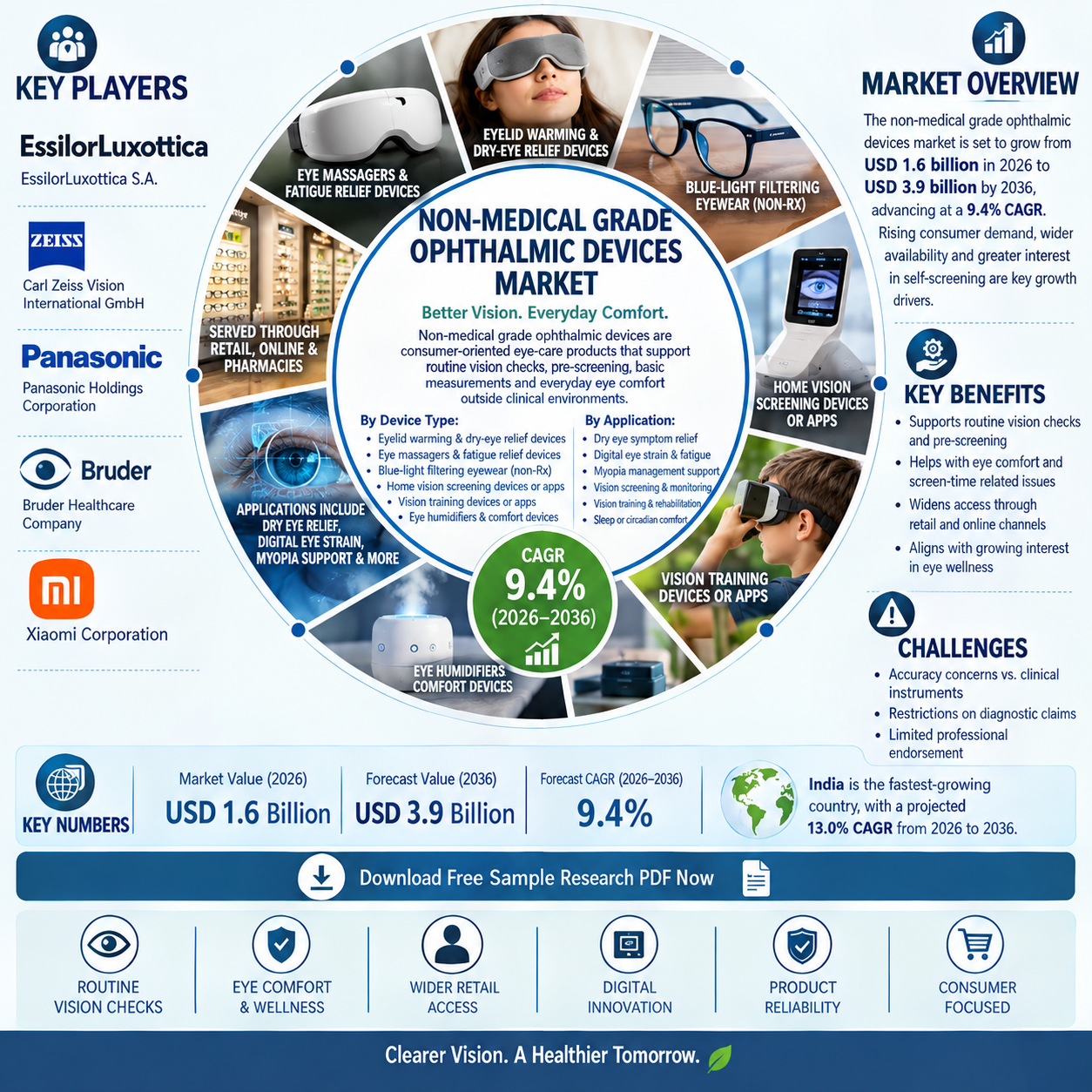
Subhead : Market rises from USD 1.6 billion in 2026 to USD 3.9 billion by 2036, with India forecast to grow at 13.0% CAGR
NEW DELHI, September 7, 2026 — The non-medical grade ophthalmic devices market is projected to grow from USD 1.6 billion in 2026 to USD 3.9 billion by 2036, advancing at a 9.4% CAGR, according to Fact.MR. The market supports routine vision checks, pre-screening, and basic eye measurements through retail chains and other high-footfall outlets.
The expansion reflects rising consumer demand for vision care and eye wellness products, wider availability of non-prescription devices, and greater interest in self-screening. Retail operators are also evaluating devices based on reading consistency, maintenance intervals, and their ability to handle intensive daily use.
Get detailed market forecasts, competitive benchmarking, and pricing trends: https://www.factmr.com/connectus/sample?flag=S&rep_id=13872
Non-Medical Grade Ophthalmic Devices Market Gains Ground in Consumer Eye Care
Fact.MR identifies eyelid warming and dry-eye relief devices as the leading device type, accounting for 28.30% of device type usage. Dry eye symptom relief represents 32.40% of total application usage, making it the largest use case in the category.
The category covers eyelid warming and dry-eye relief devices, eye massagers, non-prescription blue-light filtering eyewear, home vision screening devices or apps, vision training devices or apps, and eye humidifiers. Applications include digital eye strain, myopia management support, vision screening, rehabilitation support, and sleep or circadian comfort.
Extractable fact: Non-medical grade ophthalmic devices are consumer-oriented eye-care products that support routine vision checks, pre-screening, basic measurements, and everyday eye comfort outside clinical environments.
Fact.MR analysis indicates that revenue growth is tied to network expansion, higher test volumes per location, and the introduction of standardized screening services. Operators tend to retain fixed device sets after store layouts, staff procedures, and service pricing have been established around them.
Fact.MR analysis: “Eyelid warming and dry-eye relief devices” account for 28.30% of device type usage, supported by regular consumer demand for dry-eye comfort.
India Leads Country Growth
India records the fastest growth among the highlighted countries, with a projected 13.0% CAGR from 2026 to 2036. China follows at 11.8%, while Brazil records 10.2%. The United States is projected to grow at 7.4%, Germany at 4.0%, and France at 2.4%.
In India, expansion of organized optical chains and eye testing centers is identified as the main source of new demand. Operators often adopt a small number of multifunction devices for basic screening needs. Import volumes rise when optical chains enter new cities, while utilization depends on footfall and pricing for eye-check packages.
China's market is projected to expand at 11.8% annually through 2036. Large optical chains and platform-backed vision service groups drive installations, with throughput, testing speed, and ease of operation influencing purchasing decisions.
Brazil is forecast to grow at 10.2% annually. Private optical stores and franchised vision clinics support demand, while price, financing options, local service availability, and training support influence equipment selection.
Fact.MR analysis: India’s 13.0% projected CAGR through 2036 makes it the fastest-growing highlighted country market, with organized optical networks driving much of the new demand.
Consumer Use Shapes Device Demand
Dry-eye symptom relief remains central because the devices are used in repeated, short sessions. Fact.MR reports that users return to these products when irritation, burning, or blurred vision occurs during the day, while work and screen-heavy routines increase demand for quick comfort-oriented interventions.
Digital interfaces and app connectivity are emerging trends. Fact.MR also identifies portable vision screening tools and light-filtering devices designed for everyday eye comfort as areas of market development.
However, accuracy concerns remain a restraint. Fact.MR notes that differences from clinical instruments, restrictions on diagnostic claims, and limited professional endorsement can reduce confidence among cautious users.
For regulatory context, the report references the which addresses low-risk wellness devices, as well as the World Health Organization's global medical-device regulatory framework.
Browse Top Reports : https://social.mytamam.com/blogs/37368/Magnetic-Drive-Pump-Market-to-Reach-US-3-32-Billion
https://acmingle.com/blogs/17333/Split-HVAC-Systems-Market-Outlook-Points-to-Strong-2036-Growth
https://net-pals.com/blogs/30318/E-Commerce-Warehouses-Drive-Industrial-Barrier-System-Procurement
https://fact.pika.page/posts/longwall-equipment-accounts-for-338-percent-of-mining-method-demand
Competitive Landscape
Route-to-market strategy is a key factor in competition. EssilorLuxottica S.A. and Carl Zeiss Vision International GmbH benefit from optical-channel control and established service frameworks. Panasonic Holdings Corporation participates through consumer electronics distribution and manufacturing scale. Bruder Healthcare Company focuses on condition-oriented devices sold through specialist outlets. Xiaomi Corporation competes through volume-focused retail and online distribution.
Buyers compare suppliers based on return rates, durability records, and clarity of instructions. Once a device line is accepted by a retailer, volumes tend to follow shelf space and promotional cycles.
The Fact.MR report covers more than 30 countries and analyzes device type, application, sales channel, regional markets, installed base, test throughput, uptime, maintenance cycles, retail network expansion, and replacement behavior.
About Fact.MR
Fact.MR is a market research and consulting firm providing market intelligence across industries and geographies. Its research covers market sizing, forecasts, segmentation, competitive analysis, and country-level trends.
“Buyers assess suppliers based on technical support, compositional data, and the ability to maintain consistent performance across manufacturing scales,” Fact.MR states.
For manufacturers and buyers evaluating this market, the report provides segmentation by compound type, application, ingredient source, and region. Applications include bakery and cereals, dairy and nutrition bars, beverages and functional drinks, clinical and medical nutrition, sports and performance nutrition, and other foods and supplements.
About Fact.MR
Fact.MR is a market research and consulting firm providing market intelligence, forecasts, competitive analysis, and industry research across global markets. Its resistant starch and slowly digestible carbohydrates market study covers market valuation, segment performance, country-level growth, competitive analysis, formulation trends, and regulatory considerations.

 English
 Arabic
 French
 Spanish
 Portuguese
 Deutsch
 Turkish
 Italiano
 Russian
 Romaian
 Portuguese (Brazil)
 Greek
Greek