


Can Andrology Room Design Include Digital Monitoring Systems?
Introduction
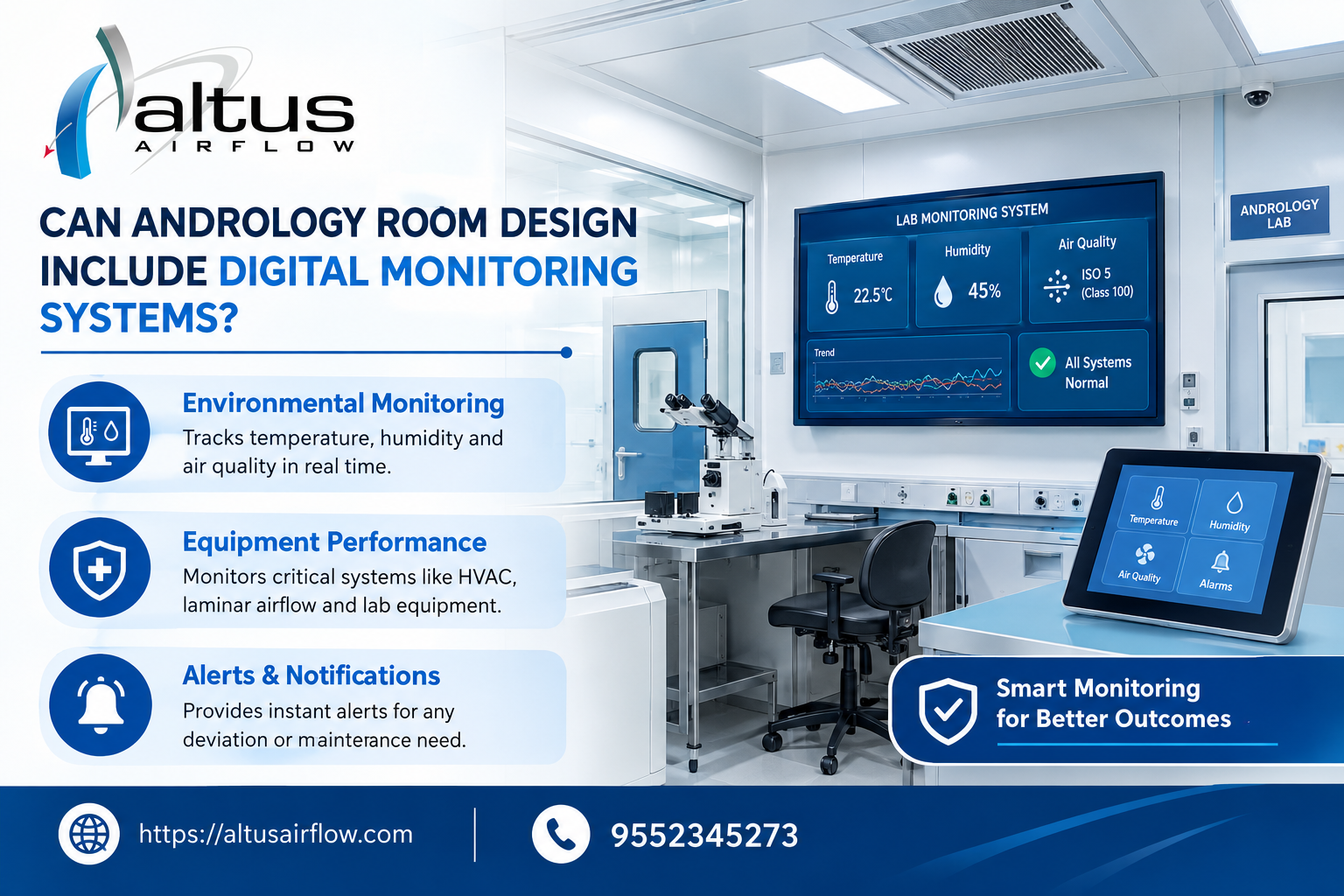
Andrology Room Design can include digital monitoring systems to help laboratories continuously observe and document important environmental conditions. Temperature, humidity, pressure, air quality, equipment status, and other parameters can be monitored through sensors connected to centralized displays or digital control platforms. These systems can provide laboratory personnel with timely information when conditions move outside predefined ranges. Altus Airflow focuses on integrating environmental-control requirements with appropriate monitoring and control solutions to support reliable laboratory operations.
Why Digital Monitoring Matters in Andrology Facilities?
Andrology laboratories handle sensitive biological samples and require carefully controlled environmental conditions. Changes in temperature, humidity, airflow, or other room parameters can affect the laboratory environment and may interfere with established operating procedures. Digital monitoring provides a convenient way to observe these conditions continuously instead of depending entirely on occasional manual measurements.
A monitoring system can collect readings at predetermined intervals or continuously, depending on the equipment and configuration. Data can then be displayed on a local panel, computer, tablet, or centralized facility-management platform. This gives laboratory staff a clearer overview of environmental performance and can make it easier to identify abnormal conditions before they become persistent problems.
Temperature Monitoring
Temperature monitoring is one of the most useful digital functions in an andrology facility. Sensors can be installed at appropriate locations to measure room temperature and transmit readings to a monitoring interface.
The system can be configured with predefined operating limits. If the measured temperature moves beyond an established range, an alarm or notification can alert authorized personnel. This allows staff to investigate possible causes such as HVAC malfunction, sensor problems, open doors, excessive heat loads, or other environmental changes.
Historical temperature records can also be useful during quality reviews because they provide information about environmental conditions over a particular period rather than relying only on a single manual reading.
Humidity Monitoring
Relative humidity can also be monitored digitally. Excessively high or low humidity may affect comfort, equipment performance, material conditions, and the overall stability of a controlled laboratory environment.
Humidity sensors can provide real-time readings and maintain historical records. When connected to an appropriate control system, the monitoring platform may also generate alerts when readings approach or exceed defined limits.
The exact acceptable range should be established according to the laboratory's procedures, equipment requirements, applicable standards, and environmental-control strategy rather than using a universal value for every facility.
Pressure Differential Monitoring
Pressure relationships between rooms can be important where an andrology facility contains different environmental zones. Digital differential-pressure sensors can continuously monitor the pressure relationship between designated spaces.
For example, the monitoring system may display whether the room is maintaining its intended relationship with an adjacent corridor or supporting area. If pressure moves outside the defined range, an alarm can notify facility personnel so that the HVAC system, doors, filters, or other potential causes can be investigated.
Continuous monitoring can be particularly useful because pressure conditions may change when doors are opened, ventilation systems operate differently, or filters and mechanical components require maintenance.
Airflow and Ventilation Monitoring
Digital systems can also support monitoring of ventilation-related parameters. Depending on the HVAC design, sensors and control devices may provide information about supply-air temperature, airflow status, fan operation, filter condition, room pressure, or other selected parameters.
The purpose is not simply to collect data but to provide useful information about whether the environmental-control system is operating as intended. Detailed airflow performance measurements may still require specialist testing and calibrated instruments during commissioning and validation.
Digital monitoring therefore works alongside, rather than replacing, professional HVAC testing and periodic verification.
Air Quality and Particle Monitoring
Where appropriate, digital environmental monitoring can include selected air-quality parameters. Depending on the facility's requirements, this may involve particulate monitoring or other indicators relevant to the controlled environment.
Particle monitoring can provide information about changes in airborne particulate levels and may support environmental assessment programs. However, the type of sensor, particle-size range, sampling method, alarm limits, and monitoring frequency should be selected according to the laboratory's specific requirements.
Routine environmental monitoring should also be supported by proper filtration, ventilation, cleaning, maintenance, and operational controls.
Equipment Status Monitoring
Digital monitoring can extend beyond room conditions to include selected equipment. HVAC units, air-handling systems, filtration systems, pumps, alarms, sensors, and other infrastructure may provide status information to a centralized platform.
For example, a control interface may indicate whether an air-handling unit is operating, whether a fan has stopped, or whether a particular alarm condition has occurred. Such information can help facility teams respond more quickly to technical issues.
Equipment monitoring should be designed around the systems that are genuinely important to laboratory operation rather than collecting unnecessary information that creates complexity without providing practical value.
Centralized Monitoring Platforms
A centralized monitoring platform can bring multiple environmental parameters together on a single interface. Instead of checking separate instruments, authorized users may be able to view temperature, humidity, pressure, equipment status, and selected alarms from one location.
Dashboards can present current readings in an easy-to-understand format. Some systems may also provide historical graphs, trend reports, event logs, and alarm records.
This centralized approach can make environmental oversight more organized, particularly in facilities with several controlled rooms or multiple operating zones.
Automated Alerts and Notifications
One of the most useful features of digital monitoring is automated notification. When a parameter moves outside its predefined limits, the system can generate an alert for designated personnel.
Notifications may be presented through the local control panel or other approved communication methods, depending on the system. The objective is to reduce the time between detecting an abnormal condition and beginning an investigation.
Alarm limits should be carefully configured. Too many unnecessary alarms can lead to alarm fatigue, while excessively broad limits may delay the identification of meaningful environmental deviations.
Data Logging and Historical Records
Digital systems can record environmental measurements over time. These records can help laboratory managers identify trends, investigate incidents, review recurring problems, and evaluate whether environmental systems are performing consistently.
Historical data may also support internal quality-management procedures and maintenance planning. For example, a gradual change in temperature stability or pressure performance could indicate that an HVAC component requires inspection.
Data retention periods, access permissions, backup arrangements, and record-management practices should be established according to the facility's policies and applicable requirements.
Calibration of Digital Sensors
Digital monitoring is only useful when the sensors provide reliable measurements. Temperature, humidity, pressure, and other sensors should therefore be selected appropriately and maintained according to a defined calibration program.
Calibration involves comparing an instrument's performance against an appropriate reference and addressing deviations according to established procedures. Calibration records should identify the instrument, calibration date, reference information, results, and next required assessment where applicable.
Sensor placement also matters. A poorly positioned sensor may not accurately represent the environmental condition that the laboratory intends to monitor.
Integration With HVAC Controls
Digital monitoring can be integrated with HVAC control systems where appropriate. Sensors can provide information to controllers, while the monitoring interface can display system performance to authorized users.
For example, temperature and humidity sensors can contribute to automated control strategies, while differential-pressure sensors can provide information about room pressure conditions. HVAC alarms can also be incorporated into a centralized monitoring platform.
Any automated control strategy should be properly engineered, tested, commissioned, and maintained. Critical parameters should have appropriate fallback and manual intervention procedures where required.
Supporting Preventive Maintenance
Monitoring data can contribute to preventive maintenance. Instead of relying exclusively on fixed service intervals, facility teams can review trends and alarms to identify potential deterioration.
Repeated temperature fluctuations, increasing pressure instability, frequent equipment alarms, or other unusual patterns may indicate that an inspection is necessary. Early attention can help reduce the possibility of prolonged environmental deviations.
Digital monitoring does not replace scheduled maintenance, but it can provide additional information that helps maintenance personnel make better-informed decisions.
Integration With Building Management Systems
Larger healthcare facilities may already operate a building management system or centralized facility-management platform. An appropriately designed monitoring solution can potentially integrate selected laboratory parameters with the wider system.
This can allow facility teams to monitor important environmental conditions alongside other building services. Integration should be carefully controlled so that access, alarm management, cybersecurity, data integrity, and system responsibilities are clearly defined.
The laboratory should retain appropriate visibility and control over parameters that directly affect its operational requirements.
Digital Monitoring in Andrology Room Design
Modern Andrology Room Design can incorporate digital monitoring from the earliest planning stage rather than adding sensors after construction is complete. This allows sensor locations, cable routes, control panels, network connections, electrical requirements, and maintenance access to be incorporated into the overall room design.
Planning monitoring infrastructure early can also reduce installation conflicts with HVAC ducts, modular panels, electrical services, lighting, medical equipment, and other systems. The result is a more organized technical installation and easier access for future maintenance.
Security and Access Control
Environmental monitoring systems can contain operational data that should be protected from unauthorized changes. User access can therefore be divided according to responsibilities.
For example, laboratory staff may be allowed to view readings and acknowledge alarms, while authorized technical personnel may have additional access for system configuration or maintenance. Password management, access logging, software updates, backups, and network protection should be addressed according to the facility's IT and cybersecurity policies.
Validation and Commissioning
Digital monitoring systems should be tested before being placed into routine operation. Commissioning can verify sensor readings, alarm thresholds, communication links, displays, data logging, and integration with other control systems.
Reference instruments may be used to compare sensor readings during commissioning. Alarm simulations can also help confirm that notifications are generated correctly when conditions exceed defined limits.
The completed system should have appropriate documentation covering sensor locations, equipment specifications, calibration information, alarm settings, operating instructions, and maintenance requirements.
Benefits for Laboratory Operations
Digital monitoring can provide several practical benefits. Continuous visibility can reduce dependence on manual readings, while historical records can make investigations and quality reviews more systematic. Automated alarms can improve awareness of abnormal conditions, and centralized dashboards can simplify supervision of multiple parameters.
The technology can also support better communication between laboratory personnel, facility-management teams, and maintenance staff. When an environmental issue occurs, recorded data can provide useful context for determining when the deviation began and whether it is recurring.
Planning Considerations
Before installing a digital monitoring system, the laboratory should identify which parameters genuinely require continuous monitoring. Temperature, humidity, pressure, HVAC status, and other parameters may be appropriate depending on the facility's needs.
The project should also define sensor locations, measurement ranges, alarm limits, data-retention requirements, calibration intervals, user permissions, backup arrangements, and maintenance responsibilities. These decisions should be made in consultation with laboratory, engineering, quality, and IT teams where applicable.
Conclusion
Digital monitoring systems can be an important addition to an andrology facility by providing continuous visibility of temperature, humidity, pressure, ventilation status, equipment conditions, and other selected parameters. When incorporated during Andrology Room Design, monitoring infrastructure can be coordinated with HVAC, electrical, modular construction, networking, and maintenance requirements from the beginning. Altus Airflow supports this integrated approach by considering environmental-control and monitoring requirements as part of a coordinated laboratory solution.
A well-designed monitoring system should combine accurate sensors, appropriate alarm limits, reliable data logging, calibration, secure access, and proper commissioning. With these elements in place, Altus Airflow can help laboratories establish a more organized approach to environmental monitoring and long-term facility management.
FAQs
1. Can Andrology Room Design include digital monitoring systems?
Yes, Andrology Room Design can include digital monitoring for temperature, humidity, pressure, airflow-related parameters, equipment status, alarms, and other selected environmental conditions.
2. What parameters can be monitored digitally?
Common parameters include temperature, relative humidity, differential pressure, HVAC status, and selected air-quality or equipment-performance indicators.
3. Can digital systems provide alerts?
Yes. Monitoring platforms can be configured to generate alerts when selected parameters move outside predefined limits.
4. Are digital sensors required to be calibrated?
Yes. Sensors should be maintained and calibrated according to the facility's established procedures and applicable requirements.
5. Can monitoring systems store historical data?
Yes. Many systems can record readings and maintain historical trends, event logs, and alarm records.
Read Our Previous Blog --------------->Do Modular Cardiac OT Manufacturers serve government hospitals?

 English
 Arabic
 French
 Spanish
 Deutsch
 Turkish
 Dutch
Dutch
 Italiano
 Russian
 Romaian
 Portuguese (Brazil)
 Greek
Greek