


SATCOM on the Move: Choosing Antennas for Mobile and Manpack Terminals
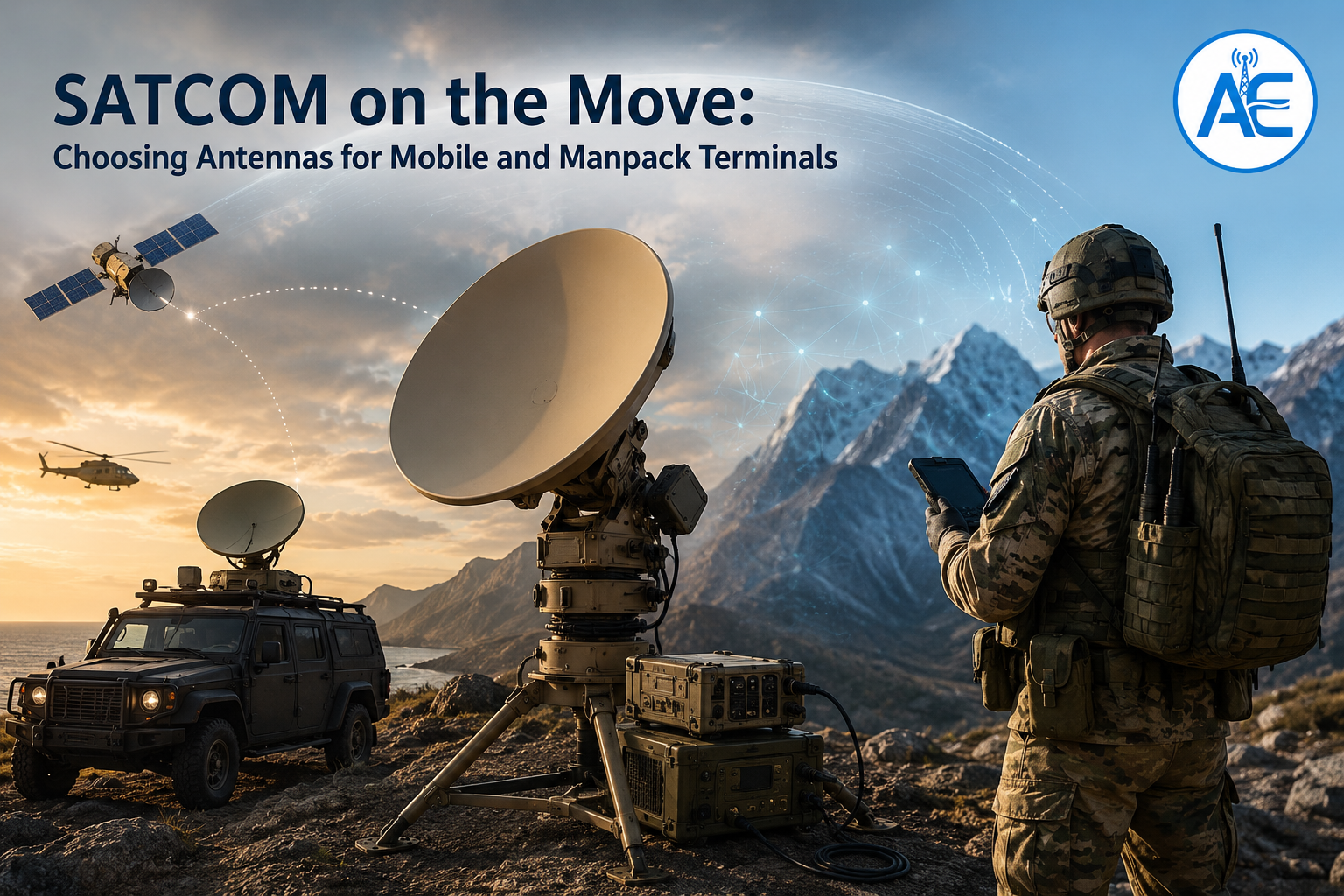
A vehicle crossing rough terrain, or an operator carrying a manpack radio on foot, cannot use the same antenna bolted to a fixed ground station. A fixed installation assumes a stable mount, generous power, and a known look angle to the satellite. Assumptions that disappear once the platform starts moving. Selecting a UHF Military SATCOM Antenna for a mobile or manpack application means weighing gain, polarization, pointing tolerance, size, weight and ruggedization together, rather than adapting a fixed-site design and hoping it holds up in the field.
Antenna Requirements for SATCOM on the Move
Both manpack and vehicular configurations fall under the same broad category of UHF Military SATCOM Antenna, but the right choice depends entirely on which constraint weight or link margin matters more for the mission.
- Size, Weight and Power Requirements for Mobile SATCOM Antennas
Manpack and vehicular terminals operate under limits a fixed installation never faces. On a manpack radio, every gram of antenna weight competes directly with everything else the operator carries. A vehicle offers more room and power, but mounting space, drag and available DC supply still set a ceiling on what's practical. Larger antennas generally deliver higher gain, so mobile SATCOM design is a continuous trade-off between portability and link performance.
- Pointing, Coverage and Axial Ratio in Mobile SATCOM
A fixed antenna points at a single satellite and stays there. A moving platform changes heading and attitude constantly, so the antenna needs wide angular coverage, an active tracking mount, or a pattern tolerant of pointing error. Circular polarization is common in mobile SATCOM because it reduces sensitivity to the antenna's roll orientation as the platform turns, an advantage linear polarization doesn't offer in the same way. Axial ratio describes how closely the antenna's polarization approaches ideal circular; a poor axial ratio can quietly erode link margin even when gain and frequency coverage look fine on paper.
Manpack and Vehicular UHF Military SATCOM Antennas
A manpack SATCOM antenna generally prioritizes low weight, a compact footprint, straightforward integration with a portable radio, and gain adequate for the link budget rather than maximized. Every additional decibel of gain tends to cost the size or weight the operator carries.
Vehicular systems can accommodate larger apertures, higher gain, sturdier mounting and more available power, along with mechanical protection a handheld unit can't practically match. Neither configuration is better in general, a vehicular antenna isn't a workable substitute where portability is the actual requirement, and a manpack antenna won't sustain the link margin a vehicle-mounted system can deliver.
Helical and Quadrifilar Helix Antennas for Mobile SATCOM
Helix-based designs suit portable and mobile SATCOM because their geometry produces circular polarization in a compact, mechanically simple package.
- Quadrifilar Helix Antenna for Portable SATCOM
A Quadrifilar helix antenna uses two crossed helical loops fed in quadrature to generate circular polarization with a wide, largely hemispherical beam. That broad coverage suits a platform where precise pointing isn't practical, and its compact, low-profile shape fits manpack and small vehicular installations well. The design trades peak gain for beamwidth, usually the right trade where maintaining contact through movement matters more than squeezing out maximum signal strength.
- High Gain Helical Antenna for Mobile SATCOM
A high gain helical antenna uses a longer helix to concentrate energy into a narrower beam, improving link budget where gain genuinely matters. That narrower beam brings tighter pointing requirements in return, so the advantage only pays off where the platform can hold a reasonably steady orientation toward the satellite, through a tracking mount, a stable vehicle, or limited motion. Choosing between the two designs comes down to whether the application values coverage and pointing tolerance more, or link margin more.
SATCOM Ground Station and Satellite Telemetry & Tracking Antennas
The fixed side of a SATCOM link runs on a different set of priorities entirely. A SATCOM ground station antenna typically uses a large, high-gain, precisely steerable aperture to hold a strong, stable link with one or more satellites from a known location, close to the opposite design philosophy from a manpack antenna built for portability.
A satellite telemetry and tracking antenna serves a related but distinct role within TT&C operations, supporting the links used to monitor and manage the satellite itself rather than carry user traffic. Mobile terminal, ground station and TT&C antennas each solve a genuinely different problem.
Ruggedization Requirements for Deployable SATCOM Antennas
A deployable antenna's RF performance means little if it fails mechanically in the field. Temperature extremes, rain, dust, wind loading, vibration, mechanical shock and repeated handling all take a toll that a fixed installation rarely experiences. Vehicle-mounted antennas need to withstand sustained vibration and road shock; manpack antennas need to survive being packed, dropped and redeployed repeatedly. Field performance depends as much on mechanical and environmental reliability as it does on the RF numbers printed on a datasheet.
Why Choose Antenna Experts for Deployable SATCOM Antennas
A standard catalogue antenna covers a standard requirement well. Once frequency, gain, polarization, size, weight, mounting or environmental rating fall outside that standard, closing the gap calls for custom engineering rather than compromise. Antenna Experts is a trusted antenna manufacturer in India. We work through that process directly with SATCOM integrators and defense programs, starting from the platform's actual constraints, manpack, vehicular or fixed ground station, before proposing or developing an antenna built around them.
That work spans custom design and manufacturing across fixed, mobile and portable configurations, engineering to specific frequency, gain, polarization and form-factor requirements, plus testing and validation to confirm a design holds up mechanically as well as electrically. Contact Antenna Experts to discuss a manpack, vehicular or deployable SATCOM antenna requirement for your program.
Frequently Asked Questions
What antenna suits manpack SATCOM?
A compact, lightweight antenna with gain adequate for the link budget, often a quadrifilar helix design chosen for its circular polarization and wide coverage. The priority is keeping weight and bulk to a minimum while still closing the link reliably.
Why use a helical antenna for portable SATCOM?
Helical geometry naturally produces circular polarization in a compact, mechanically simple form, which suits the pointing tolerance and size limits of portable terminals better than many linear designs.
How is SATCOM maintained while moving?
Through a combination of wide-coverage antenna patterns, polarization that tolerates changing orientation, and, in some systems, a tracking mount that keeps the antenna pointed toward the satellite as heading and attitude shift.
What frequency does UHF military SATCOM use?
UHF military SATCOM generally operates within the broader UHF band used for satellite communications, roughly 225–400 MHz Exact channels depend on the specific satellite system and authorized frequency plan, and should be confirmed for each program rather than assumed.

 English
 Arabic
 French
 Spanish
 Deutsch
 Turkish
 Dutch
Dutch
 Italiano
 Russian
 Romaian
 Portuguese (Brazil)
 Greek
Greek