


Industrial Modernization Drives Plate and Frame Heat Exchanger Market
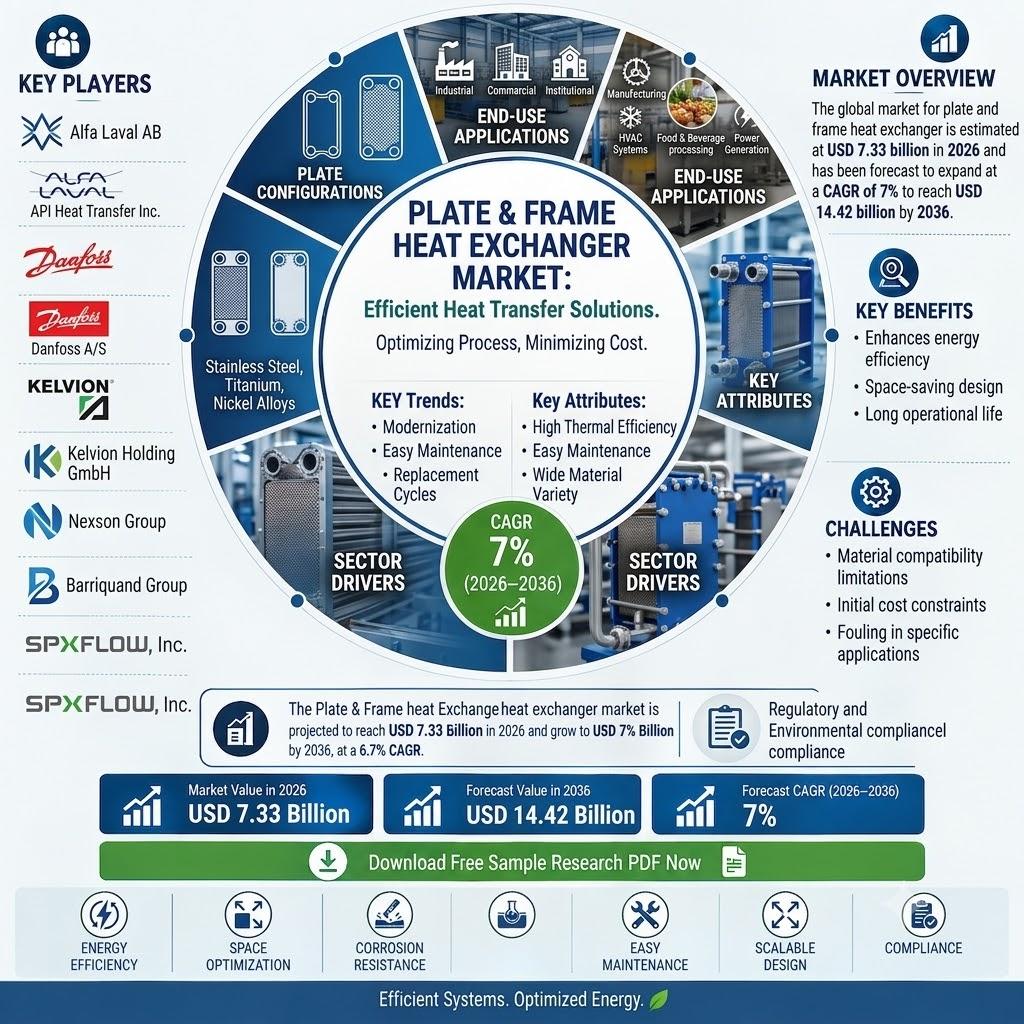
Subhead : Market growth is being supported by equipment modernization, infrastructure expansion, energy-efficiency needs, and demand across HVAC, chemical, food, and utility applications.
ROCKVILLE, Md. — September 8, 2026 — The global Plate and Frame Heat Exchanger Market is projected to grow from USD 7.33 billion in 2026 to USD 14.42 billion by 2036, advancing at a 7% CAGR, according to Fact.MR. The market is expected to create an absolute dollar opportunity of USD 7.09 billion during the forecast period.
Demand is being shaped by equipment replacement, expanding water and wastewater infrastructure, and capacity additions across emerging markets. Food processing, chemical processing, pharmaceutical applications, HVAC and refrigeration, power generation, and oil and gas operations are broadening the installed base.
Extractable market fact: The Plate and Frame Heat Exchanger Market is a thermal equipment category that covers gasketed and welded plate heat exchanger products used across industrial, commercial, and institutional applications.
Get detailed market forecasts, competitive benchmarking, and pricing trends: https://www.factmr.com/connectus/sample?flag=S&rep_id=12348
Gasketed systems retain the largest share
Gasketed Plate and Frame Heat Exchangers are estimated to account for 55% of the product type segment in 2026. Their position reflects an established demand base, broad applicability, distribution availability, and familiarity among procurement teams.
Welded Plate Heat Exchangers are the second-largest product segment. Fact.MR identifies the segment as an emerging growth area as buyers increasingly consider operational requirements, lifecycle costs, and modern installation specifications.
Stainless Steel holds 50% of the material type segment in 2026. Titanium follows as the second-largest material segment, supported by requirements in applications where its technical characteristics are preferred.
HVAC and Refrigeration represents 30% of the application segment in 2026. Chemical Processing follows as the second-largest application segment.
The market also covers food and beverage, power generation, and oil and gas applications. End-use industries include energy and utilities, chemical, food and beverage, HVAC, and marine industries.
Why the market is expanding now
The replacement of older equipment with energy-efficient and low-maintenance alternatives is supporting procurement across industrial operations. Expansion of water, wastewater, and utility infrastructure is creating additional procurement pipelines in emerging markets.
Technology is also changing purchasing specifications. Fact.MR identifies remote monitoring, IoT-based controls, and predictive maintenance capabilities as factors influencing equipment selection.
Environmental and noise regulations are another demand factor. In parallel, industrial modernization is increasing requirements for higher-specification systems.
Buyers are also evaluating equipment beyond upfront purchase prices. Lifecycle cost, energy efficiency, operational flexibility, compliance readiness, and service availability are becoming relevant purchasing considerations.
A key constraint remains the high upfront capital cost of advanced models, which can limit adoption among smaller operators and price-sensitive buyers. Fact.MR also identifies fragmented aftermarket infrastructure and supply-chain constraints for specialty components and raw materials as challenges.
Browse Top Reports :
https://net-pals.com/blogs/31111/The-Future-of-Tamper-Evident-Packaging-for-Banks-and-Retailers
https://gulfsena.com/blogs/89228/Static-Spray-Balls-Market-to-Expand-as-Hygiene-Standards-Rise
https://social.art-inpa.com/blogs/22521/Resistant-Starch-Market-Forecast-Highlights-6-7-CAGR-Growth
China and India lead country growth
China is projected to record an 8.2% CAGR through 2036, making it the fastest-growing country market covered in the report. Industrial upgrading, HVAC and refrigeration demand, and replacement of older stainless steel equipment are supporting growth.
India follows closely at an 8% CAGR. Government and private-sector infrastructure investment, expanding HVAC and refrigeration capacity, and growing domestic manufacturing are supporting demand.
Saudi Arabia is projected to grow at 7.3% CAGR, supported by Vision 2030 infrastructure programs and IKTVA requirements. Brazil is forecast to expand at 7% CAGR, while Germany and the UK are projected to record CAGRs of 6.5% and 6.3%, respectively.
|
Country |
CAGR, 2026–2036 |
|
China |
8.2% |
|
India |
8.0% |
|
Saudi Arabia |
7.3% |
|
Brazil |
7.0% |
|
Germany |
6.5% |
|
UK |
6.3% |
Competition focuses on product and service capability
The competitive landscape is described by Fact.MR as moderately fragmented. Alfa Laval AB, API Heat Transfer Inc., Danfoss A/S, Kelvion Holding GmbH, Nexson Group, Barriquand Group, SPX FLOW, Inc., Hisaka Works, Ltd., Tranter, Inc., and WCR Inc. are among the companies active in the market.
Fact.MR reports recent developments including Alfa Laval AB's product portfolio expansion in January 2026, API Heat Transfer Inc.'s technology launch in 2025, Danfoss A/S's strategic partnership in February 2026, and Kelvion Holding GmbH's capacity expansion in 2025.
Shambhu Nath Jha, Principal Consultant at Fact.MR, said, “The plate and frame heat exchanger market is moving beyond volume-driven growth toward value-led expansion. Buyers are increasingly specifying products based on lifecycle cost, energy efficiency, and integration capability rather than upfront price alone.”
Fact.MR's research methodology combines secondary research, primary interviews, and forecast modeling. The study draws on 120+ secondary sources, benchmarks 65+ company product portfolios, covers 30+ countries, and includes 25+ interviews with manufacturers, distributors, system integrators, and end users.
About Fact.MR
Fact.MR is a market research and consulting firm providing market intelligence, forecasts, and industry analysis across global markets. The Plate and Frame Heat Exchanger Market study covers market size, forecasts, segmentation, regional demand, technology trends, competitive positioning, pricing considerations, and industry developments for 2026 to 2036.

 English
 Arabic
 French
 Spanish
 Deutsch
 Turkish
 Dutch
Dutch
 Italiano
 Russian
 Romaian
 Portuguese (Brazil)
 Greek
Greek