Online pricing changes faster than most businesses can keep up with. A competitor can reduce the price of a product in the morning, launch a discount in the afternoon, and quietly return to the original price before dinner. By the time someone updates a spreadsheet, the market may have already moved on.
We have seen this happen more than once — especially in competitive e-commerce markets where hundreds or thousands of products need to be monitored. Manual checking sounds manageable until the product list starts growing. Then the spreadsheet becomes less of a solution and more of a full-time roommate.
This is where price intelligence becomes valuable. Businesses can collect competitor pricing data, analyze changes, identify patterns, and make better pricing decisions.
But where does web scraping fit into all of this?
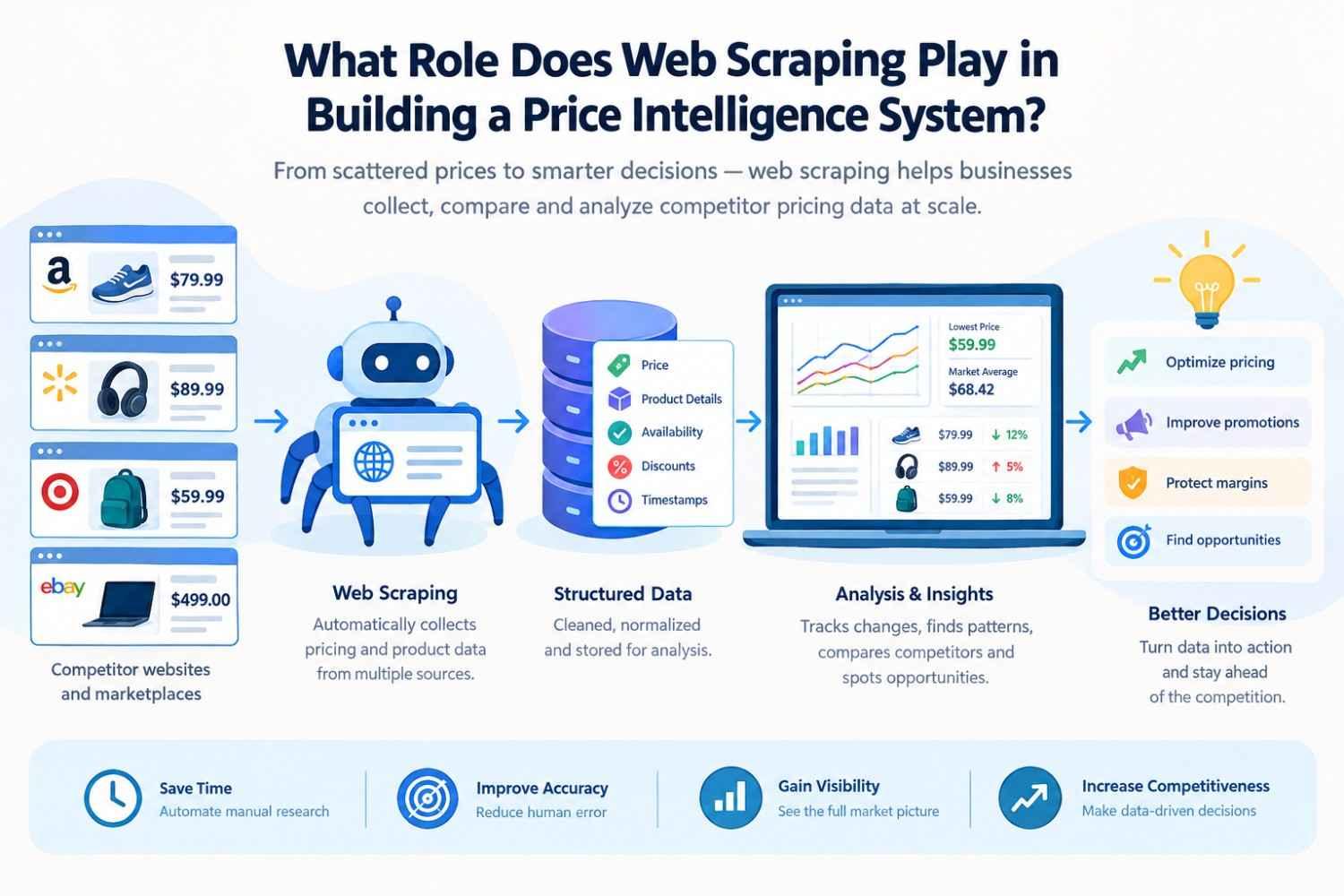
Web scraping acts as a data collection foundation for many price intelligence systems, automatically gathering pricing and product information from online sources so businesses can monitor, compare, and analyze market changes at scale.
Let's look at how it works — and why simply collecting prices is only the beginning.
What Is a Price Intelligence System?
A price intelligence system is a technology-driven solution that collects, organizes, and analyzes pricing information from competitors and the wider market.
Instead of looking at one product at one point in time, businesses can build a continuous stream of pricing information.
A typical system may track:
- Competitor product prices
- Original and discounted prices
- Promotions
- Product availability
- Product variations
- Pricing history
- Competitor websites
- Market pricing trends
The important part is that the system does not simply answer, “What does this product cost today?”
It can also help answer:
- How has the price changed?
- Which competitor changed its price?
- How frequently are discounts offered?
- Which products are consistently cheaper?
- Is a competitor becoming more aggressive?
- When should we consider adjusting our own price?
That is where ordinary pricing data starts becoming useful business intelligence.
Why Is Pricing Data Important for Modern Businesses?
Competitor Prices Change Frequently
Online businesses rarely operate in a static pricing environment. Competitors change prices based on demand, inventory, promotions, seasonality, and sometimes simply because they can.
A price that was competitive last week may suddenly become uncompetitive today.
Regular monitoring helps businesses stay aware of those movements instead of discovering them after customers have already noticed.
Customers Compare Prices Instantly
Customers no longer need to visit several physical stores to compare prices. A few searches can reveal multiple sellers within seconds.
That makes pricing transparency higher than ever.
If customers consistently find a similar product elsewhere for less, businesses need to understand why — and whether the price difference requires action.
Manual Monitoring Does Not Scale
Checking five products manually may be fine.
Checking 5,000 products across 50 competitor websites?
That is a different story.
Manual monitoring takes time, introduces human error, and makes historical tracking difficult. Employees may record a price incorrectly, miss a product variation, or simply forget to check a competitor on a busy day.
Automation solves much of this repetitive work.
Historical Pricing Reveals Patterns
One price tells us what is happening now.
A collection of prices over time tells us what is happening repeatedly.
Historical data can reveal seasonal discounts, recurring promotions, competitor pricing cycles, and unusual price movements.
And sometimes the most interesting discovery is that yesterday's “surprise discount” was actually the fifth time a competitor had done exactly the same thing.
How Does Web Scraping Support Price Intelligence?
Web scraping is often the first major technical layer in a price intelligence workflow.
A scraper visits selected web pages, extracts relevant information, and converts it into structured data that can be stored and analyzed.
Depending on the project, collected information can include:
- Product name
- Product URL
- Current price
- Previous price
- Discount percentage
- Currency
- Availability
- Product SKU
- Product variation
- Promotional information
- Timestamp
For example, a business selling electronics may monitor several competitors for the same laptop model.
The scraper can collect the current prices regularly and store each observation with a timestamp. The intelligence system can then compare today's price with yesterday's, last week's, or last month's price.
This distinction matters.
Web scraping collects the information. Price intelligence turns that information into insights.
One supplies the ingredients; the other attempts to cook something useful with them.
What Data Can Web Scraping Collect for Price Intelligence?
Competitor Product Prices
The most obvious data point is the current selling price.
Businesses can monitor the same products across multiple competitors and identify price differences.
This can help answer questions such as:
- Which competitor currently has the lowest price?
- How far are we from the market average?
- Which products have experienced the biggest price changes?
Discounts and Promotions
Price intelligence should not focus only on the final selling price.
Promotional information can also matter.
A system may collect:
- Sale prices
- Percentage discounts
- Coupon information
- Promotional campaigns
- Limited-time offers
- Buy-one-get-one promotions
This creates a broader picture of how competitors attract customers.
Product Availability
Price and availability often need to be analyzed together.
A competitor selling a product for less may not necessarily represent a direct pricing threat if the item is out of stock.
Therefore, tracking stock status alongside pricing can provide better context.
Product Variations
Products are not always identical.
A clothing retailer may sell the same design in multiple sizes and colors. Electronics may have different storage capacities or configurations.
A good system needs to distinguish these variations rather than treating every similar product as identical.
Historical Pricing Information
Repeated scraping creates a historical pricing dataset.
Instead of storing only the latest value, businesses can maintain previous observations and identify how pricing evolves over time.
That historical layer is where many useful insights begin to appear.
How Does the Price Intelligence Workflow Work?
Step 1 — Identify Target Competitors
First, businesses need to determine which competitors and product categories matter.
Trying to scrape every website on the internet is neither practical nor particularly useful.
The focus should be on relevant competitors, products, regions, and marketplaces.
Step 2 — Collect Pricing Data
Once sources are identified, automated scraping can collect relevant information according to a defined schedule.
The frequency depends on the market.
Some businesses may need daily monitoring. Others may require updates every few hours because prices change rapidly.
Step 3 — Clean and Normalize the Data
Raw scraped information is rarely ready for analysis.
Data may contain:
- Duplicate products
- Missing values
- Different currencies
- Different naming formats
- Incorrect or incomplete fields
Data cleaning and normalization help create a consistent dataset.
Step 4 — Store Historical Data
Every pricing observation can be stored with information such as:
- Product
- Competitor
- Price
- Date
- Time
- Availability
This creates a historical pricing database.
Step 5 — Analyze Pricing Changes
The system can compare current and historical information to detect changes.
For example:
Competitor A: $499 → $459
Competitor B: $489 → $479
Our price: $475
Suddenly, the pricing team has a much clearer picture of the market.
Step 6 — Generate Alerts and Insights
Businesses can create rules that trigger alerts when certain conditions occur.
For example:
- Competitor price drops by more than 10%
- Product becomes unavailable
- New promotion appears
- Market average changes significantly
- A competitor undercuts the current price
This reduces the need for someone to constantly stare at dashboards.
Thankfully, spreadsheets do not need to be invited to every meeting anymore.
How Can Web Scraping Enable Real-Time Price Monitoring?
Real-time or near-real-time monitoring can be valuable in markets where prices change frequently.
Instead of collecting information once a month, businesses can configure automated collection at suitable intervals.
For example, an online retailer might monitor important products every few hours.
This can help detect:
- Sudden price reductions
- Flash sales
- New promotions
- Price increases
- Competitor stock changes
However, “real-time” does not necessarily mean scraping every website every second.
The appropriate monitoring frequency depends on the business model, market volatility, technical requirements, and source websites.
The goal is not to collect the maximum amount of data.
The goal is to collect useful and sufficiently fresh data.
How Does Web Scraping Help Track Competitor Price Changes Over Time?
Historical comparison is one of the strongest advantages of automated pricing data collection.
Suppose a competitor's product price is:
- January: $100
- February: $95
- March: $110
- April: $90
Looking at today's price alone would miss the pattern.
Historical data shows that the competitor frequently changes pricing and may use aggressive promotional cycles.
Businesses can compare:
- Day-over-day pricing
- Week-over-week pricing
- Month-over-month pricing
- Seasonal pricing
- Promotional periods
This information can help pricing teams understand not only what changed, but also how competitors behave over time.
How Can Businesses Use Scraped Pricing Data for Better Decisions?
Optimize Product Pricing
Businesses can compare their prices with relevant competitors and determine whether products are positioned competitively.
This does not mean blindly matching the lowest price.
Instead, market data becomes one factor in a broader pricing strategy.
Identify Pricing Opportunities
Competitor data can reveal products where market pricing leaves room for action.
For example, if competitors consistently charge significantly more for a particular product category, a business may identify an opportunity to position itself differently.
Protect Profit Margins
Competing only on price can become an expensive habit.
Price intelligence helps businesses understand market movements before automatically reducing prices.
Sometimes the best decision is to do nothing.
That can be surprisingly difficult when everyone else appears to be changing prices.
Improve Promotional Strategies
Historical competitor data can show when competitors typically launch discounts.
Businesses can use this information to plan their own campaigns more intelligently.
Support Dynamic Pricing
Pricing data can also become an input for dynamic pricing systems.
Automated pricing rules can consider factors such as:
- Competitor prices
- Inventory
- Demand
- Product performance
- Market conditions
The objective is to make pricing more responsive without turning every pricing decision into a manual exercise.
What Technologies Are Used in a Price Intelligence System?
A modern system may combine several technologies rather than relying on scraping alone.
Common components include:
- Web scraping frameworks
- APIs
- Proxy infrastructure
- Data validation systems
- Databases
- Cloud infrastructure
- Data pipelines
- Analytics dashboards
- Alert systems
- AI and machine learning
AI can add another layer of intelligence.
For example, machine learning can help identify similar products, detect unusual price movements, categorize products, and identify pricing patterns.
This becomes particularly useful when thousands of products need to be compared across multiple sources.
What Challenges Can Web Scraping Solve in Price Intelligence?
Large-Scale Data Collection
Automation allows businesses to collect pricing information across large numbers of products and sources.
Frequent Price Changes
Automated monitoring can capture changes without requiring employees to repeatedly visit competitor websites.
Multiple Competitors
Pricing information from multiple sources can be consolidated into a single system.
Unstructured Website Data
Web pages are designed for people to read, not databases to understand.
Scraping systems can transform relevant webpage information into structured records.
Data Consistency
Automated pipelines can apply consistent rules for formatting, validation, and normalization.
What Challenges Should Businesses Consider When Building a Scraping-Based Price Intelligence System?
Building a scraper is not necessarily the difficult part.
Keeping it reliable over time can be.
Websites change their layouts. Content may load dynamically. Some pages may use anti-bot technologies. Product information may be inconsistent.
Other challenges include:
- Website structure changes
- JavaScript-rendered content
- CAPTCHAs
- IP restrictions
- Missing data
- Duplicate products
- Product matching
- Currency differences
- Data freshness
- Infrastructure scaling
- Applicable legal and website-use considerations
This is why a production-grade price intelligence system needs ongoing monitoring and maintenance.
A scraper that worked perfectly six months ago may suddenly wake up one morning and decide that the product price is now hidden inside a completely different HTML structure.
Technology has a sense of humor.
Why Does Data Quality Matter in Price Intelligence?
A pricing system is only as useful as the information entering it.
If the collected price is incorrect, every downstream analysis can also become incorrect.
This is the classic “garbage in, garbage out” problem.
Businesses should consider:
- Data validation
- Duplicate detection
- Missing-value handling
- Currency normalization
- Product matching
- Timestamp verification
- Outlier detection
Suppose a competitor's actual price is $199, but the system accidentally captures $1,999 because of a page-formatting issue.
The resulting pricing recommendation could be spectacularly wrong.
Reliable price intelligence therefore requires more than scraping — it requires data quality controls.
Should Businesses Build a Price Intelligence System In-House or Hire a Web Scraping Company?
There is no universal answer.
Building in-house can provide greater control and may make sense for businesses with strong technical teams and long-term infrastructure requirements.
However, it also means handling:
- Development
- Infrastructure
- Monitoring
- Maintenance
- Scaling
- Data quality
- Website changes
Working with an experienced web scraping company can reduce some of this technical burden and provide access to specialized scraping expertise.
The right approach depends on the number of sources, data volume, monitoring frequency, internal capabilities, and long-term objectives.
The important thing is to evaluate the total cost — not just the initial development cost.
How Much Does It Cost to Build a Price Intelligence System?
There is no single price because every system has different requirements.
The total cost can depend on:
- Number of competitor websites
- Number of products
- Scraping frequency
- Data complexity
- Infrastructure
- Proxy requirements
- Storage
- Dashboard functionality
- Product matching
- AI requirements
- Maintenance
A basic competitor monitoring solution may be relatively simple.
An enterprise system monitoring millions of product records across multiple markets is a completely different beast.
The best approach is to define the required data, sources, frequency, and business outcomes before estimating development costs.
What Are the Benefits of Using Price Intelligence Services?
Businesses can gain several advantages from an automated pricing intelligence strategy, including:
- Automated competitor monitoring
- Faster pricing decisions
- Reduced manual research
- Better market visibility
- Historical pricing insights
- Improved promotional planning
- More informed pricing strategies
- Scalable data collection
The biggest benefit is not simply knowing what competitors charge.
It is being able to understand why those prices matter and what action may be appropriate.
How Can Businesses Measure the Success of a Price Intelligence System?
A price intelligence system should have measurable objectives.
Businesses can monitor:
- Data accuracy
- Data freshness
- Competitor coverage
- Scraping success rate
- Price-change detection speed
- Alert accuracy
- Time saved
- Pricing response time
- Margin improvement
- Revenue impact
For example, reducing manual monitoring from several hours per day to a few minutes of dashboard review can itself represent significant operational value.
The system should ultimately support business decisions — not become another dashboard that everyone opens once and then politely ignores.
What Is the Future of Web Scraping in Price Intelligence?
The future of pricing intelligence will likely involve more automation, intelligence, and predictive capabilities.
Emerging applications include:
- AI-powered data extraction
- Automated product matching
- Predictive pricing
- Intelligent anomaly detection
- Automated competitor alerts
- Real-time market intelligence
- Advanced pricing analytics
AI can help businesses move beyond simply asking, “What is the competitor's price?”
The more valuable questions become:
“Why did the price change?”
“Is this change temporary?”
“Is the competitor likely to repeat it?”
“How should we respond?”
Web scraping provides the raw market information. AI, analytics, and business rules can then transform that information into actionable intelligence.
Conclusion
Web scraping plays a foundational role in building a price intelligence system because it provides the market data businesses need to understand competitive pricing.
But scraping alone is not intelligence.
The real value comes from the complete process:
Scraping → Cleaning → Storing → Comparing → Analyzing → Acting
When these pieces work together, businesses can move from manually checking competitor websites to continuously understanding market movements.
And that is the real goal.
Competitors will keep changing prices whether we monitor them or not. Customers will continue comparing prices. Markets will continue moving.
So instead of guessing what the market is doing, businesses can build systems that show them.
Sometimes the smartest pricing decision is to change the price.
Sometimes it is to keep it exactly where it is.
The difference is knowing why.
Frequently Asked Questions
What is web scraping in price intelligence?
Web scraping is the automated process of collecting pricing, product, availability, and promotional information from online sources. This data can then be analyzed within a price intelligence system.
How does web scraping collect competitor pricing data?
A scraping system retrieves information from selected web pages, extracts relevant product and pricing fields, cleans the data, and stores it for comparison and analysis.
Can web scraping track prices in real time?
Yes. Scraping systems can be configured for frequent or near-real-time monitoring, depending on business requirements, website behavior, infrastructure, and permitted access.
What information can a price intelligence system collect?
It can collect product prices, discounts, availability, product variations, promotional information, URLs, and historical pricing observations.
Is web scraping better than manual price monitoring?
For large-scale monitoring, automated scraping is generally faster and more scalable than manually checking websites. Manual research can still be useful for validation and specialized analysis.
How often should competitor prices be monitored?
The ideal frequency depends on how quickly prices change. Highly dynamic markets may require frequent monitoring, while slower-moving categories may only require daily or weekly collection.
Can web scraping support dynamic pricing?
Yes. Competitor pricing data can be used as one input into dynamic pricing models alongside inventory, demand, sales performance, and other business factors.
What challenges can affect scraped pricing data?
Website changes, dynamic content, CAPTCHAs, access restrictions, inconsistent product information, duplicate products, and missing data can affect scraping accuracy and reliability.
How can businesses maintain scraped pricing data quality?
Businesses can use validation rules, normalization, duplicate detection, product matching, timestamp checks, and ongoing monitoring to improve data quality.
Should a business build its own price intelligence system?
It depends on internal technical capabilities, data volume, number of sources, budget, and maintenance requirements. Businesses with complex requirements may benefit from specialized development expertise.




 English
 Arabic
 French
 Portuguese
 Deutsch
 Turkish
 Dutch
Dutch
 Italiano
 Russian
 Romaian
 Portuguese (Brazil)
 Greek
Greek