


US Leak Detection Market Growth Outlook Through 2034
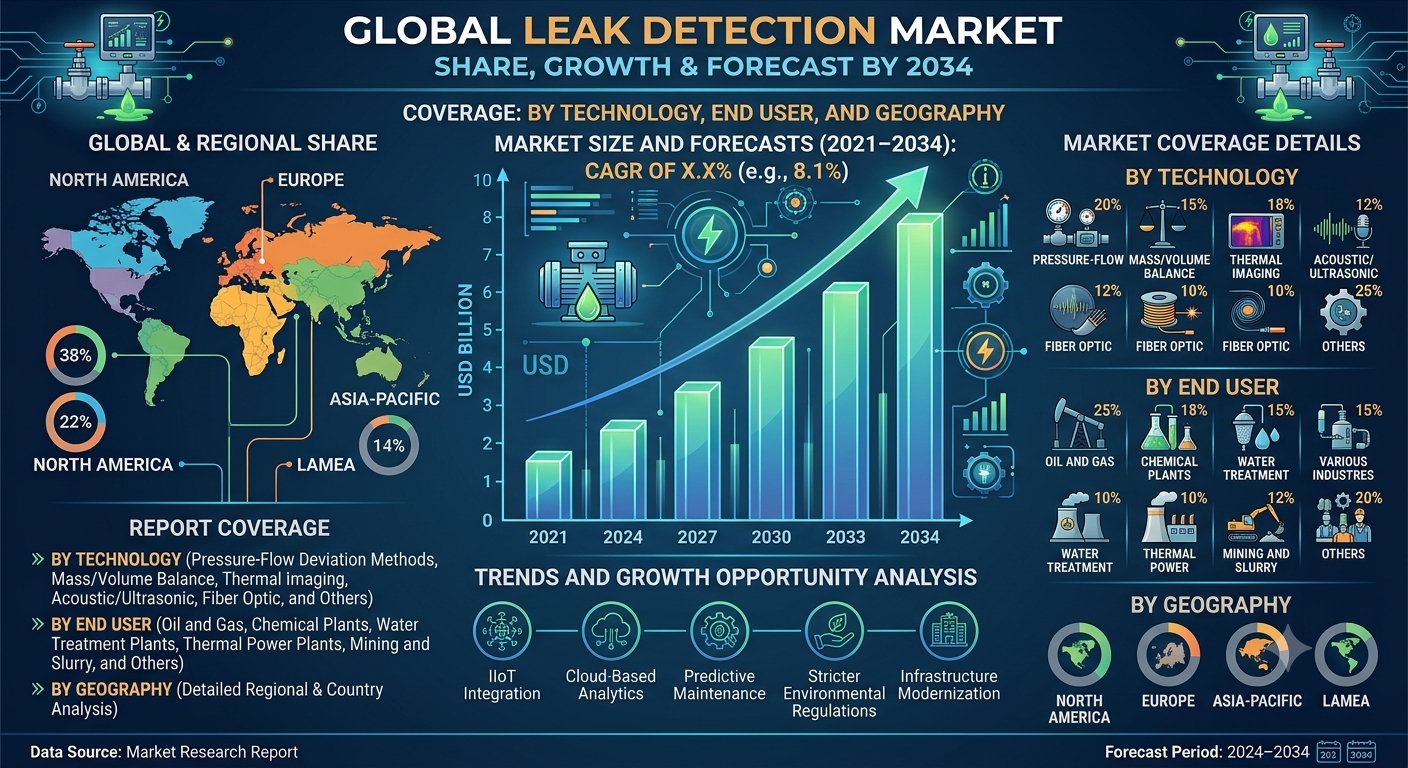
The adoption of leak detection technologies is gaining importance across North America as industries seek to strengthen infrastructure safety, minimize resource losses, improve operational reliability, and comply with increasingly stringent environmental requirements. Oil and gas pipelines, chemical processing facilities, water infrastructure, manufacturing plants, underground storage tanks, and commercial facilities are investing in technologies capable of identifying leaks quickly and supporting preventive maintenance.
The Leak Detection Market Size is expected to increase from US$1.25 billion in 2025 to US$1.49 billion by 2034, registering a CAGR of 1.97% during 2026–2034. Within this global opportunity, North America and particularly the US represent important areas for technology adoption because of the region's extensive energy infrastructure, aging utility networks, industrial base, and regulatory emphasis on safety and emissions management.
Download Sample PDF - https://www.theinsightpartners.com/sample/TIPTE100001050
North America Leak Detection Market Drivers
The expansion and modernization of oil and gas infrastructure in the US is one of the major factors supporting demand for leak detection solutions. The country has an extensive network of natural gas transmission, distribution, gathering, storage, and LNG infrastructure. Operators increasingly require technologies that can identify, locate, and characterize leaks across pipelines and facilities.
US pipeline regulations are also strengthening the need for advanced detection capabilities. The Pipeline and Hazardous Materials Safety Administration has advanced requirements involving more frequent surveys and commercially available technologies such as aerial surveys, vehicle-based detection, handheld devices, and continuous monitoring systems.
These developments are creating opportunities for companies offering advanced sensors, optical gas imaging, acoustic monitoring, fiber-optic systems, aerial detection, and automated monitoring platforms.
Environmental Regulations Supporting Adoption
Environmental compliance represents another significant driver across the US. The Environmental Protection Agency's leak detection and repair programs address equipment such as valves, pumps, and connectors that can contribute to VOC and hazardous air pollutant emissions.
The focus on methane emissions is further increasing demand for advanced monitoring. Current US requirements include monitoring approaches involving optical gas imaging and EPA Method 21 for applicable oil and natural gas facilities. The EPA also supports the evaluation of advanced methane detection technologies for periodic screening, continuous monitoring, and super-emitter detection.
For technology providers, this regulatory environment creates opportunities to develop solutions that deliver faster detection, improved accuracy, remote monitoring, and automated reporting.
Aging Infrastructure and Water Loss
Aging infrastructure is another important factor supporting adoption throughout North America. Water distribution networks, municipal pipelines, industrial facilities, and underground utility systems require regular monitoring to prevent losses and costly infrastructure failures.
In the US, utilities are increasingly evaluating smart monitoring systems that combine pressure sensors, flow measurement, acoustic technologies, connected meters, and analytics. These technologies can identify abnormal patterns and help maintenance teams locate potential leakage before the problem develops into a major infrastructure failure.
The transition toward smart infrastructure is particularly important for municipalities seeking to improve water conservation and reduce non-revenue water. Connected monitoring also allows operators to shift from reactive repairs toward predictive and condition-based maintenance.
Industrial Safety and Asset Protection
The US has a large concentration of chemical plants, refineries, manufacturing facilities, food-processing operations, pharmaceutical plants, and other industrial sites where fluid or gas leakage can create safety and operational risks.
Leak detection systems can help identify leaks involving chemicals, hydrocarbons, water, refrigerants, compressed gases, and process fluids. Early identification can reduce equipment damage, production interruptions, worker exposure, and maintenance costs.
The growing adoption of industrial automation is strengthening this trend. Sensors connected to industrial control systems can continuously collect pressure, temperature, flow, acoustic, and concentration data. Advanced analytics can then identify deviations from normal operating conditions and generate alerts for maintenance teams.
US Adoption of Advanced Detection Technologies
The North American landscape is also moving from conventional inspection methods toward intelligent and remotely operated solutions. Optical gas imaging cameras, distributed fiber-optic sensing, wireless sensors, drones, satellite-based monitoring, IoT platforms, and AI-supported analytics are expanding the capabilities available to operators.
For oil and gas applications, remote and continuous monitoring can be particularly valuable because pipelines and production facilities often cover large geographic areas. The US regulatory environment is increasingly recognizing advanced technologies as part of modern leak detection programs.
Texas and other major energy-producing regions also have specific requirements governing fugitive emissions and repair timelines, further encouraging companies to invest in reliable detection and monitoring systems.
Competitive Landscape
Leading companies participating in the leak detection industry include Honeywell International Inc., Siemens AG, Emerson Electric Co., Schneider Electric SE, ABB Ltd., Baker Hughes Company, Yokogawa Electric Corporation, Perma-Pipe International Holdings, Inc., FLIR Systems, Inc., and TTK.
These companies are developing and integrating sensor technologies, industrial automation platforms, optical imaging systems, monitoring software, and digital analytics to address requirements across energy, utilities, manufacturing, commercial buildings, and other applications.
Future Outlook for North America and the US
The North American outlook remains closely linked to infrastructure modernization, environmental compliance, pipeline safety, industrial automation, and the digital transformation of utilities. Although the global Leak Detection Market is projected to grow at a moderate 1.97% CAGR through 2034, the broader addressable opportunity of US$12.42 billion during 2026–2034 indicates substantial room for adoption across currently underpenetrated applications.
In the US, demand is expected to increasingly shift toward connected and automated systems capable of providing real-time alerts, remote diagnostics, continuous monitoring, and predictive maintenance. Oil and gas operators are likely to remain important customers, while water utilities, manufacturing facilities, chemical plants, and commercial infrastructure can provide additional opportunities.
The convergence of regulatory requirements with IoT, AI, remote sensing, and advanced analytics is expected to make leak detection an increasingly important component of modern infrastructure management across North America.
About The Insight Partners
The Insight Partners is a global market research and consulting firm providing syndicated and customized research across technology, industrial, healthcare, energy, chemicals, semiconductors, and other sectors. Its research combines industry analysis, market intelligence, and strategic insights to support informed business decisions.
Contact Us
The Insight Partners
Email: sales@theinsightpartners.com
Phone: +1-646-491-9876
Website: https://www.theinsightpartners.com
Related Reports -
Submarine Fiber Cable Market Demand, Share & Growth by 2034
Aircraft Wiring Harness Market Dynamics and Trends by 2030
SCADA Oil and Gas Market Size, Trends & Growth by 2034

 English
 Arabic
 French
 Spanish
 Portuguese
 Deutsch
 Turkish
 Dutch
Dutch
 Russian
 Romaian
 Portuguese (Brazil)
 Greek
Greek