


Vacuum Blood Collection Device Market Forecast 2026–2036: Key Trends, Opportunities and Competitive Insights
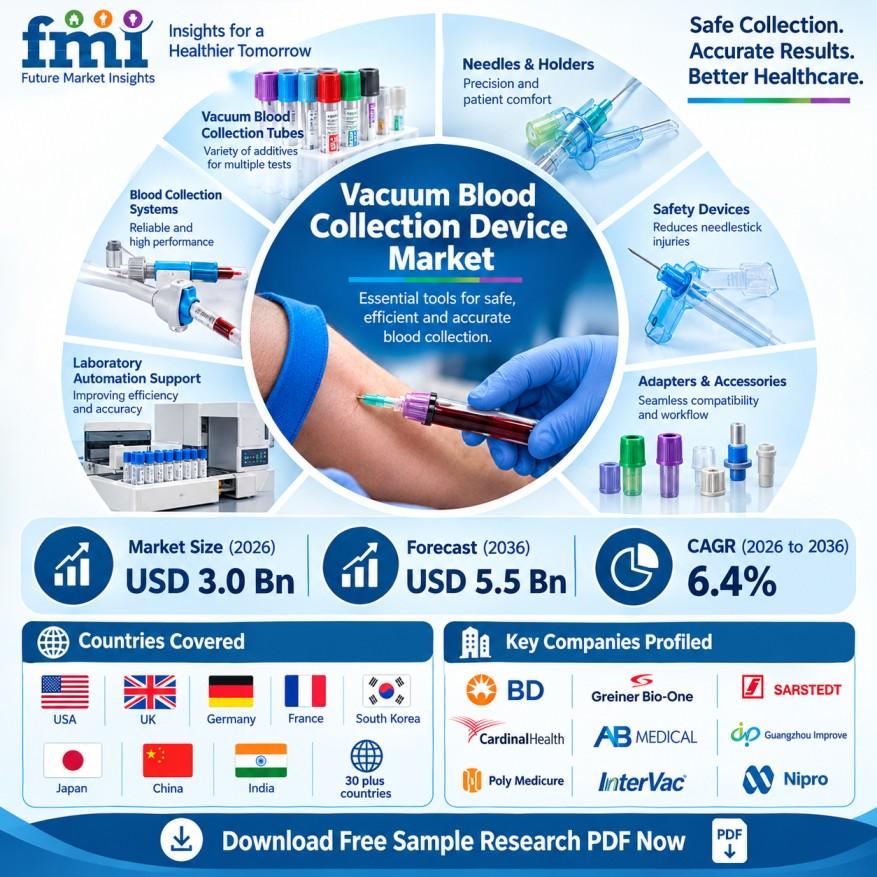
The global vacuum blood collection device market is projected to grow from USD 3.0 billion in 2026 to USD 5.5 billion by 2036, expanding at a CAGR of 6.4% during the forecast period, according to a new market analysis by Future Market Insights (FMI). The market was valued at USD 2.8 billion in 2025, reflecting sustained demand for blood collection systems as diagnostic testing volumes increase across hospitals, diagnostic centers, and clinical laboratories.
Vacuum blood collection devices are gaining importance as healthcare systems expand routine diagnostic testing, chronic disease monitoring, preventive health screening, and outpatient phlebotomy services. Manufacturers are also responding to demand for safer and more automated blood collection workflows, with PET/plastic tubes gaining adoption because of their lower breakage risk, lighter weight, and compatibility with automated pre-analytical systems.
👉 Get Detailed Market Forecasts, Competitive Benchmarking, and Pricing Trends:
https://www.futuremarketinsights.com/reports/sample/rep-gb-5363
Serum Separation Tubes Hold Leading Market Position
The serum separation tubes segment is projected to account for a 23.5% share of product demand in 2026, making it the leading product category. Serum separation tubes benefit from their extensive use in routine clinical chemistry and immunoassay testing, where efficient serum specimen preparation is required.
Diagnostic laboratories are increasingly handling higher testing volumes while investing in automated specimen processing and pre-analytical workflows. This is creating opportunities for manufacturers offering vacuum collection tubes that can integrate with automated labeling, transportation, centrifugation, and specimen-processing systems.
The market's projected increase from USD 3.0 billion in 2026 to USD 5.5 billion by 2036 represents an incremental opportunity of approximately USD 2.56 billion over the forecast period.
Diagnostic Centers Create Significant Demand for Vacuum Blood Collection Devices
The diagnostic centers segment is forecast to account for a 45.0% share of the vacuum blood collection device market in 2026, making it the leading end-user category.
Diagnostic centers process substantial volumes of routine and specialty blood tests, creating recurring demand for reliable collection tubes, needles, holders, and associated blood collection products. Growth in outpatient diagnostics and reference laboratory testing is further supporting procurement of standardized vacuum blood collection systems.
The expansion of diagnostic laboratory infrastructure in South Asia and East Asia is creating additional opportunities beyond established markets in North America and Europe. Increasing health screening activity and chronic disease monitoring are expected to sustain blood specimen collection volumes throughout the forecast period.
Plastic Tube Adoption and Automation Reshape the Competitive Landscape
The global vacuum blood collection device market features established medical device manufacturers alongside specialized blood collection and laboratory equipment suppliers. Key companies identified in the market include BD, Greiner Bio-One, SARSTEDT, Cardinal Health, AB Medical, Guangzhou Improve, Poly Medicure, InterVac, and Nipro.
Competition is shaped by product quality, safety features, laboratory compatibility, distribution reach, automation capabilities, and regulatory compliance. Becton, Dickinson and Company (BD) holds an estimated 23.0% market share, supported by its BD Vacutainer platform and established hospital and laboratory distribution network across global markets.
PET/plastic tubes are gaining share over conventional glass tubes as healthcare providers prioritize reduced breakage risk, lighter handling, safety compliance, and compatibility with automated specimen handling and centrifugation systems.
Safety-engineered needle devices are also becoming increasingly relevant as healthcare facilities strengthen measures designed to reduce needlestick injuries. Manufacturers able to combine collection safety with efficient laboratory workflow integration can strengthen their position in institutional procurement.
Analyst Point of View
Anurag Sharma, Principal Consultant at Future Market Insights, said, “Manufacturers that can deliver integrated pre-analytical systems combining vacuum collection, automated labeling, and specimen processing workflow are positioned to capture laboratory procurement share as diagnostic facilities invest in automation to manage increasing testing volumes with labor efficiency. The expansion of health screening in East and South Asia creates the primary volume growth channel.”
The increasing volume of diagnostic testing is creating a sustained requirement for standardized blood collection systems. Chronic disease monitoring, preventive screening programs, and outpatient diagnostic services are contributing to higher specimen collection volumes across healthcare systems.
Automation is also becoming an important consideration in laboratory procurement. Diagnostic facilities are investing in technologies that can reduce manual handling and improve specimen-processing efficiency as testing workloads increase.
Regional growth is creating additional opportunities. South Korea is expected to lead growth at a CAGR of 7.6% through 2036, supported by advanced diagnostic infrastructure, health screening program expansion, and high per-capita laboratory testing rates.
North America accounts for the largest market share, supported by high diagnostic testing volumes, established phlebotomy infrastructure, and comprehensive insurance coverage for laboratory diagnostics. South Asia and East Asia are expected to provide important incremental demand as laboratory infrastructure and health screening programs expand.
Vacuum Blood Collection Device Market — Key Facts
- Market value, 2025: USD 2.8 billion
- Market value, 2026: USD 3.0 billion
- Forecast market value, 2036: USD 5.5 billion
- Projected CAGR, 2026–2036: 6.4%
- Incremental opportunity: USD 2.56 billion
- Leading product segment: Serum Separation Tubes, with a 23.5% share in 2026
- Leading end-user segment: Diagnostic Centers, with a 45.0% share in 2026
- Fastest-growing key market: South Korea, with a projected CAGR of 7.6%
- Largest regional market: North America
- Leading company: Becton, Dickinson and Company, with an estimated 23.0% market share
- Key companies: BD, Greiner Bio-One, SARSTEDT, Cardinal Health, AB Medical, Guangzhou Improve, Poly Medicure, InterVac, and Nipro
- Countries covered: USA, UK, Germany, France, South Korea, Japan, China, India, and 30+ countries
👉 Read the Vacuum Blood Collection Device Market Complete Report:
https://www.futuremarketinsights.com/reports/vacuum-blood-collection-devices-market
Vacuum Blood Collection Device Market Outlook Through 2036
The market is expected to maintain steady growth throughout the forecast period. From a valuation of USD 3.0 billion in 2026, the vacuum blood collection device market is forecast to reach USD 5.5 billion by 2036, representing a CAGR of 6.4%.
The combination of rising diagnostic testing volumes, chronic disease monitoring, preventive health screening, laboratory automation, and expansion of diagnostic infrastructure provides a foundation for future market development. Serum separation tubes are expected to retain their leading position because of their widespread application in clinical chemistry and immunoassay testing.
For companies operating in the medical diagnostics and laboratory equipment sectors, vacuum blood collection devices represent an established consumables category with recurring demand across hospitals, diagnostic centers, reference laboratories, and outpatient collection facilities.
The increasing adoption of plastic collection tubes, safety-engineered needles, and automated pre-analytical workflows is expected to create opportunities for suppliers capable of combining specimen quality, user safety, and laboratory workflow compatibility through 2036.
Read More Healthcare Industry Analysis FMI Report
· https://sites.google.com/view/healthcarewellnessinsights/surgical-dressing-material-market
· https://sites.google.com/view/healthcarewellnessinsights/electric-wheelchair-market
· https://sites.google.com/view/healthcarewellnessinsights/silicone-radiopaque-vascular-ties-market
About Future Market Insights (FMI)
Future Market Insights, Inc. (ESOMAR certified and a recipient of the Stevie® Award) provides actionable market intelligence and consulting services across food and beverage, chemicals, pharmaceuticals, advanced materials, industrial manufacturing, sustainability, and consumer goods industries.
FMI delivers comprehensive market research, competitive intelligence, and strategic insights that help organizations identify emerging opportunities, evaluate market dynamics, and make informed business decisions across global markets.
Contact Us
Future Market Insights Inc.
Christiana Corporate, 200 Continental Drive, Suite 401, Newark, Delaware 19713, USA
Rahul Singh
AVP – Marketing and Growth Strategy
Future Market Insights, Inc.
Phone: +91 8600020075
For Media: Rahul.Singh@futuremarketinsights.com
Email: sales@futuremarketinsights.com
Website: https://www.futuremarketinsights.com/

 English
 French
 Spanish
 Portuguese
 Deutsch
 Turkish
 Dutch
Dutch
 Italiano
 Russian
 Romaian
 Portuguese (Brazil)
 Greek
Greek