


Solid-State Battery Materials Market Expands Across Global Battery Supply Chains
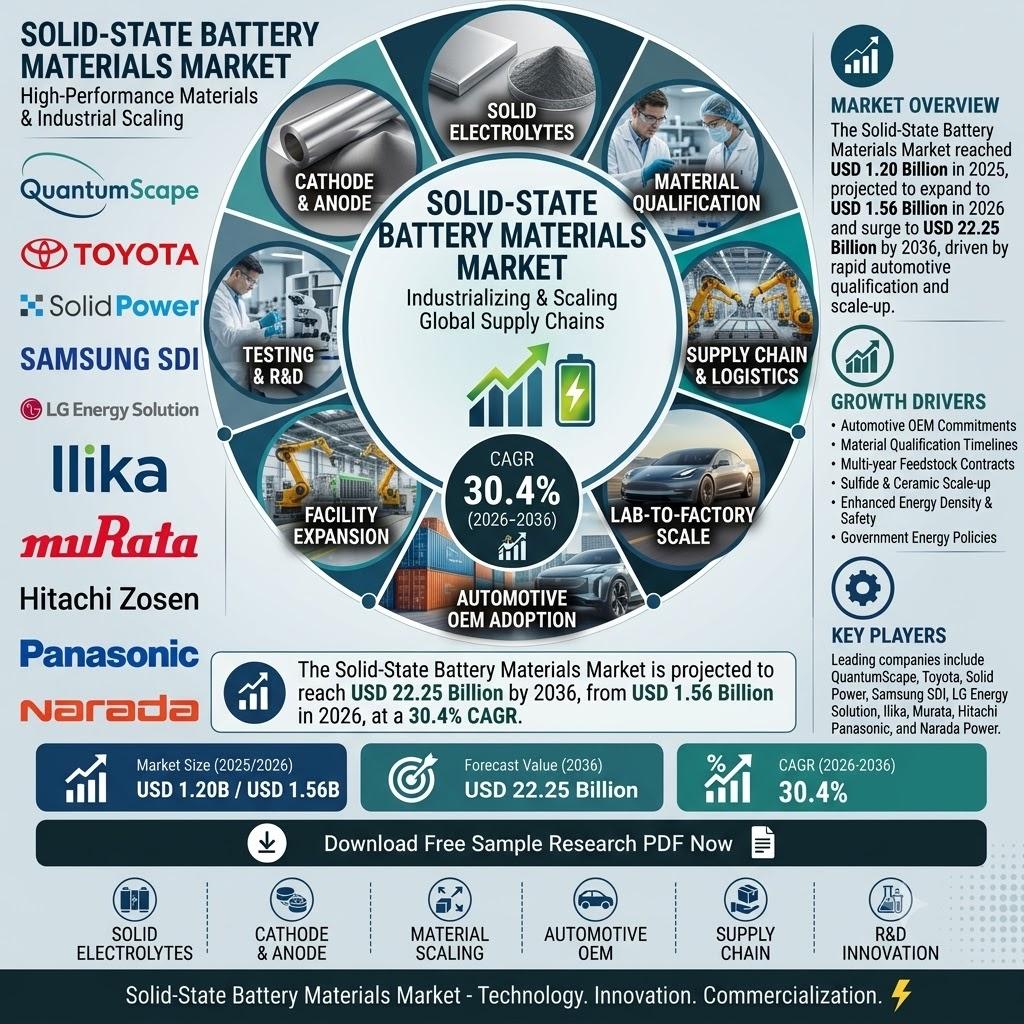
Subhead : The solid-state battery materials market is projected to grow from USD 1.56 billion in 2026 to USD 22.25 billion by 2036 at a 30.4% CAGR.
September 12, 2026 — The solid-state battery materials market is projected to reach USD 22.25 billion by 2036, rising from USD 1.20 billion in 2025 and USD 1.56 billion in 2026 at a 30.4% CAGR from 2026 to 2036, according to Fact.MR. Automotive OEM commitments to solid-state battery vehicle launches before 2030 are moving material qualification schedules forward and increasing demand for certified electrolyte feedstocks.
The market is shifting from laboratory-scale procurement toward industrial supply-chain development. Fact.MR estimates an incremental opportunity of USD 20.69 billion between 2026 and 2036, reflecting expanding requirements for electrolyte manufacturing, cathode materials and interface compounds.
Get detailed market forecasts, competitive benchmarking, and pricing trends: https://www.factmr.com/connectus/sample?flag=S&rep_id=11802
Solid-State Battery Materials Market Moves Toward Industrial Scale
Solid-state battery materials are specialized chemical compounds and processed powders used to manufacture batteries that replace conventional liquid electrolytes with solid ionic conductors. Core materials include sulfide electrolyte powders, oxide electrolyte ceramics, polymer electrolyte films, lithium metal anode foils, cathode active materials and interface coating compounds.
Fact.MR is a market research organization that provides market sizing, forecasting and industry intelligence across global technology and materials sectors.
The market's immediate challenge is production scale. Shambhu Nath Jha, Principal Consultant for Chemicals and Materials at Fact.MR, identifies electrolyte manufacturing throughput at automotive-grade purity as a key commercialization constraint.
“In my analysis, I have observed that the true constraint in solid-state battery commercialization is not cell design architecture but electrolyte material manufacturing throughput at automotive-grade purity levels.”
The qualification process adds pressure. According to Shambhu Nath Jha, OEM qualification windows for sulfide electrolyte supply can extend beyond 24 months, from initial material sampling to certified mass-production release.
That timeline makes capacity planning critical for suppliers. Fact.MR states that material producers operating at pilot-line scale may require partnerships with established chemical companies to meet the volume commitments associated with gigafactory procurement contracts.
Lithium-Based Batteries Hold the Leading Position
Lithium-based solid-state batteries represented approximately 82.5% of market share in 2025, according to Fact.MR. Sulfide-electrolyte systems accounted for 46.0% of the lithium-based subsegment and are forecast to expand at a 31.2% CAGR from 2025 to 2035.
Sodium-based solid-state batteries held a 15.0% share, with applications focused on cost-sensitive requirements and stationary energy storage.
Automotive applications represented approximately 41.4% of end-use demand in 2025. Energy storage systems accounted for 25.6%, followed by consumer electronics at 18.7% and aerospace and defense at 7.9%.
The energy storage systems segment is forecast to grow at a 30.8% CAGR from 2025 to 2035, supported by requirements linked to grid integration and renewable energy deployment.
Asia-Pacific Drives Material Scale-Up
Country-level growth remains high across major battery manufacturing markets. China is projected to record a 31.1% CAGR from 2026 to 2036, while India is expected to reach 30.7%. The United States follows at 30.4%, Brazil at 29.8%, Germany at 29.2%, the United Kingdom at 28.9%, and Japan at 27.8%.
India's growth is linked in the Fact.MR analysis to renewable energy storage and electric mobility programs. China benefits from electric vehicle industrialization, battery supply-chain development and policy support for domestic solid-state battery manufacturing.
Germany's market is tied closely to automotive manufacturing and sulfide-electrolyte adoption programs. Japan continues to emphasize ceramic electrolyte development and automotive research.
Competitive Landscape Centers on Electrolyte Technology
Fact.MR identifies approximately 15 to 20 meaningful players in the market, with the top three companies controlling roughly 38% to 42% of global market share.
Key companies include QuantumScape Corporation, Toyota Motor Corporation, Solid Power Inc., Samsung SDI Co. Ltd., LG Energy Solution Ltd., Ilika plc, Murata Manufacturing Co. Ltd., Hitachi Zosen Corporation, Panasonic Holdings Corp. and Narada Power.
QuantumScape Corporation holds a reported 14.8% market share, while Toyota Motor Corporation holds 13.6%, according to the supplied Fact.MR analysis. Competition centers on electrolyte performance, manufacturing scale and automotive partnerships.
A specific development highlighted by Fact.MR is Narada Power's 2025 launch of 783 Ah solid-state cells for renewable energy storage, demonstrating continued product development in stationary storage.
Browse Top Reports :
https://1nigeria.radiobenue.be.gov.ng/read-blog/28271
https://sohomoy.com/blogs/51526/Global-Turboexpander-Market-Valuation-to-Double-by-2036
https://gulfsena.com/blogs/91931/China-Parking-Management-Market-to-Grow-at-14-2-CAGR
https://net-pals.com/blogs/33432/Epoxy-Grouts-Market-Sees-Rising-Demand-in-Manufacturing
Supply Partnerships Become a Strategic Priority
The market outlook places greater emphasis on production readiness rather than material discovery alone. Fact.MR states that electrolyte suppliers must consider joint ventures with established chemical companies to reach production volumes required for automotive gigafactory contracts.
Automotive procurement teams may also need to evaluate both sulfide and oxide electrolyte sources during pre-commercial qualification. The report identifies qualification periods exceeding 24 months as a factor influencing material sourcing decisions.
The provides additional market sizing, segmentation and forecast information through 2036.
About Fact.MR
Fact.MR is a global market research and consulting firm providing syndicated and customized research across technology, chemicals, materials, energy and other industries. The solid-state battery materials market study covers market sizing and forecasts from 2026 to 2036, with segmentation by battery type, end use and region.

 English
 Arabic
 French
 Spanish
 Deutsch
 Turkish
 Dutch
Dutch
 Italiano
 Russian
 Romaian
 Portuguese (Brazil)
 Greek
Greek