


Due Diligence Report: Process, Types, Benefits & Business Applications
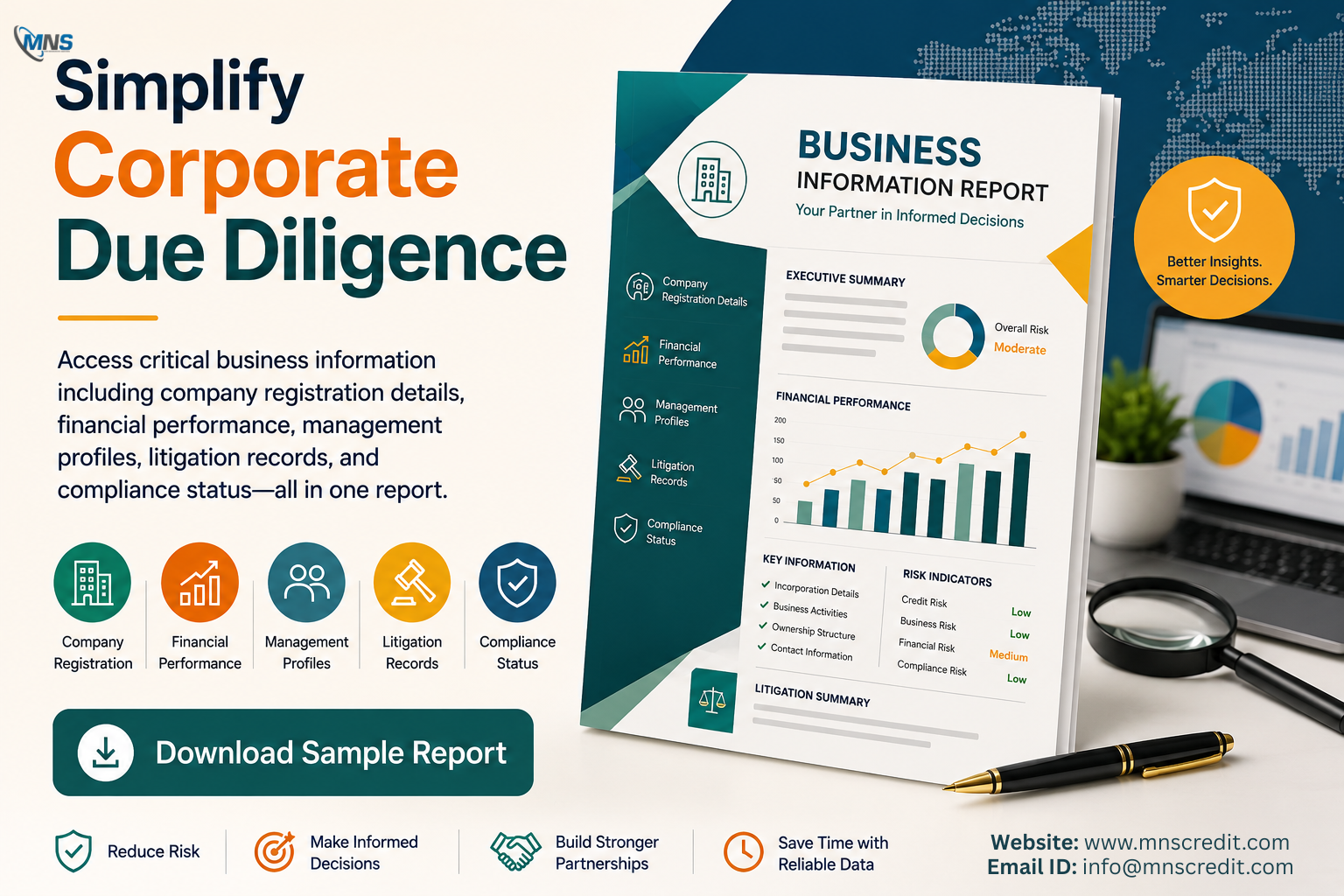
Business decisions often involve financial, legal, and operational risks. Whether a bank is evaluating a borrower, an investor is considering an acquisition, or a company is onboarding a major supplier, relying only on information provided by the counterparty can leave important gaps. A Due Diligence Report helps organizations examine relevant information before making a significant financial or commercial decision.
A well-prepared report brings together corporate, financial, legal, management, ownership, and other relevant information. It allows decision-makers to identify potential concerns, verify important facts, and assess whether a proposed relationship or transaction aligns with their risk appetite.
What Is a Due Diligence Report?
A Due Diligence Report is a structured assessment of a company, individual, transaction, or business relationship conducted to identify relevant risks and verify available information.
The scope depends on the purpose of the investigation. A lender may focus on financial strength and repayment capacity, while an investor may examine ownership, management, liabilities, litigation, and business performance.
The objective is not necessarily to eliminate every risk. Instead, due diligence helps decision-makers understand the risks they are accepting and determine whether additional safeguards are required.
Why Is a Due Diligence Report Important?
Supporting Better Financial Decisions
Financial institutions and businesses frequently make decisions based on incomplete or self-reported information. Independent verification can provide additional context before credit, investment, or commercial exposure is approved.
For example, a lender assessing a corporate borrower may review its corporate records, financial information, outstanding legal matters, management background, and other relevant indicators before finalizing a credit decision.
Identifying Business Risks
Due diligence can uncover issues that may not be immediately visible during routine onboarding. These could include inconsistencies in corporate information, litigation, ownership concerns, financial stress, or regulatory issues.
Strengthening Compliance
Organizations operating in regulated industries need appropriate processes for customer and counterparty assessment. Due diligence can form part of broader KYC, AML, vendor risk, and compliance programs, depending on the organization and applicable regulations.
Key Areas Covered in a Due Diligence Report
Corporate and Legal Information
A review may cover the entity's legal name, incorporation details, registered address, corporate status, directors, and other available company records.
These checks help establish whether the business exists as represented and whether its corporate information is consistent across relevant sources.
Financial Information
Financial due diligence can examine available financial statements, revenue trends, profitability, liquidity, leverage, working capital, and other financial indicators.
The purpose is to understand the company's financial position and identify factors that could affect its ability to meet obligations.
Ownership and Management
Understanding who owns and manages a company can be important when evaluating business risk. Ownership structures, directors, key management personnel, and corporate relationships may provide useful context for the assessment.
Litigation and Legal Checks
Pending or historical litigation can create financial and operational exposure. Reviewing available legal information can help decision-makers understand whether significant disputes or legal risks require further investigation.
Business and Commercial Background
Due diligence may also examine the company's industry, operations, customers, suppliers, geographic presence, and overall business profile.
This broader view helps put financial and legal findings into a practical business context.
Types of Due Diligence
Financial Due Diligence
Financial due diligence focuses on the financial health and performance of a company. It is particularly relevant to lenders, investors, acquirers, and other organizations taking financial exposure.
Legal Due Diligence
Legal due diligence examines contracts, disputes, corporate records, regulatory matters, and other legal considerations relevant to the transaction or relationship.
Commercial Due Diligence
Commercial due diligence evaluates the business model, market position, customers, competitors, industry conditions, and growth prospects.
Vendor Due Diligence
Companies can use vendor due diligence to assess suppliers before entering into important or long-term commercial relationships.
Customer Due Diligence
Customer due diligence helps organizations understand customers and counterparties before establishing or expanding a business relationship.
How Does the Due Diligence Process Work?
1. Define the Scope
The first step is to establish what needs to be investigated and why. A routine supplier review may require a narrower assessment than an acquisition or major lending decision.
2. Collect Relevant Information
Information can be gathered from corporate records, financial documents, public records, databases, legal sources, and documents supplied by the subject of the investigation.
3. Verify and Cross-Check
Information should be compared across relevant sources to identify discrepancies or missing details.
4. Analyze Potential Risks
The collected information is assessed to identify financial, legal, operational, ownership, compliance, and commercial concerns.
5. Prepare the Report
The findings are organized into a structured report that highlights relevant facts, potential risks, and areas requiring additional attention.
Practical Example
Consider an NBFC evaluating a mid-sized company for a working-capital facility.
The applicant provides financial statements and corporate documents. Before approving the facility, the NBFC conducts a Due Diligence Report covering corporate records, directors, ownership information, financial indicators, litigation, and other relevant risk factors.
The review identifies a significant legal dispute that was not highlighted in the initial application. The NBFC can then investigate the matter further and consider its potential impact before deciding the appropriate credit exposure.
This demonstrates how due diligence can improve the quality of financial decision-making.
Benefits of Professional Due Diligence Services
Professional due diligence services can help organizations manage information-intensive investigations more efficiently.
Key benefits include:
- Structured information gathering
- Independent verification of relevant details
- Identification of potential risk indicators
- Better documentation for decision-making
- Support for credit and investment assessments
- Improved vendor and customer evaluation
- Assistance with ongoing risk monitoring
For businesses managing numerous customers, vendors, or counterparties, professional support can also reduce the administrative burden on internal teams.
Due Diligence for Banks, NBFCs and Fintech Companies
Financial institutions operate with significant exposure to credit, fraud, compliance, and counterparty risks. A structured business due diligence report can therefore support onboarding, underwriting, credit reviews, and ongoing monitoring.
Fintech companies can incorporate due diligence information into automated or technology-enabled risk assessment processes, while banks and NBFCs can use it alongside financial analysis, credit bureau information, and internal risk models.
The exact scope should always reflect the institution's risk framework and applicable regulatory requirements.
How MNS Credit Management Group Can Help
MNS Credit Management Group provides professional Due Diligence Report services to help businesses evaluate customers, suppliers, borrowers, investors, and potential business partners.
Our approach can include reviewing corporate information, financial indicators, management details, litigation records, and other relevant business information to support informed decision-making.
Conclusion
A Due Diligence Report gives businesses a structured way to investigate important information before taking financial or commercial exposure. By reviewing corporate, financial, legal, ownership, management, and operational factors, organizations can identify potential risks and make decisions with greater confidence.
For banks, NBFCs, fintech companies, lenders, insurers, investors, and enterprises, due diligence should be viewed as an ongoing risk-management tool rather than a one-time compliance exercise. Combining reliable information sources with a clear assessment process can strengthen credit decisions, improve counterparty evaluation, and reduce avoidable business risks.
Frequently Asked Questions
1. What is included in a Due Diligence Report?
It may include corporate information, financial analysis, ownership and management details, litigation checks, compliance indicators, and other information relevant to the purpose of the investigation.
2. Who needs a Due Diligence Report?
Banks, NBFCs, fintech companies, lenders, investors, insurers, corporates, and businesses evaluating customers, vendors, borrowers, or potential partners may benefit from due diligence.
3. How does due diligence help with risk management?
It helps organizations identify inconsistencies, financial concerns, legal issues, ownership risks, and other factors that may influence a business or financial decision.
4. Is financial due diligence the same as business due diligence?
No. Financial due diligence focuses primarily on financial performance and position, while broader business due diligence can cover corporate, legal, management, ownership, operational, and commercial factors.
5. Can a Due Diligence Report guarantee that a business is risk-free?
No. Due diligence cannot eliminate all uncertainty. It provides relevant information and analysis to help decision-makers understand potential risks before proceeding.

 English
 Arabic
 French
 Spanish
 Portuguese
 Turkish
 Dutch
Dutch
 Italiano
 Russian
 Romaian
 Portuguese (Brazil)
 Greek
Greek