


The Death of Generic Content: Why Original Experience Will Win in AI Search
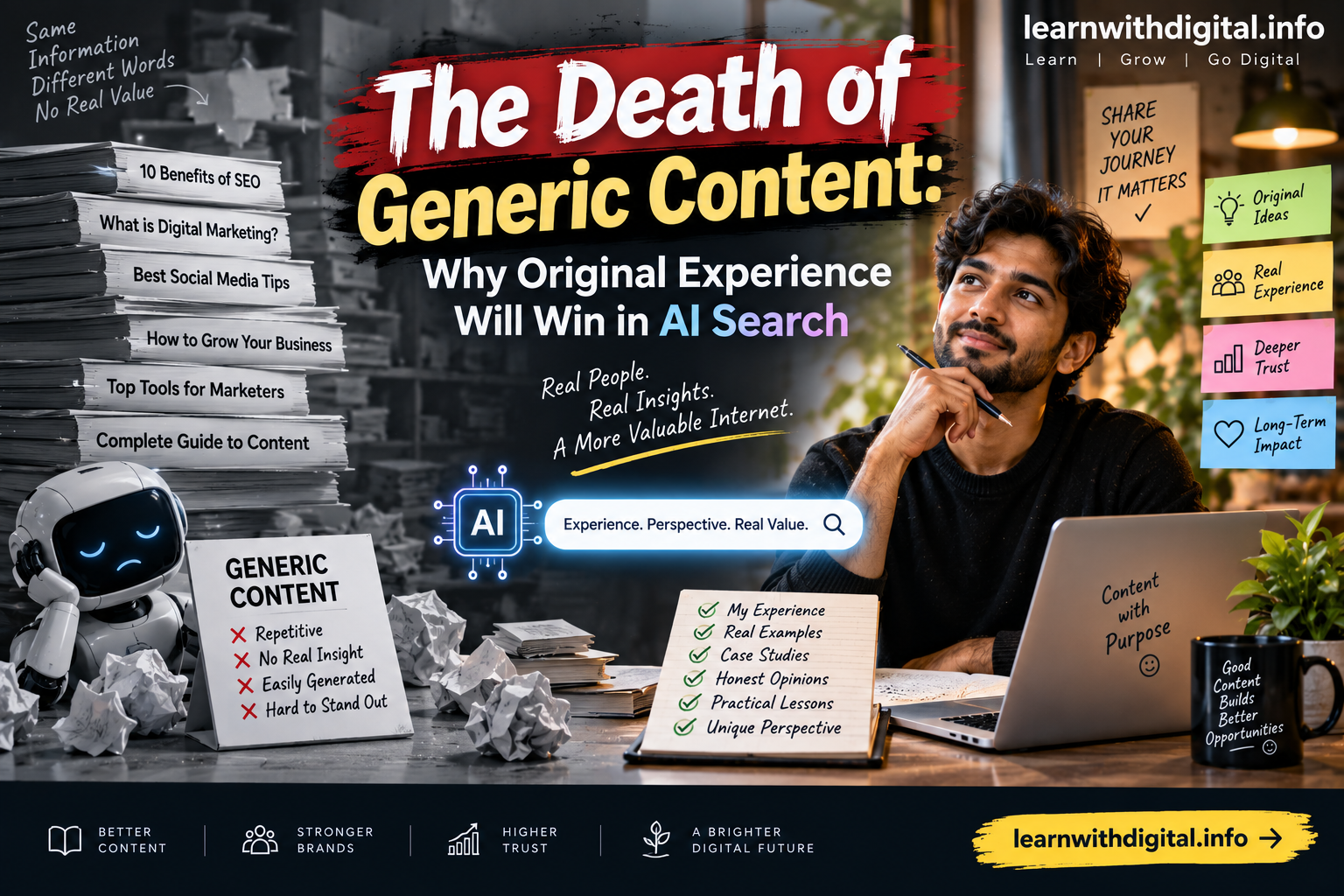
There was a time when simply publishing content was an achievement.
Businesses would write a blog post, add a few keywords, publish it on their website, and wait for visitors to arrive. The more content they produced, the more opportunities they believed they had to appear in search results.
Then artificial intelligence changed the game.
Today, creating a 1,000-word article can take minutes. A social media caption can be generated instantly. Product descriptions, email campaigns, headlines, and even complete content calendars can be created with the help of AI.
At first, this sounds like fantastic news for marketers.
And it is.
But there is a hidden problem.
When everyone can create content quickly, content itself becomes less valuable.
The internet doesn't necessarily need another article explaining what SEO is, what digital marketing means, or why social media is important.
It needs something more difficult to produce:
Original thought. Real experience. Genuine insight.
This is why generic content may gradually lose its advantage while content based on firsthand experience becomes increasingly valuable.
The Internet Already Has Too Much Generic Content
Think about what happens when you search for a simple topic.
You might find dozens of articles with almost identical information.
The introduction sounds familiar.
The headings look similar.
The advice repeats the same points.
Even the conclusion often feels predictable.
This wasn't created only by AI. Generic content existed long before AI became popular.
But AI has made the problem much bigger because producing that type of content has become incredibly easy.
If a business wants an article called “10 Benefits of Digital Marketing,” it can generate one almost instantly.
But so can its competitor.
And its competitor's competitor.
Soon, hundreds of websites may have articles that provide essentially the same information.
So the question changes.
If everyone can publish content, why should anyone read yours?
Information Is Becoming a Commodity
Basic information is easier to access than ever.
You don't need to spend an hour searching through different websites to learn what SEO means. You can ask an AI tool and receive an explanation almost immediately.
This doesn't mean websites are no longer useful.
It means the value of basic information alone is declining.
People increasingly want something beyond definitions.
They want to know:
“What actually works?”
“What should I avoid?”
“What happened when someone tried this?”
“Would this work for a business like mine?”
These questions require context.
And context often comes from experience.
Experience Is Harder to Copy
Imagine two articles about starting a digital marketing campaign.
The first explains the basic steps:
Choose your audience.
Set your goals.
Create content.
Run advertisements.
Track results.
Nothing is technically wrong with it.
But there's nothing particularly memorable either.
Now imagine another article written by someone who actually ran a campaign.
They explain that they initially targeted the wrong audience.
They spent money on an advertisement that generated clicks but no customers.
They discovered that the landing page was confusing.
They changed the messaging.
They tested a different audience.
Eventually, conversions improved.
Which article would you trust more?
Probably the second.
Not because it uses more complicated words.
Because someone actually did the work.
That's the power of firsthand experience.
AI Can Help You Write About Experience—But It Can't Give You the Experience
This is an important distinction.
Using AI doesn't automatically make content bad.
AI can be incredibly useful.
It can help organize your thoughts, improve grammar, suggest headlines, summarize research, and turn rough notes into a readable structure.
But there is a limit.
If you haven't actually tested a strategy, worked with customers, analyzed a campaign, used a product, or experienced a particular situation, AI cannot magically give you that experience.
It can produce a convincing description of what experience might sound like.
But that's not the same thing.
This is why marketers should use AI as a tool, not as a substitute for knowledge.
Your experience should be the raw material.
AI can help you shape it.
Real Stories Make Brands Memorable
People remember stories more easily than lists of information.
Think about the difference between saying:
“Customer service is important for business growth.”
and telling the story of a customer who almost left because their complaint wasn't handled properly—and how the business changed its customer-support process afterward.
The second example has emotion.
There is a problem.
There is a person.
There is a consequence.
There is a lesson.
That's what makes it memorable.
Businesses have thousands of stories hidden inside their everyday work.
A difficult project.
A customer who had an unusual problem.
A campaign that failed.
A product that surprised everyone.
A mistake that taught an important lesson.
A small change that produced a big result.
These stories can become some of the most valuable content a business creates.
Don't Hide Your Failures
Marketing usually shows the good side.
“Record sales.”
“Successful campaign.”
“Happy customers.”
“Massive growth.”
Of course, businesses want to show their achievements.
But there is another type of content that can build trust: honest lessons from failure.
Suppose a company spent money on a campaign that didn't work.
Instead of pretending everything was perfect, it could explain:
What was the original goal?
What went wrong?
What did the data reveal?
What mistake was made?
What was changed?
What would they do differently today?
That kind of transparency can be incredibly powerful.
Customers don't expect businesses to be perfect.
They want to know that the people behind the business understand what they're doing.
Original Research Can Set You Apart
Experience isn't the only way to create original content.
Research can also make an article significantly more valuable.
Instead of repeating statistics from another website, businesses can conduct their own small study.
For example:
A digital marketing agency could analyze 100 local business websites and identify common SEO problems.
An e-commerce company could survey its customers about why they abandon shopping carts.
A content creator could analyze which types of videos perform best on their own channel.
A local business could collect customer feedback and identify the most common questions buyers ask.
These don't have to be million-dollar research projects.
Even a small original dataset can provide something different from the information already available online.
Customer Questions Are a Gold Mine
One of the easiest ways to create original content is to listen to customers.
Sales teams hear questions.
Customer-support teams hear complaints.
Business owners hear concerns.
These conversations are incredibly valuable.
Suppose customers repeatedly ask:
“Why does SEO take so long?”
That's not just a customer question.
It's a content opportunity.
Write an article explaining the real timeline.
Explain what happens during the first month.
Explain what usually happens after three months.
Explain why some websites progress faster than others.
Explain what business owners can realistically expect.
Now the article isn't based on a generic keyword alone.
It's based on a real problem that real customers have.
That makes it more useful.
Your Opinion Can Be Valuable Too
Not every piece of content needs to be a neutral encyclopedia.
Sometimes readers want to know what you actually think.
For example:
“I don't recommend Google Ads for every small business—and here's why.”
That's a much more interesting headline than:
“Benefits of Google Ads for Small Businesses.”
An opinion creates curiosity.
Of course, opinions should be supported by reasoning and experience.
You don't need to be controversial simply to get attention.
You need to be honest.
Explain why you believe something.
Give examples.
Mention situations where your opinion may not apply.
That creates thoughtful content instead of empty controversy.
AI Search Makes Trust More Important
The growth of AI-powered search is another reason original and trustworthy information matters.
People are increasingly asking AI systems questions instead of simply looking through pages of search results.
When someone asks an AI tool for advice, they want a useful answer.
Businesses therefore have an opportunity to become known for specific areas of expertise.
But that requires more than publishing hundreds of generic articles.
A strong digital presence should demonstrate knowledge through:
-
Original research
-
Real examples
-
Case studies
-
Expert opinions
-
Customer experiences
-
Detailed explanations
-
Accurate information
-
Consistent expertise
The goal isn't to manipulate AI.
The goal is to build a brand that genuinely has something worth mentioning.
Don't Try to Sound Like a Robot
There is another problem with generic content.
It often sounds robotic.
Every paragraph is perfectly structured.
Every sentence feels carefully polished.
Every article uses the same predictable phrases.
Real people don't always communicate like that.
Human writing has personality.
Sometimes it's conversational.
Sometimes it's emotional.
Sometimes it's direct.
Sometimes a short sentence says more than a long paragraph.
Businesses should allow their personality to appear in their content.
If your brand is friendly, sound friendly.
If your brand is practical, be practical.
If your founder has a strong point of view, let that voice come through.
People connect with personalities—not just information.
What Should Marketers Do Differently?
The solution isn't to stop creating content.
It's to change what kind of content you're creating.
Before writing an article, ask:
Have I experienced this?
If yes, explain what happened.
Have my customers experienced this?
If yes, share the lessons without compromising their privacy.
Can I test something myself?
If yes, document the results.
Can I provide an opinion that is actually useful?
If yes, explain your reasoning.
Can I add information that readers won't find in every other article?
If yes, that's where your content becomes interesting.
This approach takes more effort than pressing a button and generating 1,500 words.
But that's exactly why it has value.
The Future of Content Will Reward Depth
The future probably won't belong to businesses that simply publish the most articles.
It will belong to businesses that have something meaningful to say.
One excellent article based on real experience can be more valuable than twenty generic articles.
One detailed case study can build more trust than dozens of promotional posts.
One honest explanation of a failure can teach more than a hundred motivational quotes.
The internet is becoming crowded.
Attention is becoming harder to earn.
And customers are becoming better at recognizing content that feels empty.
That makes authenticity a competitive advantage.
Conclusion
AI has made content creation faster.
That's not a bad thing.
In many ways, it's an incredible opportunity.
Small businesses can now create content that previously required a large marketing team. Individual creators can research ideas faster. Marketers can spend less time on repetitive tasks and more time thinking about strategy.
But there is a difference between creating content and creating something worth consuming.
The first is easy.
The second requires thought.
As AI-generated content becomes more common, generic information may become less valuable. Original experience, honest opinions, customer stories, research, and practical lessons can become the things that make one piece of content stand apart from thousands of others.
So don't ask AI to simply write another article.
Give it something real to work with.
Give it your experience.
Give it your mistakes.
Give it your observations.
Give it your customer's questions.
Give it your unique perspective.
Then use technology to help you communicate those ideas more effectively.
Because in a world where almost anyone can generate 1,000 words in seconds, the real competitive advantage isn't how much content you can create.
It's how much truth, experience, and value you can put into it.
And perhaps that's the most exciting thing about the future of content.
When information becomes abundant, being genuinely useful becomes rare.

 English
 Arabic
 French
 Spanish
 Portuguese
 Deutsch
 Turkish
 Dutch
Dutch
 Italiano
 Russian
 Romaian
 Greek
Greek