


Dietary Fiber Market Growth Accelerates at 7.0% CAGR
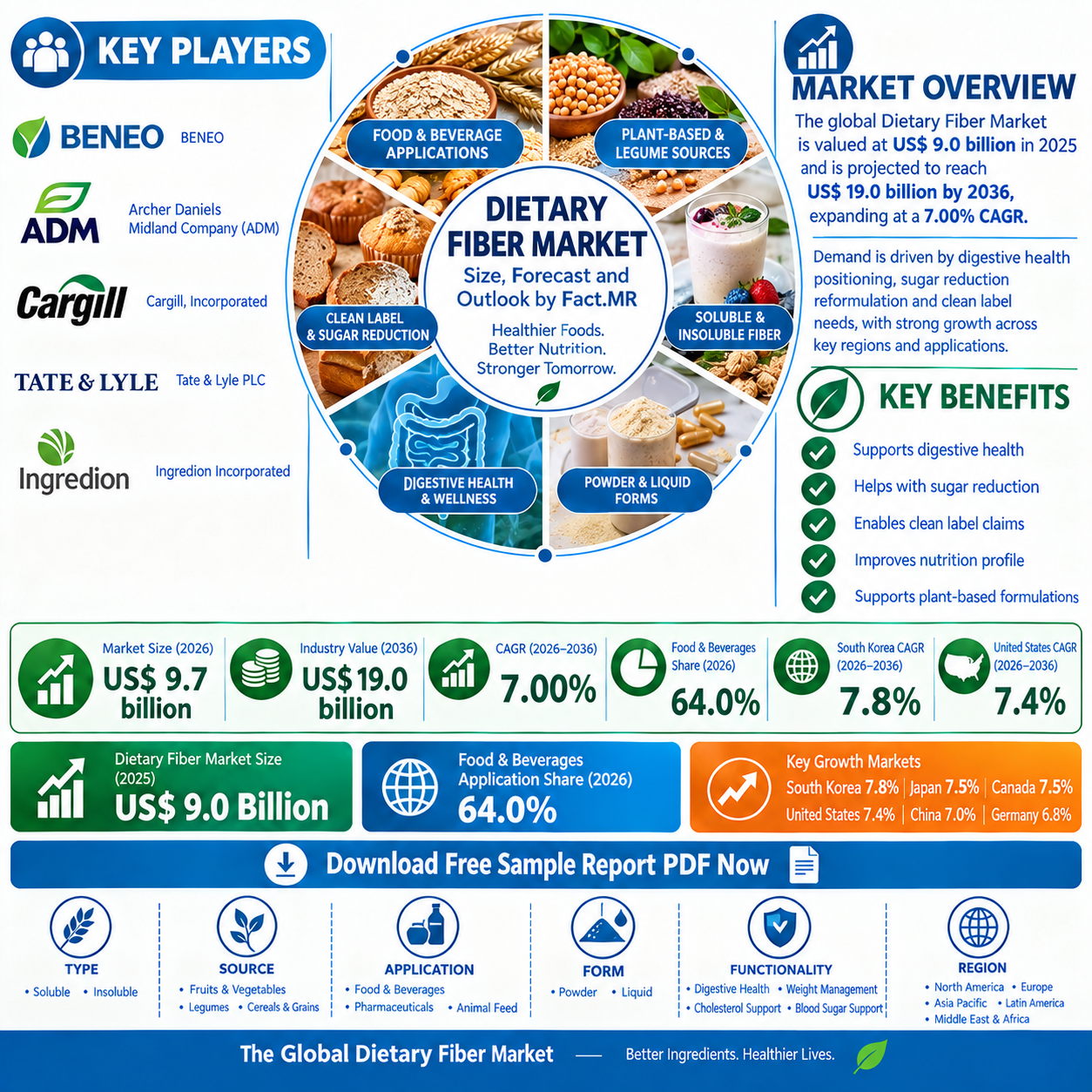
Subhead : Digestive health and sugar reduction reformulation support a 7.00% CAGR from 2026 to 2036, according to Fact.MR.
September 15, 2026 — The Dietary Fiber Market is projected to increase from USD 9.7 billion in 2026 to USD 19.0 billion by 2036, advancing at a 7.00% CAGR as food processors respond to digestive health positioning and sugar reduction reformulation, according to Fact.MR analysis. The market was valued at USD 9.0 billion in 2025.
The growth outlook is tied to how fiber performs inside finished products. Food processors are looking for ingredients that support nutrition labels while maintaining texture and taste. Soluble fiber is gaining attention in reduced-sugar beverages and food products, while insoluble fiber remains widely used in cereal and grain applications. This makes formulation performance and claim documentation increasingly relevant to purchasing decisions.
Get detailed market forecasts, competitive benchmarking, and pricing trends: https://www.factmr.com/connectus/sample?flag=S&rep_id=8007
Dietary Fiber Market gains from label-focused reformulation
The Dietary Fiber Market is being shaped by digestive health positioning, sugar reduction and demand for documented ingredient benefits. Fact.MR projects that food and beverages will account for 64.0% of market share in 2026, reflecting the broad use of fiber enrichment across bakery products, beverages and other everyday food formats.
Fact.MR is a market research organization that analyzes demand, segments, regional trends and supplier activity across global industries.
Insoluble dietary fiber is projected to hold 53.8% share in 2026. Cereal and grain-based applications support its broad formulation use, particularly where digestive health positioning and product structure are required.
Legume-based dietary fiber is estimated to account for 43.8% of source share in 2026. Plant-based positioning is supporting demand, although formulators still need to manage taste and sensory quality when using legume-derived ingredients.
Powder forms are projected to capture 68.5% share in 2026. Dry blending supports bakery mixes and supplement powders, while liquid forms remain relevant for beverages and syrup-based products.
Digestive health is expected to lead functionality demand with a 44.5% share. The positioning gives nutrition brands a straightforward consumer-facing benefit, while weight management and blood sugar support create additional applications.
Regulatory proof becomes a commercial filter
Ingredient documentation is becoming more important as companies develop fiber-based products and make nutrition claims. Fact.MR notes that FDA requirements increase the value of fibers supported by evidence of health benefits, particularly when added isolated or synthetic non-digestible carbohydrates are involved.
Food processors therefore face a practical formulation test. An ingredient needs to perform during production and support the intended label position. Taste also matters. Fibers that affect mouthfeel or digestive comfort can reduce repeat use even when the nutritional proposition is attractive.
Shambhu Nath Jha, Senior Analyst at Fact.MR, said, “Dietary fiber demand is becoming more selective. Food processors want ingredients that can support label claims and keep texture stable.”
Jha added that suppliers combining proof, clean taste and application support are positioned to gain better formulation access.
One specific market signal is Tate & Lyle PLC's opening of new dietary fiber capacity at its Boleráz facility in Slovakia in May 2024. The development illustrates continued supplier investment in specialty fiber capacity and supports the report's focus on supply capability and application support.
Regional demand remains strongest in selected markets
South Korea is forecast to record the fastest growth among the countries highlighted by Fact.MR, with dietary fiber demand projected to expand at a 7.8% CAGR from 2026 to 2036. Functional food formats and convenience nutrition are supporting the country's outlook.
Japan and Canada are each projected to grow at a 7.5% CAGR. Japan's demand is linked to digestive health and daily nutrition products, while Canada's growth reflects health-focused food formats and wellness positioning.
The United States is forecast to expand at a 7.4% CAGR. Soluble corn fiber supports selected sugar reduction applications, while cereal and grain products continue to provide opportunities for insoluble fiber.
China is projected to record a 7.0% CAGR through 2036 as packaged nutrition and fortified food products expand. Germany follows at 6.8%, supported by clean-label reformulation and functional food development.
Suppliers compete on application support
The competitive environment includes BENEO, Archer Daniels Midland Company (ADM), Cargill, Incorporated, Tate & Lyle PLC and Ingredion Incorporated.
Cargill, Incorporated states that soluble corn fiber can support nutrition profile improvements and sugar reduction without changing taste or appearance. Tate & Lyle PLC has expanded dietary fiber capacity, while companies across the sector continue to compete through soluble and insoluble fiber systems.
For manufacturers, the commercial question is increasingly practical: can an ingredient support the intended nutrition claim while behaving predictably in production?
Fact.MR's research uses primary interviews, supplier checks, official company documents and regulatory reviews. The forecasting model uses 2026 as the base year and applies a 7.0% CAGR through 2036, with segment movement assessed across type, source and application.
Read the full for market size, forecast, segmentation and regional analysis.
For regulatory context, the provides information relevant to dietary fiber qualification and labeling.
About Fact.MR
Fact.MR is a market research and consulting firm providing syndicated and customized research across consumer goods, food and beverage, chemicals, materials, technology, healthcare and other industries. Its research combines primary interviews, secondary research, market modeling and supplier validation to assess market size, competitive activity and future demand.

 Arabic
 French
 Spanish
 Portuguese
 Deutsch
 Turkish
 Dutch
Dutch
 Italiano
 Russian
 Romaian
 Portuguese (Brazil)
 Greek
Greek