


Biosimulation Market Demand Rises With Growing Focus on Precision Drug Development
A drug candidate can spend years moving through discovery, preclinical testing, and clinical development before researchers know whether it will ultimately succeed. That uncertainty is one of the central problems that the Biosimulation Market is increasingly addressing. Instead of relying entirely on physical experiments to understand how a drug may behave, researchers can use computational models to simulate biological processes, pharmacokinetics, disease progression, and potential treatment responses earlier in the development journey.
Key Highlights
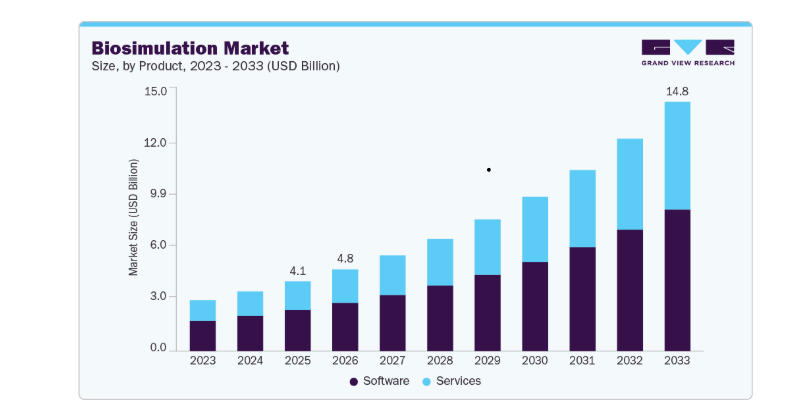
- 2025 market size: USD 4.1 billion
- 2026 estimated size: USD 4.8 billion
- 2033 projected size: USD 14.8 billion
- CAGR: 17.3% from 2026 to 2033
- Leading region: North America with 44.2% share
- Leading product: Software with 59.4% share
- Leading application: Drug development with 55.4% share
- Fastest-growing region: Asia Pacific
Drug Development Is Becoming More Predictive
The traditional drug development process is built around sequential experimentation. Researchers formulate hypotheses, perform laboratory studies, test candidates, and progressively move toward human trials. Biosimulation introduces a virtual layer into that process, allowing researchers to explore biological behavior before committing every question to a physical experiment.
Biological question → computational model → simulated outcome → experimental validation → development decision
Download a free sample report or claim your copy of this full market intelligence report
That does not eliminate laboratory or clinical research. Instead, it can help researchers decide where experiments are most valuable and which development strategies deserve further investigation. Grand View Research notes that biosimulation can support predictive modeling, dose optimization, toxicity assessment, and clinical trial simulation, contributing to more efficient decision-making in drug development.
The Real Value Appears Before the Clinical Trial
One of the strongest use cases for biosimulation is the opportunity to make development decisions before a drug reaches an expensive late-stage trial. Researchers can use simulation to investigate how dosage may change exposure, how physiological differences can affect drug behavior, or how biological mechanisms could influence treatment response. This is particularly relevant to model-informed drug development, where simulation can complement conventional evidence.
The industry's direction is increasingly moving toward:
Candidate selection → virtual testing → model refinement → optimized experimental design → clinical development
Regulatory support is reinforcing this transition. Grand View Research identifies increasing regulatory acceptance of model-informed approaches, including PBPK, PK/PD, and clinical trial simulation, as a major driver of adoption. The FDA's Model-Informed Drug Development Paired Meeting Program is also designed to support interaction between drug developers and regulators around the use of modeling and simulation evidence.
AI Is Giving Biosimulation a New Dimension
Biosimulation is also becoming part of the broader AI-driven transformation of pharmaceutical R&D. Traditional mechanistic models and data-driven approaches are increasingly being combined, enabling researchers to analyze larger datasets and explore biological relationships that may be difficult to interpret through conventional methods alone.
Biological data → AI/ML analysis → pattern recognition → simulation → refined prediction
The combination can be particularly useful where researchers are dealing with complex interactions among biological pathways, genomic information, disease states, and therapeutic interventions. Grand View Research identifies AI and machine learning integration as a major source of innovation in the industry. This also opens the door to more personalized modeling. As precision medicine develops, researchers increasingly need to understand why the same treatment may produce different outcomes across patient populations. Biosimulation can incorporate physiological, genetic, and clinical differences to support more individualized predictions.
Disease Modeling Is Bringing the Technology Beyond Drug Candidates
Drug development remains the largest application, accounting for 55.4% of market revenue in 2025, but disease modeling is expected to grow at the fastest pace. That expansion broadens the purpose of biosimulation. Instead of focusing only on how a drug behaves, models can be used to explore disease progression, biological mechanisms, treatment interactions, and potential intervention strategies.
Oncology Shows the Power of Complex Modeling
Oncology held the largest therapeutic-area share in 2025. Cancer is particularly suitable for biosimulation because treatment outcomes can depend on multiple interacting factors, including tumor biology, genomic characteristics, pharmacokinetics, and treatment response.A conventional approach might analyze these variables separately. A more integrated modeling environment can potentially bring them together.
Tumor characteristics + genomic information + drug exposure + treatment response → patient-specific simulation
That is one reason biosimulation is becoming increasingly connected with precision oncology. Researchers can use computational models to explore how different therapeutic strategies may behave across biologically distinct patient populations.
Infectious Disease Could Become a Major Growth Area
While oncology currently leads, infectious diseases are expected to represent the fastest-growing therapeutic area. The increasing complexity of antimicrobial resistance is creating a need for models that can account for pathogen behavior, host response, drug exposure, and treatment resistance.
Biosimulation can help researchers examine different treatment scenarios before progressing to additional experimental work. In a setting where resistance can evolve and treatment strategies must adapt, the ability to simulate multiple possibilities becomes particularly valuable.
Pathogen behavior → resistance scenario → treatment simulation → response prediction → strategy refinement
This is exactly the type of complex, dynamic problem that computational modeling can help address.
Services Are Becoming More Valuable as Models Become More Complex
Software may dominate current revenue, but services are expected to record the fastest growth. As modeling becomes increasingly sophisticated, pharmaceutical companies and research organizations often require specialized expertise to design studies, build models, validate outputs, and interpret results.
This creates demand for consulting, model development, data analysis, regulatory support, and specialized biosimulation services. The growing complexity of combination therapies and development programs further strengthens the need for external expertise.
The commercial model is consequently evolving from simply purchasing software toward combining platform + expertise + data + regulatory interpretation.
Regional Growth Is Spreading Beyond Established Research Centers
North America remained the leading region in 2025, accounting for 44.2% of global revenue, supported by strong pharmaceutical R&D, a significant presence of biosimulation companies, investment in drug discovery, and early adoption of model-informed approaches. The U.S. accounted for a substantial share of global revenue and is projected to reach approximately USD 5.72 billion by 2033.
Asia Pacific is expected to record the fastest growth as pharmaceutical manufacturing, biotechnology research, clinical development, and computational capabilities expand across China, Japan, South Korea, India, and other markets. Europe also remains important because of its established pharmaceutical ecosystem, research institutions, and regulatory engagement with modeling and simulation.
The market is therefore developing through both maturity and expansion: established markets are integrating biosimulation more deeply, while emerging markets are increasing their adoption of computational drug-development methods.
Key Companies
The competitive landscape includes
Certara, Dassault Systèmes
Advanced Chemistry Development
Inc. (now part of Revvity)
Simulations Plus, Schrödinger
Chemical Computing Group
Competition is increasingly shaped by software capabilities, model validation, regulatory experience, AI integration, cloud accessibility, specialized therapeutic applications, and partnerships with pharmaceutical and research organizations.
The Laboratory and the Computer Are Becoming Partners
The long-term significance of the Biosimulation Market is that computational modeling is moving closer to the center of drug-development decision-making. Simulation does not replace physical science; it helps researchers decide where physical science can be applied more intelligently.
Model → test → learn → refine → predict → test again
As models become more sophisticated and regulators become more familiar with simulation-based evidence, biosimulation could become an increasingly routine part of pharmaceutical R&D rather than a specialized analytical capability.
With the market projected to reach USD 14.8 billion by 2033, the direction is clear: drug development is becoming more computational, more data-driven, and increasingly designed around predicting biological behavior before making costly development decisions.
About us:
Grand View Research, a market research and consulting company, provides syndicated research reports, customized research reports, and consulting services. Grand View Research database is used by the world's renowned academic institutions and Fortune 500 companies to understand the global and regional business environment. Our database features thousands of statistics and in-depth analysis on 46 industries in 25 major countries worldwide.

 English
 Arabic
 French
 Portuguese
 Deutsch
 Turkish
 Dutch
Dutch
 Italiano
 Russian
 Romaian
 Portuguese (Brazil)
 Greek
Greek