


Compressed Air Lubricator Market Size to Double Nearly by 2036
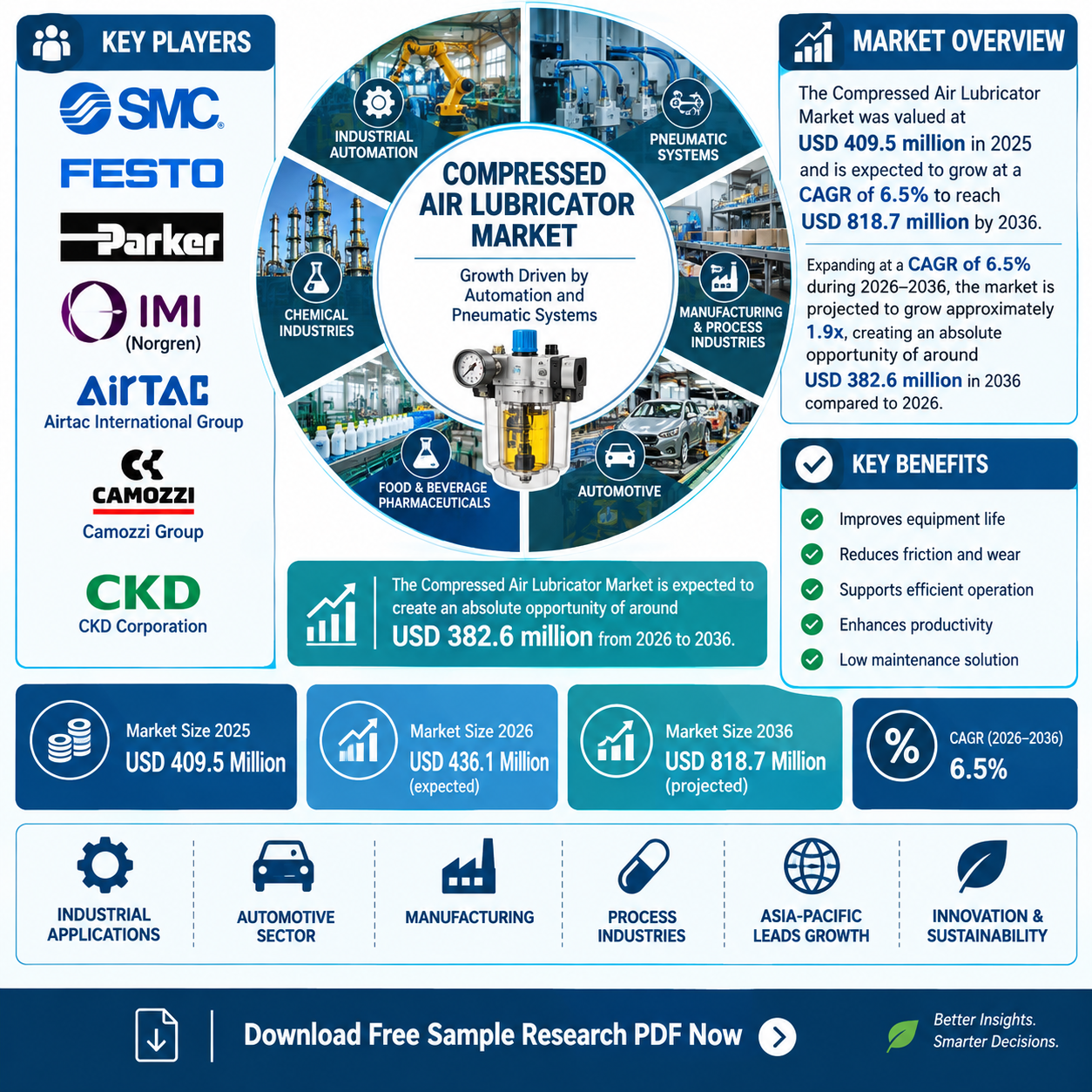
Subheadline: The Compressed Air Lubricator Market is projected to grow at 6.5% CAGR from 2026 to 2036, driven by automation and pneumatic system adoption.
September 16, 2026 — The global Compressed Air Lubricator Market is projected to grow from USD 436.1 million in 2026 to USD 818.7 million by 2036, expanding at a 6.5% CAGR, according to Fact.MR analysis. The market was valued at USD 409.5 million in 2025.
The market is expected to generate an absolute dollar opportunity of approximately USD 382.6 million between 2026 and 2036. Rising industrial automation, wider adoption of pneumatic systems, and demand for efficient lubrication are shaping purchasing requirements across manufacturing and process industries.
Get detailed market forecasts, competitive benchmarking, and pricing trends: https://www.factmr.com/connectus/sample?flag=S&rep_id=14918
Compressed Air Lubricator Market Growth Tied to Automation
Why now? Industrial automation and pneumatic equipment adoption are increasing the need for controlled lubrication in high-cycle applications. Fact.MR identifies manufacturing, metal and machinery, chemical industries, automotive operations, food and beverage, and pharmaceuticals among the sectors contributing to demand.
Compressed Air Lubricators are devices that introduce controlled lubrication into compressed-air systems to reduce friction and support equipment operation. The market includes standalone lubricators and integrated Filter–Regulator–Lubricator (FRL) units, covering different flow capacities, pressure ranges, installation types, and lubrication methods.
Growing demand for maintenance efficiency is supporting the use of lubricators in pneumatic tools and automated production lines. At the same time, integrated FRL packages are gaining attention because industrial systems increasingly favor compact air-preparation configurations.
Shambhu Nath Jha, Principal Consultant at Fact.MR, said, “Growing demand for efficient and low-maintenance air preparation systems is accelerating the adoption of integrated FRL units and automatic lubricators.”
The shift is also visible in lubrication technology. Fact.MR identifies automatic lubricators, micro-fog lubrication systems, and minimum lubrication systems as technologies supporting productivity and lower oil consumption.
Standalone and Automatic Lubricators Lead Key Segments
Standalone Lubricators account for 54.9% of the product type segment in 2026, supported by their use in existing pneumatic systems and standalone industrial applications. Integrated Units account for the remaining 45.1%, reflecting adoption of compact FRL systems.
Automatic Lubricators hold 61.2% of the operation segment in 2026. Their share is linked to rising automation and the requirement for consistent lubrication with reduced manual intervention. Manual Lubricators account for 38.8%.
Oil-mist Lubrication leads the lubrication method segment with a 44.2% share in 2026. Micro-fog Lubrication follows at 27.8%, supported by applications seeking higher efficiency and lower oil consumption.
Medium Flow systems, covering 500–3000 L/min, hold 43.5% of the market in 2026. Medium Pressure systems, covering 5–10 bar, account for 55.1%.
Point-of-Use Lubricators represent 61.8% of the installation segment. Pneumatic Tools are identified as the leading application.
Industrial Applications hold the largest end-use share at 45.8%, while the Automotive Sector accounts for 20.3%.
Asia-Pacific Records Fast Country-Level Growth
Asia-Pacific is identified by Fact.MR as the most dynamic regional market, with industrialization, manufacturing expansion, automation, and pneumatic system adoption supporting demand.
India is projected to grow at 8.5% CAGR from 2026 to 2036. Japan follows at 8.4%, while China is projected to expand at 8.1%. Italy is expected to register 7.1%, compared with 5.7% for the United States, 5.5% for South Korea, and 4.4% for Germany.
India's growth is associated with industrial expansion, SMEs, automotive workshops, process industries, and increased use of pneumatic tools. Japan's growth is linked to automation, robotics, and precision manufacturing. China's market is supported by large-scale manufacturing and industrial expansion.
North America and Western Europe remain developed markets. Fact.MR associates these regions with established pneumatic-system penetration, aftermarket demand, energy-efficiency efforts, and increasing interest in consolidated air-preparation products.
Oil-Free Systems Create a Market Constraint
The expansion of oil-free compressed-air systems presents a restraint for traditional lubricator demand. Food, pharmaceutical, and electronics applications can also face restrictions where oil contamination is a concern.
Fact.MR also identifies additional maintenance and filtration requirements as constraints for lubricated-air systems. Pre-lubricated and self-lubricating components can reduce the need for external lubrication in some applications.
At the same time, automatic and smart lubricators integrated with industrial automation systems represent an opportunity area. Aftermarket and replacement demand for existing pneumatic systems, particularly in developing markets, also supports future demand.
Shambhu Nath Jha, Principal Consultant at Fact.MR, added, “Advancements in lubrication technologies such as micro-fog and minimal lubrication systems are enhancing efficiency and reducing oil consumption.”
Industry Developments Reflect Automation Focus
SMC Corporation introduced the In-line Air Filter ZFD Series in 2025, designed to remove contaminants from compressed-air streams and support pneumatic-system reliability.
Festo launched AX Motion Insights Electric in 2025, an AI-based monitoring solution designed for predictive maintenance and performance monitoring of motion systems.
SMC Corporation also introduced the Air Saving Impact Blow Valve IBV Series in 2025, targeting reduced compressed-air consumption while maintaining application performance.
In 2024, Bosch Rexroth completed its acquisition of HydraForce to expand its global fluid-power capabilities.
Top Trending Reports :
https://social.mytamam.com/blogs/39650/Mailer-Packaging-Market-to-Reach-USD-167-22-Billion-by
https://ayushjadhavblogs.blogspot.com/2026/09/insulation-market-set-to-grow-at-69.html
https://fridayad.co.in/article/hvehv-gis-market-us1517-billion-opportunity-by-2036
https://www.pikumil.com/blogs/182097/Dietary-Fiber-Market-to-Nearly-Double-Over-2026-2036
Competitive Landscape
The Compressed Air Lubricator Market includes SMC Corporation, Festo, Parker Hannifin, IMI plc (Norgren), Airtac International Group, Camozzi Group, CKD Corporation, Metal Work S.p.A., Emerson Electric Co., and Bosch Rexroth.
Fact.MR states that the top five players — SMC Corporation, Festo, IMI plc, Parker Hannifin, and Emerson Electric Co. — together account for approximately 50% to 55% of the total market.
The research covers product type, lubricator type, operation, lubrication method, flow capacity, pressure range, installation, distribution channel, application, end-user industry, and region. Forecasts cover 2026 to 2036 and draw on primary interviews with pneumatic component manufacturers, air-treatment providers, distributors, OEMs, and end users, alongside secondary research and market-sizing analysis.
About Fact.MR
Fact.MR is a market research and consulting firm providing market intelligence, forecasts, and strategic analysis across industries. Its research combines primary interviews, secondary sources, market-sizing techniques, and data validation to assess market trends and future opportunities.

 English
 Arabic
 French
 Spanish
 Portuguese
 Deutsch
 Turkish
 Dutch
Dutch
 Italiano
 Russian
 Romaian
 Greek
Greek