


Dairy Processing Equipment Market Growth Through Production Modernization
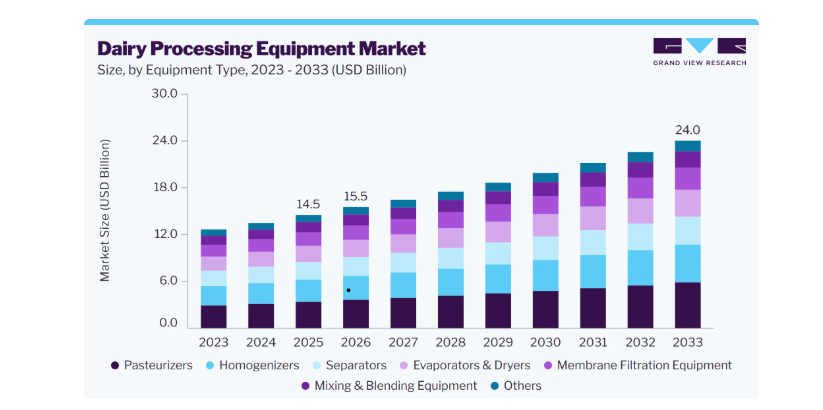
The modern dairy supply chain is built around transformation. Raw milk has a limited shelf life and requires careful handling, while consumers increasingly expect products that are safe, convenient, consistent, nutritious, and available in multiple formats. The equipment used to transform milk determines how efficiently manufacturers can meet those expectations.
The Dairy Processing Equipment Market generated USD 14.5 billion in revenue in 2025 and is forecast to reach USD 24.0 billion by 2033, advancing at a 6.4% CAGR between 2026 and 2033. Asia Pacific represented 38.6% of global revenue in 2025.
Key Highlights
Market direction: USD 14.5 billion in 2025 to USD 24.0 billion by 2033.
Equipment leader: Pasteurizers held 23.3% of revenue in 2025.
Application leader: Cheese captured 27.4% of revenue in 2025.
Faster application: Processed milk is projected to grow at 7.1% through 2033.
Regional center: Asia Pacific held the largest share in 2025.
Raw Milk Is Only the Starting Point
The economics of dairy processing begin with a simple challenge: raw milk needs to be transformed before it can become a modern retail product. That transformation involves a chain of technical steps. Milk may undergo separation, standardization, pasteurization, homogenization, fermentation, concentration, drying, or other treatments depending on the final product.
The underlying flow is straightforward: raw milk → processing → stabilization → formulation → finished dairy product.
Every stage creates equipment requirements. As manufacturers expand their product portfolios, the complexity of those requirements also increases. This is one reason equipment demand tends to rise alongside the growth of processed dairy consumption. More product categories require more specialized production capabilities.
Download a free sample report or claim your copy of this full market intelligence report
Shelf Life Has Become a Commercial Advantage
Processed dairy products are increasingly popular because they offer convenience and longer shelf life compared with raw alternatives. That makes processing technology a commercial tool as well as a food-safety necessity. Pasteurization is particularly important in this environment and remained the largest equipment category in 2025, representing 23.3% of market revenue. Equipment used for thermal treatment must provide reliable processing while supporting operational efficiency. Modern systems increasingly focus on reducing energy use, improving control, and minimizing production losses. These improvements matter because dairy processing is a high-volume industrial activity in which small efficiency gains can have an impact across large production runs.
Cheese Is a Major Engine of Equipment Demand
Cheese generated the largest application share in 2025 at 27.4%. Its popularity extends across retail, foodservice, convenience foods, and specialty products. The industry's expansion is also creating greater variety. Conventional cheese formats coexist with premium, specialty, and artisanal offerings, each placing different requirements on processing conditions and equipment control.
For manufacturers, consistency is essential. Equipment needs to support repeatable processing so that product characteristics remain stable across production cycles. This is where modern machinery provides value beyond basic capacity. Controlled processing can influence quality, efficiency, and product uniformity simultaneously.
The Processed Milk Opportunity Is Expanding
Processed milk is projected to grow at the fastest application CAGR of 7.1% from 2026 to 2033. Urban consumers are increasingly seeking packaged products that fit fast-paced routines. This supports demand for pasteurized, UHT, flavored, lactose-free, and fortified milk formats. Such products require equipment capable of handling large volumes and maintaining consistent quality. Automation becomes particularly useful when processors need to increase output without proportionally increasing manual operations.
The opportunity therefore goes beyond milk consumption itself. Higher consumption of processed milk → higher manufacturing volumes → greater need for reliable thermal and automated processing systems.
Health Trends Are Changing Processing Requirements
Consumer interest in healthier dairy products is creating new formulations. Lower-fat products, reduced-sugar offerings, protein-rich products, and dairy products containing probiotics or vitamins require careful processing to maintain the intended composition and sensory characteristics. This encourages processors to invest in systems capable of precise mixing, homogenization, filtration, and heat treatment. Advanced homogenizers are increasingly relevant because they help create uniformity and stability across dairy products. Filtration technologies can support concentration and ingredient separation, while evaporation and drying systems are important in powder and ingredient production.
The equipment market is therefore benefiting from a broader trend: consumer diversification → product diversification → processing diversification.
Automation Is Becoming a Plant-Level Strategy
Automation is no longer simply about replacing manual work. It can influence quality consistency, production speed, monitoring, resource use, and operating costs. A modern processing line may use automated controls across several interconnected stages. Data from one stage can support adjustments elsewhere, helping maintain stable production conditions. This connected approach becomes more important as dairy manufacturers scale their facilities and introduce more product variations. Instead of optimizing a single machine, processors increasingly look at the efficiency of the entire production system.
A Regional Market With Different Growth Stories
Asia Pacific was the largest regional market in 2025, contributing 38.6% of global revenue. Its position is linked with dairy consumption growth, urbanization, rising incomes, and modernization of processing infrastructure.
The regional market is projected to reach USD 9.51 billion by 2033, with a 6.8% CAGR from 2026 to 2033.
India is one of the most important markets within this expansion. Its dairy processing equipment market is projected to reach USD 3.31 billion by 2033, while the U.S. market is projected to reach approximately USD 3.30 billion over the same period.
These markets illustrate different but complementary sources of demand: expanding infrastructure in developing dairy economies and continued technological modernization in mature markets.
What the Market Is Really Selling
The dairy processing equipment market is ultimately selling manufacturers the ability to turn raw milk into products that fit modern consumer expectations. It supports safety through controlled thermal processing, consistency through homogenization and automation, flexibility through advanced processing systems, and extended shelf life through appropriate treatment technologies.
That makes equipment an integral part of dairy-sector transformation rather than a separate industrial category. As the industry continues moving toward more convenient, diverse, functional, and value-added dairy products, investment in processing capability is likely to remain central to how the market develops through 2033.
About us:
Grand View Research, a market research and consulting company, provides syndicated research reports, customized research reports, and consulting services. Grand View Research database is used by the world's renowned academic institutions and Fortune 500 companies to understand the global and regional business environment. Our database features thousands of statistics and in-depth analysis on 46 industries in 25 major countries worldwide.

 English
 Arabic
 French
 Spanish
 Portuguese
 Deutsch
 Dutch
Dutch
 Italiano
 Russian
 Romaian
 Portuguese (Brazil)
 Greek
Greek