


Data Center Asset Management Market Positions USD 7.1 Billion In 2036 Valuation As Operators Focus On Lifecycle Economics And Capacity Utilization
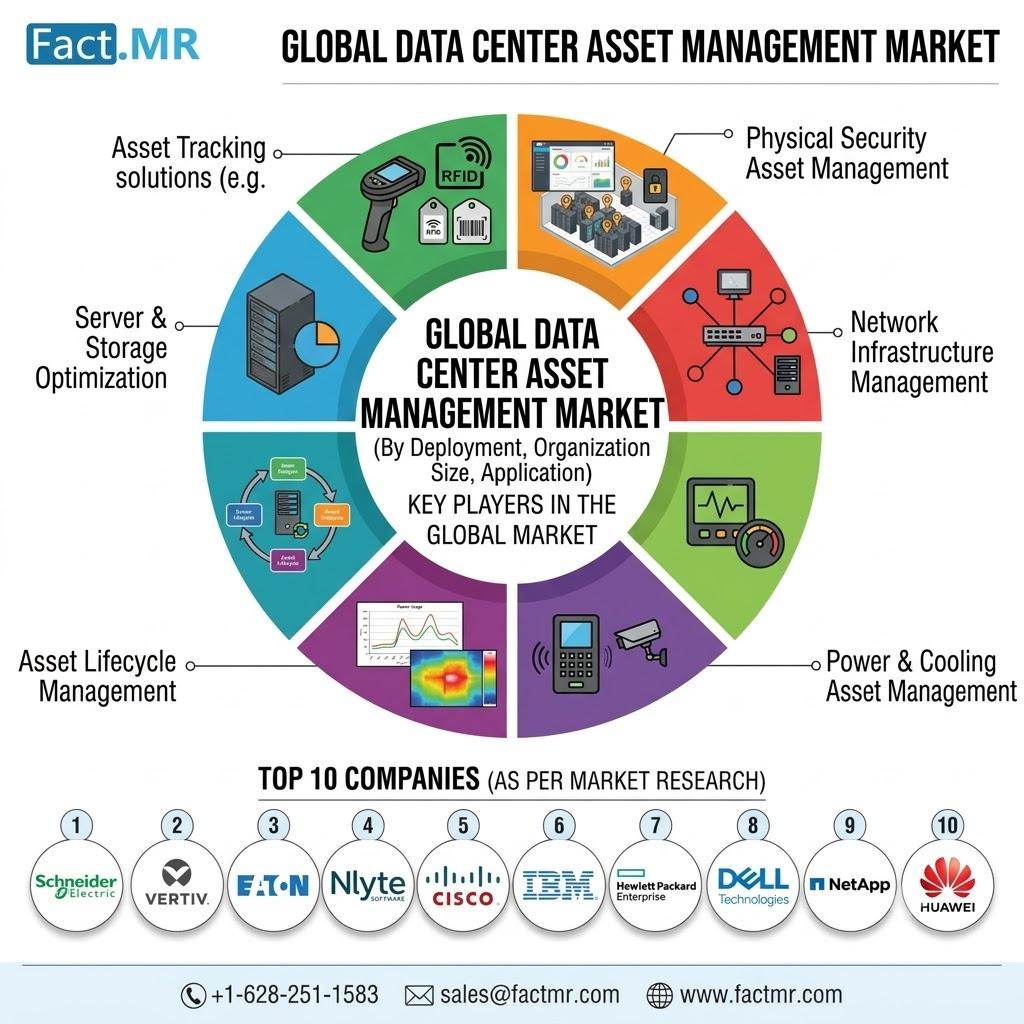
Data center operators are moving asset management beyond inventory records as AI workloads, high-density racks, distributed infrastructure, and faster refresh cycles increase the need for real-time infrastructure visibility. In March 2025, Vertiv launched its Unify software platform to provide visibility, management, reporting, and analytics across critical power and thermal infrastructure, reflecting the wider shift toward integrated infrastructure control.
According to FactMR, the Data Center Asset Management Market is projected to expand from USD 2.9 billion in 2026 to USD 7.1 billion by 2036, advancing at a 9.4% CAGR. The market was valued at USD 2.6 billion in 2025, creating an absolute opportunity of approximately USD 4.2 billion during the forecast period.
The shift matters because data center teams increasingly need to know not only what equipment is installed, but also where it is located, how it is connected, how much capacity it consumes, and when it needs to be replaced.
Get Detailed Market Forecasts, Competitive Benchmarking, and Pricing Trends: https://www.factmr.com/connectus/sample?flag=S&rep_id=15038
Why are data center operators prioritizing asset visibility?
The rise of AI infrastructure is adding more power, cooling, networking, and rack-management complexity to facilities. That makes accurate asset records more closely tied to capacity planning and operational control.
On March 18, 2025, Vertiv introduced Vertiv Unify for colocation and hyperscale data centers. The platform combines visibility and control across power and thermal infrastructure with advanced analytics. The company positioned the software around the operational challenges created by AI-driven workloads and growing infrastructure complexity.
Schneider Electric has also expanded its data center portfolio around infrastructure visibility and planning. In April 2025, the company introduced EcoConsult for Data Centers, a service designed to assess infrastructure and identify asset-modernization opportunities involving power and cooling systems.
These developments point to a broader market transition. Asset management platforms are increasingly being connected with DCIM, capacity planning, infrastructure monitoring, and lifecycle workflows rather than operating as isolated inventory databases.
What is changing across the asset lifecycle?
Asset discovery and inventory management is estimated to account for around 30% of market share in 2026. This segment remains foundational because every downstream activity depends on accurate information about installed equipment.
Rack and floor visualization is gaining importance as facilities become denser. Connectivity and dependency mapping also becomes more valuable when an equipment change can affect power, cooling, networking, or application availability.
Nlyte strengthened this direction in November 2025 with the release of Nlyte Software Version 16. The update added executive dashboards, expanded protocol support, and sustainability reporting within its data center infrastructure management offering.
The company had also described asset and capacity intelligence as foundational to integrated data center management in August 2025, emphasizing the need to understand where assets are located, how they are connected, and how they perform.
Analyst View
Shambhu Nath Jha, Senior Analyst at FactMR, said:
“this market as an infrastructure-governance and lifecycle-intelligence category rather than an inventory-software niche. Buyers are not only paying for asset records. They are paying for operational clarity, better planning, and lower risk in fast-changing data center environments.”
The analyst view highlights an important commercial change. Operators are increasingly evaluating asset-management platforms according to the operational decisions they support, including capacity expansion, equipment replacement, change control, and infrastructure planning.
Data Center Asset Management Market Snapshot
- 2025 market value: USD 2.6 billion
- 2026 market value: USD 2.9 billion
- 2036 forecast: USD 7.1 billion
- CAGR, 2026–2036: 9.4%
- Absolute opportunity: USD 4.2 billion
- Leading solution segment: Asset Discovery and Inventory Management, approximately 30% share in 2026
- Leading deployment: On-Premise, approximately 38% share in 2026
- Leading data center type: Enterprise Data Centers, approximately 34% share in 2026
- Leading application: Asset Tracking and Inventory Accuracy, approximately 28% share
- Fastest-growing country: India, 10.8% CAGR through 2036
Where is the market seeing the strongest growth?
Asia Pacific is becoming a major demand center as enterprises, cloud providers, and colocation operators add capacity.
India is projected to record a 10.8% CAGR through 2036. New data center capacity, enterprise digitization, and hyperscale expansion are increasing the need for standardized asset records and lifecycle governance.
China is expected to grow at 10.2% CAGR, supported by large-scale infrastructure development and rising requirements for capacity and asset control.
In the United States, the market is projected to expand at 9.1% CAGR. Mature DCIM adoption, infrastructure refresh cycles, and complex hyperscale and colocation environments support demand.
Germany is projected to grow at 8.6% CAGR, while Singapore is expected to record 8.3% CAGR. Both markets reflect the importance of structured infrastructure management in technically mature and space-constrained data center environments.
What opportunities are emerging for technology suppliers?
The strongest opportunities are shifting toward platforms that connect asset records with operational workflows.
Integrated DCIM: Asset management linked with power, cooling, capacity, and monitoring systems can give operators a broader view of facility conditions.
Lifecycle planning: Replacement schedules and refresh programs create demand for platforms that track assets from deployment through retirement.
Distributed infrastructure: Edge and multi-site environments increase the need for centralized visibility without requiring every location to maintain separate asset records.
Dependency mapping: As infrastructure becomes more interconnected, understanding relationships between equipment, racks, networks, power systems, and cooling assets becomes increasingly useful for change management.
Competitive activity reflects this broader direction. Key participants include Schneider Electric, Vertiv, Nlyte, Sunbird, IBM, Siemens, and Huawei. Their offerings span DCIM, infrastructure visualization, asset lifecycle management, capacity planning, and related operational technologies.
Schneider Electric's EcoStruxure IT Advisor, for example, combines asset, power, cooling, and environmental information within a data center digital twin to support capacity planning and scenario analysis.
About the Data Center Asset Management Market Report
FactMR's study covers the global Data Center Asset Management Market across 2026 to 2036. The analysis examines demand by solution type, deployment type, data center type, application, end use, and region.
The report covers:
- Asset Discovery and Inventory Management
- Rack and Floor Asset Visualization
- Capacity and Space Management
- Lifecycle and Change Management
- Asset Connectivity and Dependency Mapping
- On-Premise, Cloud-Based, and Hybrid deployment
- Enterprise, Colocation, Hyperscale, and Edge Data Centers
- Asset Tracking and Inventory Accuracy
- Capacity Planning
- Lifecycle and Refresh Management
- Change and Configuration Control
- Compliance and Audit Readiness
- IT and Telecom, BFSI, Healthcare, Government, and Manufacturing end uses
https://www.factmr.com/report/data-center-asset-management-market
The research uses primary interviews with data center operations managers, DCIM specialists, infrastructure planners, colocation operators, lifecycle-governance stakeholders, and software providers. Desk research includes company materials, industry sources, infrastructure data, and operational guidance, with market estimates developed through a hybrid top-down and bottom-up approach.
Explore More Related Studies Published by FactMR Research:
https://sites.google.com/view/industryresearchinsights/latest-reports/structured-cabling-market
About FactMR
FactMR is a market research and consulting firm providing syndicated research, custom studies, and strategic intelligence across technology, industrial, automotive, chemicals, healthcare, food, and other sectors. Its research combines primary interviews, secondary research, market modeling, and data validation to support business planning and investment decisions.

 English
 Arabic
 French
 Spanish
 Portuguese
 Deutsch
 Turkish
 Dutch
Dutch
 Italiano
 Russian
 Portuguese (Brazil)
 Greek
Greek