


Emergency Response Software Market Trends, Opportunities & Forecast 2026–2034
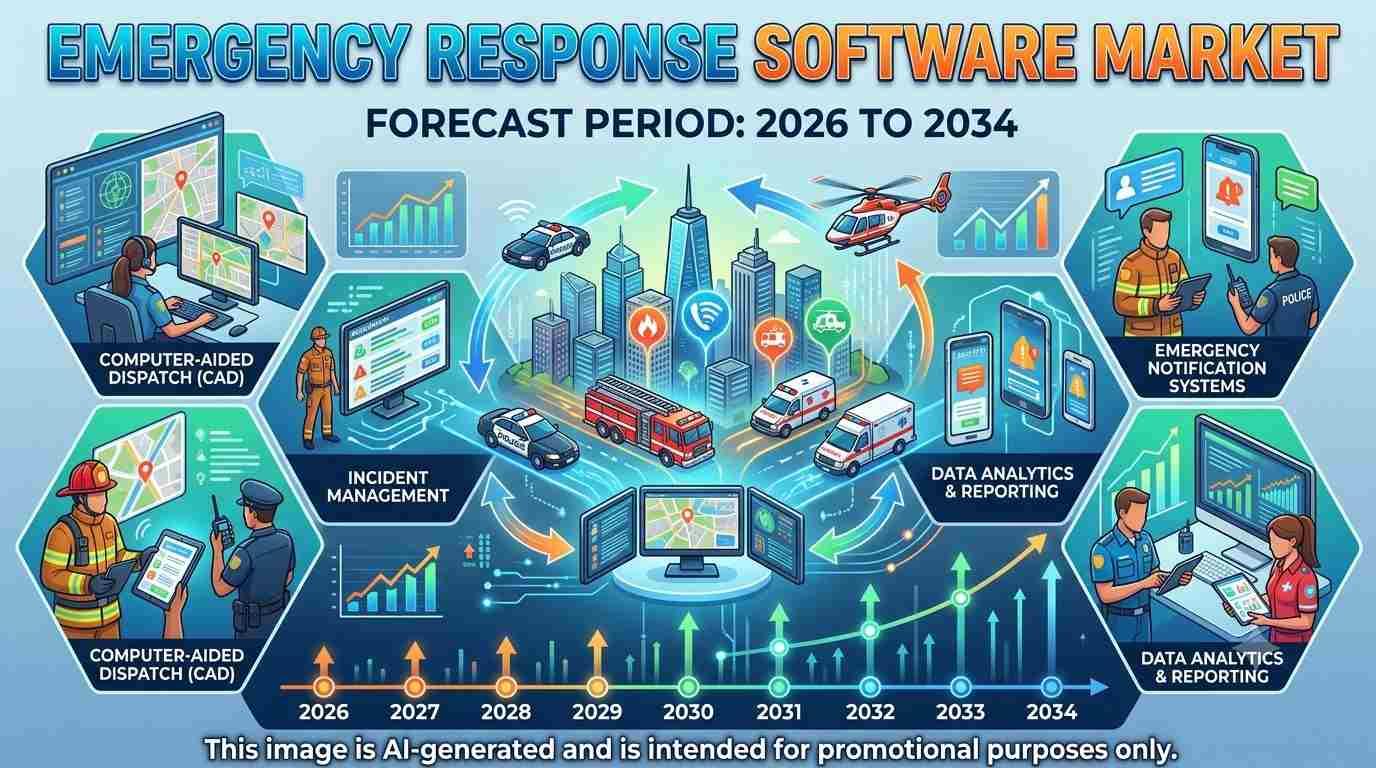
The market is expanding as public safety agencies, corporate enterprises, healthcare facilities, and governments move toward systems that reduce response times, enhance situational awareness, and improve resource allocation during critical events. Growth is supported by regulatory modernization, next-generation 911 (NG911) transitions, cloud-native software adoption, and investment in smart city infrastructure.
The Emergency Response Software Market size is expected to reach US$ 13.76 billion by 2034 from US$ 5.35 billion in 2025. The market is anticipated to register a CAGR of 11.5% during 2026–2034.
What is driving the market?
Regulatory mandates for public safety, enterprise risk management commitments, and demand for real-time situational awareness are the principal growth drivers. Emergency agencies are increasingly required to demonstrate interoperability, incorporate multimedia data streams (such as live video and text), reduce dispatch delays, and address multi-jurisdictional coordination obligations. Municipalities, educational institutions, and corporate entities are seeking platforms that lower incident response times without compromising data security, system reliability, or operational continuity. The transition is moving beyond simple voice-based radio dispatch toward measurable, data-driven response ecosystems. Suppliers are investing in cloud-hosted architectures, AI-assisted predictive analytics, IoT sensor integration, and software designed for existing geographic information systems (GIS). Fragmented legacy infrastructure, inconsistent agency funding, and the challenge of maintaining stringent cybersecurity and data-privacy performance remain important constraints.
Which region leads?
North America leads the market, accounting for an estimated 38%–42% share in 2025, supported by early NG911 adoption, robust federal funding, and established public safety frameworks. Growth is driven by cloud migration, computer-aided dispatch (CAD) upgrades, multi-agency interoperability initiatives, and severe-weather preparedness. The United States and Canada present significant opportunities as rising demand for multimedia emergency communication coincides with initiatives focused on smart city connectivity and automated incident detection. Europe holds an estimated 25%–29% share, supported by E112 regulatory mandates and cross-border public safety collaboration. Asia Pacific is identified as the fastest-growing region, with a projected CAGR of 10.2%–11.0%, as rapid urbanization, smart-city expansions, and growing commercial safety demands drive infrastructure investment in China, India, and Southeast Asia.
Which segment leads?
Computer-Aided Dispatch (CAD) is the leading solution segment, representing an estimated 35%–39% of market revenue in 2025 [2.1.8]. Its position is supported by high daily call volumes, established public-safety funding pathways, modernization of legacy command centers, and the substitution of outdated on-premise servers with agile platforms. The segment is forecast to grow at a CAGR of 9.2%–9.8% through 2033. By end-use industry, Government & Public Safety leads with an estimated 45%–49% share in 2025, reflecting massive deployment volumes and demand for integrated police, fire, and EMS software. Cloud-Based Platforms are identified as a high-growth deployment type, with an estimated 11.5%–12.5% CAGR, as secure, scalable software-as-a-service (SaaS) architectures and mobile responder applications gain adoption.
Which companies are prominent?
The report identifies Motorola Solutions, Hexagon AB, Tyler Technologies, CentralSquare Technologies, Everbridge, Mark43, RapidSOS, Esri, Caliber Public Safety, and IBM Corporation as prominent market participants [2.1.1, 2.1.2, 2.1.3, 2.1.4, 2.1.5]. These companies compete across computer-aided dispatch, mass notification systems, mobile responder applications, GIS mapping, and crisis management software. Strategic differentiation increasingly depends on artificial intelligence capabilities, platform interoperability, multi-jurisdictional coordination, secure cloud integration, and the ability to deliver mission-critical solutions at a commercial scale. The list reflects the report's competitive landscape rather than a revenue-ranked market-share table.
What is changing in 2026?
The market is shifting from siloed, on-premise communication tools toward integrated, data-rich emergency response ecosystems. Procurement specifications increasingly include AI-driven triage, multimedia data ingestion, real-time location accuracy, cybersecurity compliance, and compatibility with regional NG911 or equivalent frameworks. The transition toward Next-Generation 911 standards is accelerating throughout 2026, establishing a harmonized requirement for processing text, video, and telematics data alongside traditional voice calls.
Software vendors are accelerating the rollout of AI-assisted dispatching, predictive incident mapping, automated drone routing, and mobile-first responder interfaces. Procurement decisions are increasingly linked to evidence of interoperability and uptime performance rather than standalone feature claims, creating demand for API integrations, cybersecurity audits, and collaboration between telecommunications providers, cloud hosts, and government agencies.
What are the major investment opportunities?
The strongest opportunities lie in cloud-native dispatch systems, AI-powered predictive analytics, mobile responder applications, and secure multi-agency data-sharing platforms. Investment in IoT sensor integration, geographic information systems (GIS), automated mass notification, and drone connectivity can improve the speed and accuracy of incident assessment. Long-term procurement agreements and public-private partnerships can help software providers secure recurring government contracts.
Additional opportunities include enterprise-grade crisis management platforms for corporate campuses, intelligent traffic preemption for emergency vehicles, and mental wellness tracking tools for first responders. Software-as-a-service (SaaS) and platform-as-a-service (PaaS) models may create robust recurring revenue where real-time data processing, API integration, and continuous security monitoring operate economically at scale.
Asia Pacific and Latin America offer attractive expansion potential through developing smart city initiatives and modernizing public safety infrastructure. Investors should prioritize solutions that combine mission-critical reliability, data security, regulatory readiness, and demonstrated compatibility with local telecom networks, while assessing localized hosting requirements and budget availability.
The Insight Partners provides comprehensive syndicated and tailored market research services in the healthcare, technology, and industrial domains. Renowned for delivering strategic intelligence and practical insights, the firm empowers businesses to remain competitive in ever-evolving global markets.
• Email: sales@theinsightpartners.com
• Website: theinsightpartners.com
• Phone: +1-646-491-9876

 English
 Arabic
 French
 Spanish
 Portuguese
 Deutsch
 Turkish
 Dutch
Dutch
 Italiano
 Russian
 Romaian
 Portuguese (Brazil)