


Compound Semiconductor Materials Market Targets USD 66.90 Billion By 2036 As Group III-V Materials Maintain 46.8% Product Share
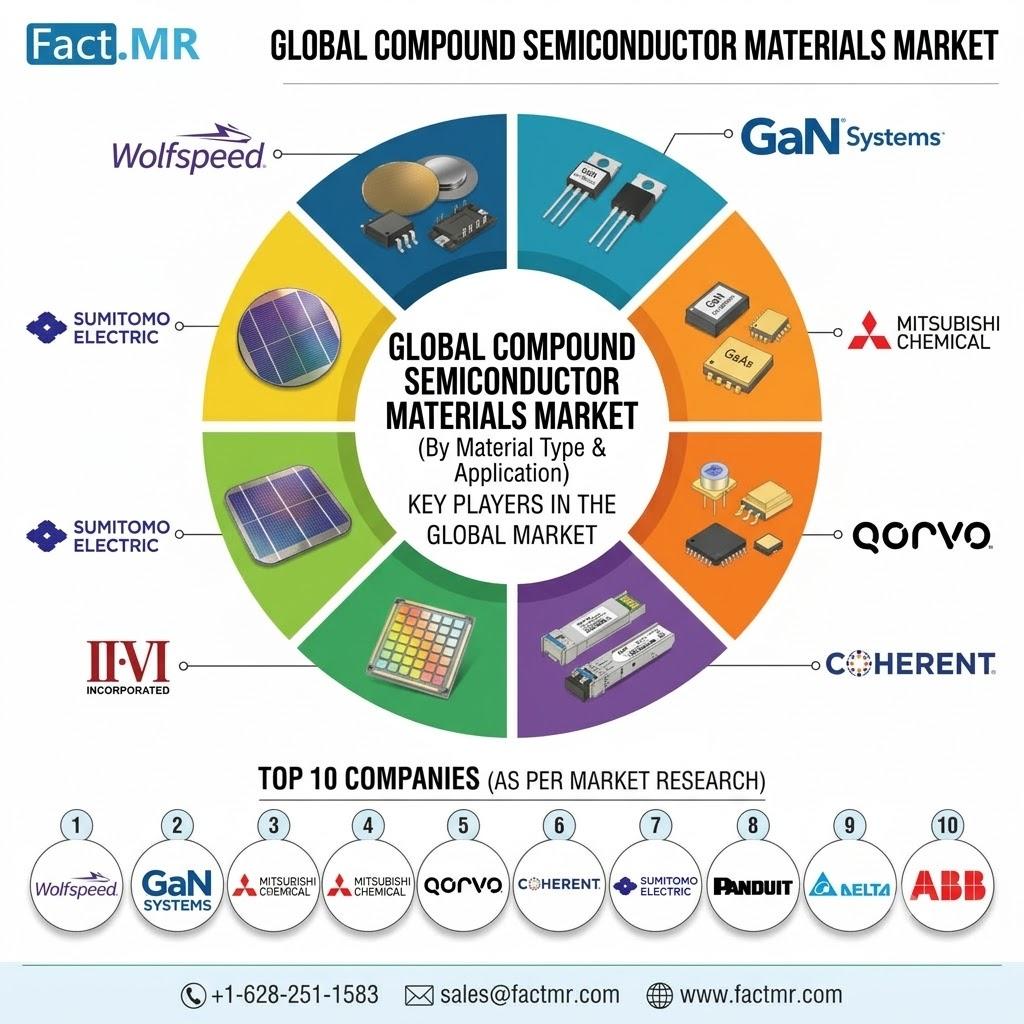
The global compound semiconductor materials market is estimated at USD 44.76 billion in 2026 and is projected to reach USD 66.90 billion by 2036, expanding at a 4.1% CAGR, according to FactMR. The market was valued at approximately USD 43 billion in 2025, creating an estimated USD 22.14 billion absolute opportunity through 2036.
The market spans material platforms including Group III-V, Group IV-IV, and Group II-VI compounds. Demand is increasingly connected to high-frequency communications, optical systems, power electronics, aerospace and defense, automotive applications, and emerging AI infrastructure.
Recent industry developments reinforce this direction. Yole reported in February 2026 that the combined compound semiconductor substrate and open epiwafer markets are expected to exceed USD 5 billion by 2031, with a roughly 14% CAGR from 2025 to 2031. Its analysis identified electrification, AI infrastructure, and next-generation connectivity as important long-term demand drivers for SiC, GaN, GaAs, and InP.
Get Detailed Market Forecasts, Competitive Benchmarking, and Pricing Trends: https://www.factmr.com/connectus/sample?flag=S&rep_id=11577
Market Snapshot
- 2025 market value: USD 43.0 billion
- 2026 market value: USD 44.76 billion
- 2036 forecast value: USD 66.90 billion
- CAGR, 2026–2036: 4.1%
- Absolute opportunity: USD 22.14 billion
- Leading product segment: Group III-V, 46.8% share in 2026
- Leading application: Telecommunication, 41.5% share
- Leading wafer-size category: 150 mm and above, 44.6% share
- Fastest-growing country markets: China at 5.3% and India at 4.9%
GaN and III-V Materials Gain Strategic Importance
Group III-V materials account for approximately 46.8% of the product segment in 2026, according to FactMR.
The category includes important materials such as gallium arsenide, gallium nitride, and indium phosphide. Their electrical, optical, and high-frequency properties make them useful for applications where conventional silicon-based approaches may not provide the required performance.
IQE, a major supplier of compound semiconductor wafers and advanced material solutions, maintains material platforms covering GaAs, GaN, InP, GaSb, and other III-V materials. Its portfolio serves communications infrastructure, aerospace and security, automotive and industrial applications, and connected devices.
GaN is also moving into a wider set of applications. IQE identifies RF communications, radar, power electronics, electric vehicles, data centers, and microLED-related technologies among applications for its GaN platform.
This broadening application base creates demand for improved epitaxy, larger wafers, better material quality, and more consistent manufacturing yields.
Telecommunications Remains a Major Application
Telecommunication represents 41.5% of the application segment in 2026, according to FactMR.
Compound semiconductor materials play a significant role in RF and optical communications because high-frequency performance and optoelectronic characteristics are central to many network components.
Sumitomo Electric continues to develop compound semiconductor technologies for communications and sensing applications. In July 2025, the company and the University of Tokyo reported research into ScAlN/GaN heterojunctions aimed at improving the performance of next-generation high-frequency GaN HEMTs.
Sumitomo Electric's compound semiconductor portfolio also covers RF GaN devices for wireless systems, radar, and other communications-related applications.
The development highlights how material engineering remains closely linked to the performance requirements of next-generation communication infrastructure.
AI Infrastructure Opens Another Material Demand Channel
AI data centers are adding another dimension to compound semiconductor demand.
IQE's 2026 interim results identify GaN and InP applications across AI and data-center infrastructure, communications, and other advanced markets. The company is also supplying 6-inch GaAs epiwafers to Quintessent for quantum-dot laser technology intended for AI data-center optical interconnects.
The significance extends beyond optical communications. Higher computing density is increasing attention on energy efficiency, thermal management, power conversion, and high-speed interconnects.
GaN is consequently being evaluated across power supplies, data-center power systems, telecommunications infrastructure, automotive electronics, and industrial equipment.
A 2025 industry forecast from Yole projected the power GaN device market to reach USD 3 billion by 2030, illustrating the scale of one downstream opportunity for GaN material technologies.
Epitaxy Becomes a Key Technology Layer
FactMR estimates that epitaxy growth represents 39.8% of the technology segment in 2026.
Epitaxy is central to compound semiconductor production because controlled layers of semiconductor material must be deposited onto substrates with precise composition and structural properties.
IQE describes its epiwafers as compound semiconductor material layers deposited on precision substrates. Its manufacturing portfolio spans major epitaxy platforms, including MOCVD and MBE, across GaAs, InP, GaSb, and GaN.
The industry is also moving toward larger wafer formats. IQE states that its GaAs epitaxy portfolio can scale to 200 mm, while its substrate operations cover sizes from 2 to 8 inches across several material systems.
Larger wafers can support higher production volumes and improved manufacturing economics when process control and material quality remain consistent.
China and India Show Stronger Growth Trajectories
FactMR projects China to expand at 5.3% CAGR through 2036, followed by India at 4.9%.
China's position is linked to its expanding semiconductor manufacturing ecosystem and demand for compound materials across communications, power electronics, and other advanced applications.
India is also developing a broader compound semiconductor ecosystem. In December 2025, Navitas Semiconductor and Cyient Semiconductors announced a partnership aimed at advancing GaN adoption in India, including applications in AI data centers, electric mobility, computing, grid infrastructure, and industrial electrification.
Other major markets show more moderate growth. FactMR projects Germany at 4.5% CAGR, Brazil at 4.1%, the United States at 3.7%, the United Kingdom at 3.3%, and Japan at 2.9% through 2036.
Material Innovation Expands Beyond Traditional Platforms
The compound semiconductor materials landscape is expanding beyond established GaAs and InP applications.
GaN and SiC are gaining attention in power electronics, while newer material structures and heterojunction technologies are being studied for higher-frequency and higher-efficiency devices.
A 2025 technical review published by Compound Semiconductor News highlighted the expansion of compound semiconductor materials into GaN, SiC, gallium oxide, and other emerging platforms, with applications spanning RF, power electronics, optoelectronics, and mobility.
At the same time, supply-chain considerations are becoming more significant. Material quality, wafer diameter, epitaxy capacity, process know-how, and manufacturing location can affect the ability of device manufacturers to scale production.
FactMR Analyst View
Shambhu Nath Jha, Principal Consultant at FactMR, states:
“The compound semiconductor materials is moving beyond volume-led replacement cycles. Growth is increasingly shaped by premiumization, expanding distribution through direct-to-consumer and e-commerce channels, and rising participation in group iii-v applications.”
For the broader semiconductor industry, the more relevant structural shift is the widening range of applications requiring specialized compound materials. Telecommunications remains an important demand center, while AI infrastructure, power electronics, aerospace, automotive, and photonics are creating additional avenues for material suppliers.
Competitive Landscape
The compound semiconductor materials market includes established material producers, substrate manufacturers, epitaxy specialists, and vertically integrated semiconductor technology companies.
Key companies profiled by FactMR include:
- Sumitomo Electric Industries, Ltd.
- JX Nippon Mining & Metals
- SK Siltron Co., Ltd.
- Shin-Etsu Chemical Co., Ltd.
- IQE PLC
- Cree, Inc.
- II-VI Incorporated
- AXT, Inc.
- Freiberger Compound Materials
- PAM-XIAMEN
Competition is increasingly centered on material quality, wafer diameter, epitaxy capability, manufacturing yield, application-specific performance, and supply reliability.
Recent activity illustrates this focus. IQE continues to expand its GaN, GaAs, and InP material platforms, while Sumitomo Electric is advancing GaN-HEMT research for high-frequency applications.
The industry is also seeing greater attention on supply-chain resilience. In September 2026, IQE announced a purchase agreement with Quintessent to supply 6-inch GaAs epiwafers for quantum-dot laser technology targeting AI data-center optical interconnects.
Read the full Compound Semiconductor Materials Market report from FactMR for detailed forecasts, segment analysis, country-level estimates, competitive assessment, and market methodology: https://www.factmr.com/report/compound-semiconductor-materials-market
Outlook to 2036
The compound semiconductor materials market is entering a period where demand is increasingly tied to application-specific performance rather than material availability alone.
Telecommunications will remain a major application, while AI data centers, power conversion, advanced automotive electronics, radar, satellite communications, and photonics can broaden the addressable market.
For suppliers, the key challenge will be scaling advanced material platforms without compromising wafer quality, yield, reliability, or cost.
FactMR forecasts the market to reach USD 66.90 billion by 2036, representing USD 22.14 billion in additional market opportunity from 2026.
The trajectory indicates continued demand for specialized materials as semiconductor manufacturers pursue higher frequency, greater power efficiency, improved optical performance, and more compact system architectures.
Explore More Related Studies Published by FactMR Research:
https://sites.google.com/view/industryresearchinsights/latest-reports/sic-traction-modules-market
About FactMR
FactMR is a global market research and consulting firm providing market intelligence, industry analysis, forecasts, and strategic research across technology, manufacturing, energy, healthcare, chemicals, and other major sectors.

 English
 Arabic
 French
 Spanish
 Portuguese
 Deutsch
 Turkish
 Dutch
Dutch
 Russian
 Romaian
 Portuguese (Brazil)
 Greek
Greek