


Healthcare Agentic Artificial Intelligence Market Growth, Predictable to Witness Sustainable Evolution Analysis By Fact.MR
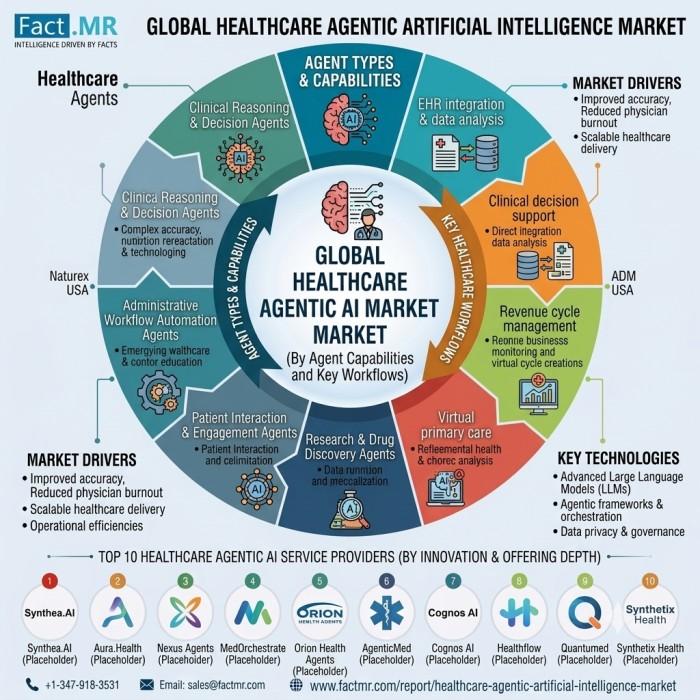
Healthcare Agentic AI Market to Reach $24.6 Billion as Hospitals Move from AI Pilots to Workflow Automation
Rockville, Maryland, United States – September 16, 2026 — Healthcare organizations are moving agentic artificial intelligence beyond isolated AI assistants as hospitals and technology providers test systems capable of coordinating multiple clinical and administrative tasks. In August 2026, Hippocratic AI introduced a platform designed to coordinate teams of conversational voice AI agents, highlighting the industry's shift toward multi-agent healthcare workflows.
The development comes as healthcare providers look for AI systems that can retrieve approved patient information, coordinate tasks and support clinical teams without requiring users to leave existing workflows. Fact.MR estimates the Healthcare Agentic Artificial Intelligence Market at USD 3.9 billion in 2026, with revenue projected to reach USD 24.6 billion by 2036, expanding at a 20.2% CAGR.
Get detailed market forecasts, competitive benchmarking, and technology trends:https://www.factmr.com/connectus/sample?flag=S&rep_id=15998
Why is agentic AI gaining attention in healthcare?
Conventional healthcare AI typically addresses a defined task. Agentic AI is designed to plan, retrieve information, use connected tools and coordinate several steps toward a defined clinical or administrative objective.
That distinction matters for hospitals dealing with documentation workloads, patient scheduling, coding, care coordination and clinical decision support. An agent can potentially connect several actions rather than simply return a generated response.
Fact.MR identifies clinical workflow automation and cloud/model infrastructure as high-impact adoption drivers. EHR integration is another important factor because agents become more useful when approved patient context is available inside the workflow.
The commercial opportunity is therefore tied to workflow fit. Healthcare organizations are unlikely to evaluate agentic AI only on model performance; integration, auditability, human review and data permissions also influence deployment decisions.
Which agent type leads the market?
Clinical Decision Agents are projected to account for 44.0% of the agent-type segment in 2026, making them the leading category. These systems help care teams review patient information, retrieve relevant context and compare potential next steps with approved clinical guidance.
Administrative Automation Agents represent another important opportunity. Clinical documentation and revenue-cycle workflows contain repetitive tasks that can potentially be coordinated through AI agents.
Patient Engagement Agents are gaining attention for virtual assistance and care navigation, while Research & Discovery Agents can support clinical-trial workflows, medical research and evidence generation.
Recent academic research also illustrates the sector's direction. A March 2026 scoping review in npj Digital Medicine found that agentic AI research covered areas including emergency medicine, oncology, radiology and rehabilitation, while emphasizing that clinical validation and standardized evaluation remain limited.
Which application is driving demand?
Clinical Decision Support is projected to hold 38.0% of the application segment in 2026. Hospitals are testing systems that can convert patient records and clinical protocols into usable information while keeping clinicians responsible for final decisions.
Medical documentation is another significant application. Agents can assist with information retrieval, summarization and workflow updates, potentially reducing the administrative burden associated with clinical records.
Virtual Patient Assistance covers use cases such as remote monitoring and medication adherence. Drug-discovery applications extend agentic AI into patient recruitment and real-world evidence generation.
The breadth of these applications means healthcare agentic AI is developing as a workflow technology rather than a single clinical product category.
Analyst Perspective
Shambhu Nath Jha, Sr. Consultant at Fact.MR, said:
“Healthcare agentic AI should be assessed against a defined clinical or administrative workflow, a clear human-review point, and the quality of the underlying data.”
The assessment reflects a key purchasing consideration. Healthcare buyers need to understand what an agent is allowed to access, what actions it can initiate and when a human must intervene.
This requirement becomes more significant as systems move from information retrieval toward action. A documentation agent and a treatment-support agent may use similar underlying models, but their risk profiles and governance requirements are very different.
Market Snapshot
- 2026 market value: USD 3.9 billion.
- 2036 projected value: USD 24.6 billion.
- Forecast CAGR, 2026–2036: 20.2%.
- Absolute opportunity: USD 20.7 billion.
- Leading agent type: Clinical Decision Agents, with 44.0% share.
- Leading application: Clinical Decision Support, with 38.0% share.
- Leading end user: Hospitals, with 42.0% share.
- Leading deployment model: Cloud-based Deployment, with 61.0% share.
- Leading core technology: Large Language Models, with 49.0% share.
The market is projected to create USD 20.7 billion in additional opportunity between 2026 and 2036.
What's Driving Near-Term Demand?
Clinical workflow automation is one of the clearest reasons healthcare organizations are testing agentic systems. Documentation, scheduling, coding and care coordination can consume substantial staff time, creating an economic case for targeted automation.
Cloud infrastructure is supporting deployment as well. Fact.MR expects Cloud-based Deployment to represent 61.0% of the market in 2026, reflecting the need for scalable model access, centralized governance and security monitoring.
EHR integration is equally important. Fact.MR notes that agents become more useful when approved patient context can be returned directly within an existing workflow.
In March 2026, Amazon Web Services introduced Amazon Connect Health, an agentic AI solution for healthcare workflows. The platform included specialized agents for areas such as patient verification, ambient documentation and appointment management, with additional capabilities including patient insights and medical coding in preview.
Large Language Models are expected to maintain the largest technology share at 49.0% in 2026, reflecting their role in natural-language interaction and multi-step reasoning.
What are the main barriers?
Clinical trust and liability are identified as high-impact restraints. Healthcare providers may delay deployment when recommendation logic, escalation rules or human-review responsibilities are unclear.
Health-data access presents another challenge. Agents require appropriate permissions to retrieve patient information, and fragmented systems can restrict the context available to an automated workflow.
Integration costs can also slow adoption. A healthcare organization may need to modify established processes before an agent can operate effectively.
Recent medical-AI research reinforces the concern. A June 2026 Nature study of an autonomous EHR agent demonstrated the ability to retrieve patient information, order and interpret tests, generate differential diagnoses and formulate treatment plans in a sandboxed environment, while researchers emphasized the need for further real-world validation, safety and governance.
Which countries offer the strongest growth opportunities?
The United States is projected to grow at 21.5% CAGR from 2026 to 2036, the fastest rate among the countries profiled by Fact.MR. China follows at 20.8%, while the United Kingdom is projected at 20.1%.
Germany is forecast to expand at 19.4% CAGR, followed by Japan at 18.7%, Canada at 18.0% and Singapore at 17.3%.
The U.S. market benefits from established healthcare IT infrastructure and significant adoption of predictive AI. Fact.MR notes that 71% of U.S. non-federal acute-care hospitals used predictive AI integrated with EHRs in 2024, up from 66% in 2023.
The United Kingdom is also progressing toward broader AI use. NHS England said in July 2026 that an AI triage tool in the NHS App was expected to reach more than 200,000 patients over the following 12 months, following an initial Sussex trial that reduced phone queues by 29%.
Who are the key companies?
The competitive landscape includes Microsoft Corporation, Google LLC, Oracle Corporation, NVIDIA Corporation, Salesforce, Inc., Amazon Web Services, Inc., IBM Corporation and Cognizant Technology Solutions Corporation.
Recent product activity shows the market moving toward healthcare-specific agents. Oracle Health's Clinical AI Agent is designed around clinical documentation, while Microsoft, Salesforce and AWS have introduced healthcare-oriented AI capabilities. NVIDIA is supporting healthcare AI infrastructure and applications, while IBM and Cognizant participate through enterprise AI and healthcare technology services.
The competitive focus is shifting from generic model access toward workflow integration. Vendors that can demonstrate controlled actions, traceability, security and clear escalation paths are likely to be better positioned for regulated healthcare environments.
About the Report
The Fact.MR study evaluates the Healthcare Agentic Artificial Intelligence Market across Agent Type, Application, End User, Deployment Model and Core Technology.
Agent types include Clinical Decision Agents, Administrative Automation Agents, Patient Engagement Agents, and Research & Discovery Agents.
Applications include Clinical Decision Support, Medical Documentation, Virtual Patient Assistance and Drug Discovery. End users include Hospitals, Clinics, Telehealth Providers and Pharmaceutical Companies.
Deployment models covered include Cloud-based Deployment, Hybrid Deployment, Software as a Service and Application Programming Interface Integration. Core technologies include Large Language Models, Multi-agent Systems, Natural Language Processing and Predictive Artificial Intelligence.
Geographic coverage spans North America, Latin America, Europe, Asia Pacific, and the Middle East & Africa, with country-level analysis for the United States, China, United Kingdom, Germany, Japan, Canada and Singapore.
Key companies profiled include Microsoft Corporation, Google LLC, Oracle Corporation, NVIDIA Corporation, Salesforce, Inc., Amazon Web Services, Inc., IBM Corporation and Cognizant Technology Solutions Corporation.
The study covers the 2026–2036 forecast period and evaluates autonomous and semi-autonomous AI agents used for clinical decisions, documentation, coding, patient engagement and workflow coordination.
Explore More Related Studies Published by Fact.MR Research:
Medical and Pharmaceutical Dynamic Sealing Solutions Market: https://www.openpr.com/news/4597508/trelleborg-leads-as-usa-medical-and-pharmaceutical-dynamic
Artificial Intelligence in Hospital Operations Market: https://www.openpr.com/news/4597510/u-s-health-systems-and-microsoft-drive-ai-hospital-operations
Artificial Intelligence in Life Sciences Market: https://www.openpr.com/news/4597511/usa-ai-in-life-sciences-market-expands-as-iqvia-rolls-out-new
Medical Devices Electronic Data Interchange Market: https://www.openpr.com/news/4597525/opentext-scales-u-s-medical-device-edi-networks-as-market
Medical Device and Medtech Enterprise Resource Planning Market:https://www.openpr.com/news/4597512/sap-se-takes-15-2-share-as-u-s-medical-device-medtech-erp
About Fact.MR
Fact.MR is a market research and consulting firm providing industry intelligence across consumer goods, food and beverages, healthcare, technology, chemicals and materials, industrial goods and other sectors. Its research process combines primary industry interviews with secondary data, company information, government sources and industry publications to develop market estimates and forecasts.
Fact.MR operates as an initiative of Eminent Research and Advisory Services, with offices listed in Rockville, Maryland, United States, and Dublin, Ireland.
Media Contact
Fact.MR
11140 Rockville Pike, Suite 400
Rockville, MD 20852, United States
Tel: +1 (628) 251-1583
Email: sales@factmr.com
Disclosure: This release is based on FMI syndicated research. Market figures represent estimates and forecasts available as of the publication date and may be revised as additional information becomes available.

 English
 Arabic
 French
 Spanish
 Deutsch
 Turkish
 Dutch
Dutch
 Italiano
 Russian
 Romaian
 Portuguese (Brazil)
 Greek
Greek