


Metal Cans Market to Double by 2036, Fact.MR Finds
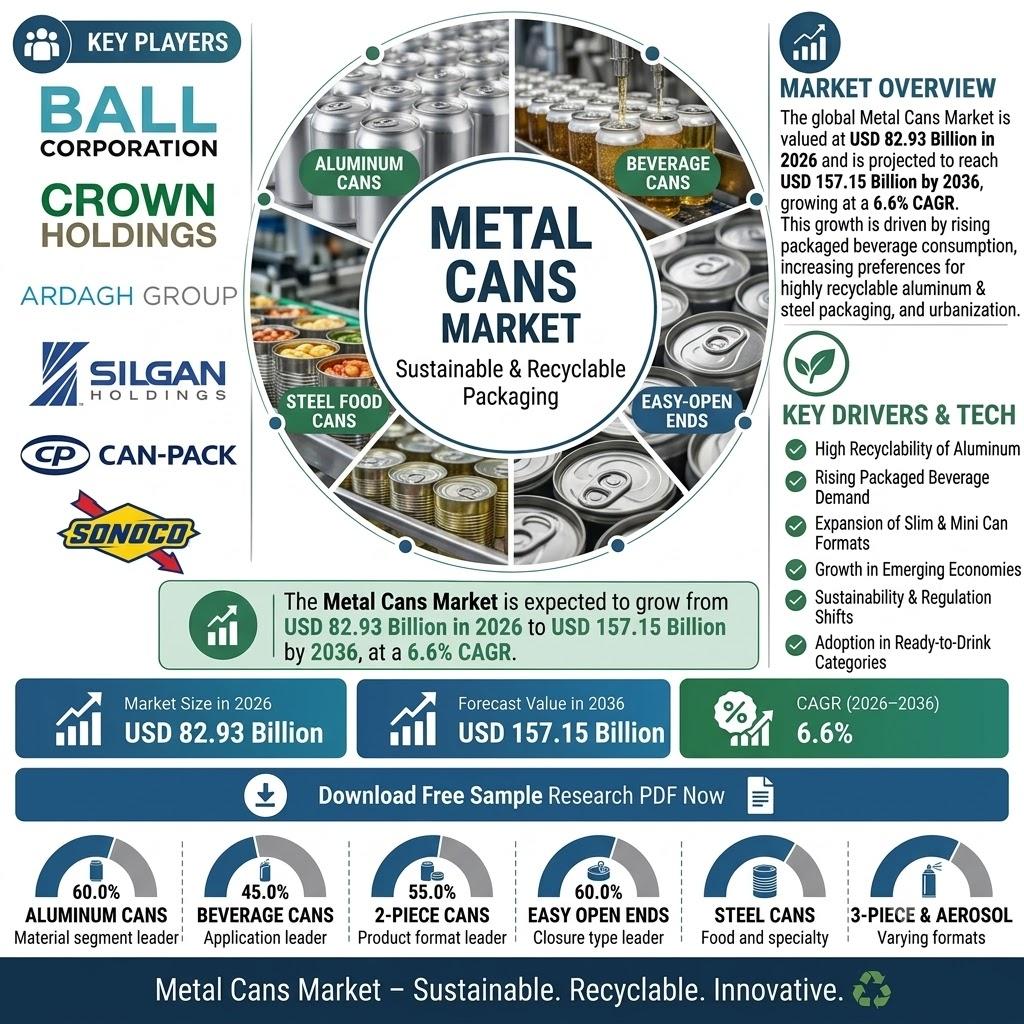
Subhead : The global Metal Cans Market is projected to grow from USD 82.93 billion in 2026 to USD 157.15 billion by 2036, expanding at a 6.6% CAGR.
ROCKVILLE, Md., September 17, 2026 — The global Metal Cans Market is projected to reach USD 157.15 billion by 2036, rising from USD 82.93 billion in 2026 at a CAGR of 6.6%, according to Fact.MR analysis. The market was valued at approximately USD 77.80 billion in 2025 and is expected to create an absolute dollar opportunity of USD 74.21 billion between 2026 and 2036.
Demand is being shaped by packaged beverage consumption, recyclable packaging preferences, and the arrival of new canned beverage categories. India and China are projected to expand at 8.9% and 8.1%, respectively, during the forecast period.
Get detailed market forecasts, competitive benchmarking, and pricing trends: https://www.factmr.com/connectus/sample?flag=S&rep_id=12136
Metal Cans Market Growth Is Led by Aluminum and Beverages
Fact.MR is a market research company that analyzes global industry demand, market size, competitive activity, and future growth through secondary research, primary interviews, and forecasting models.
Aluminum cans account for 60.0% of the material type segment in 2026, according to Fact.MR. Beverages represent 45.0% of the application segment, while 2-piece cans hold 55.0% of the product type segment.
Easy open ends also hold a 60.0% share of the closure type segment in 2026. The figure reflects the widespread use of pull-tab opening systems across beverage can applications.
The market covers rigid aluminum and steel containers used for beverages, food, aerosols, personal care products, cosmetics, and industrial applications. Product formats include 2-piece cans, 3-piece cans, and aerosol cans across small, medium, and large capacity ranges.
Why Is Demand for Metal Cans Increasing?
Packaged beverage consumption is expanding across emerging economies in Asia, Latin America, and Africa as urbanization, modern retail, and cold chain infrastructure improve product access. Fact.MR identifies these developments as direct demand drivers for aluminum and steel cans.
Sustainability is another market factor. Brand and regulatory preferences for recyclable packaging are supporting the shift from plastic and glass toward aluminum cans in carbonated soft drinks, water, energy drinks, and alcoholic beverages.
New formats are also adding demand. Slim cans, mini cans, and large-format cans allow beverage brands to target different consumption occasions while creating additional shelf presence.
The next phase is broader. Canned water, canned wine, ready-to-drink cocktails, hard seltzers, functional beverages, and cold-brew coffee are extending aluminum can adoption beyond traditional soda and beer.
Aluminum Cans Hold the Leading Material Position
Aluminum cans represent 60.0% of the material type segment in 2026. Their position is supported by lightweight construction, recyclability, rapid chilling capability, and compatibility with high-speed beverage filling lines.
Steel cans continue to serve food packaging, aerosol, and specialty industrial applications. Fact.MR notes that steel provides structural strength and corrosion resistance when combined with internal lacquer coatings, while its suitability for retort processing supports food applications.
The material balance differs by region. Beverage-heavy markets tend to show stronger aluminum usage, while food-focused markets maintain greater demand for steel cans.
Beverage Packaging Shapes Market Expansion
Beverages account for 45.0% of the application segment in 2026. Carbonated soft drinks, beer, energy drinks, flavored water, and ready-to-drink alcoholic beverages remain major demand channels.
The market is also seeing new product launches built around cans rather than bottles. This shift is especially relevant in North America and Europe, where emerging beverage categories are adding incremental demand.
Fact.MR identifies format innovation as a key growth vector in mature markets, where overall beverage volumes can remain relatively flat. New sizes and shapes allow brands to expand consumption occasions without depending only on higher overall beverage volumes.
India and China Show the Fastest Growth
India is projected to expand at a CAGR of 8.9% through 2036, supported by packaged beverage consumption, modern retail expansion, food service development, and urban adoption of canned soft drinks, energy drinks, and beer.
China follows at 8.1%, supported by large-scale beverage production and established aluminum can manufacturing infrastructure.
Brazil is projected to grow at 6.3%, with beer, energy drinks, carbonated beverages, and aluminum recycling infrastructure supporting demand. The U.S. market is projected to expand at 5.6%, driven by new beverage categories, sustainability-driven format switching, and slim, mini, and large-format cans.
Germany is forecast at 4.8%, while the UK and Japan are projected at 4.4% and 3.9%, respectively.
Aluminum Costs Remain a Market Constraint
Aluminum price volatility remains a central cost issue for manufacturers. Fact.MR links margin pressure to LME pricing, energy costs, and trade policy, which can complicate long-term supply contracts with beverage customers.
Competition from PET bottles, cartons, and flexible pouches also limits metal can penetration in price-sensitive food and beverage segments. Manufacturing capacity presents another constraint because can-making lines, coating systems, and end-making equipment require substantial capital investment.
At the same time, recycled aluminum content creates an opportunity. Fact.MR identifies increased recycled aluminum use as a route toward lower production energy consumption and reduced carbon footprint.
Analyst Perspective
Shambhu Nath Jha, Principal Consultant at Fact.MR, said, “The metal cans market is being reshaped by the intersection of sustainability regulation and consumer preference shifts. Aluminum cans are gaining share against glass and plastic across beverage categories as brands respond to recyclability messaging, lightweighting targets, and retail shelf efficiency requirements.”
Jha added, “India, China, and Brazil are generating the fastest growth as packaged beverage consumption rises with urbanization, modern retail expansion, and cold chain development. In mature markets, the growth vector is format innovation, including slim cans, mini cans, and large-format multipacks, rather than volume expansion.”
A specific research detail underscores the depth of the analysis: Fact.MR's methodology draws on 130+ secondary sources, 50+ company product and capacity portfolios, 30+ countries, and 25+ primary interviews with can manufacturers, beverage brand owners, retailers, and recycling operators.
Top Trending Reports :
https://social.mytamam.com/blogs/39988/Compressed-Air-Lubricator-Market-to-Reach-USD-818-7-Million
https://ayushjadhavblogs.blogspot.com/2026/09/permanent-magnets-market-set-to-grow-at.html
https://sportivo.network/blogs/278090/Smart-Technology-Shapes-the-Global-Flow-Meter-Market
About the Metal Cans Market Report
Fact.MR's Metal Cans Market Analysis and Forecast covers market size and forecasts from 2026 to 2036 across material type, product type, application, capacity, closure type, and region. The research uses a hybrid demand-side and top-down methodology supported by shipment data, production capacity utilization, trade flows, pricing inputs, and primary interviews.
The report covers North America, Latin America, Europe, East Asia, South Asia and Pacific, and the Middle East and Africa. Key companies analyzed include Ball Corporation, Crown Holdings Inc., Ardagh Group S.A., Silgan Holdings Inc., Can-Pack S.A., Sonoco Products Company, Toyo Seikan Group Holdings, CCL Containers, Kian Joo Can Factory, and Universal Can Corporation.
About Fact.MR
Fact.MR is a market research and consulting provider offering market intelligence, forecasts, and strategic analysis across industries and geographic markets. The Hand Truck & Dolly Market assessment covers the 2026–2036 forecast period and uses secondary research, primary interviews, demand-side modeling, top-down validation, trade-flow checks, shipment analysis, pricing trends, and sensitivity testing.

 English
 Arabic
 French
 Spanish
 Portuguese
 Deutsch
 Turkish
 Dutch
Dutch
 Russian
 Romaian
 Portuguese (Brazil)
 Greek
Greek