


Freshness-Control Packaging Films Market Worth USD 2.5 Bn: Brazil Leads, Germany Expands Europe
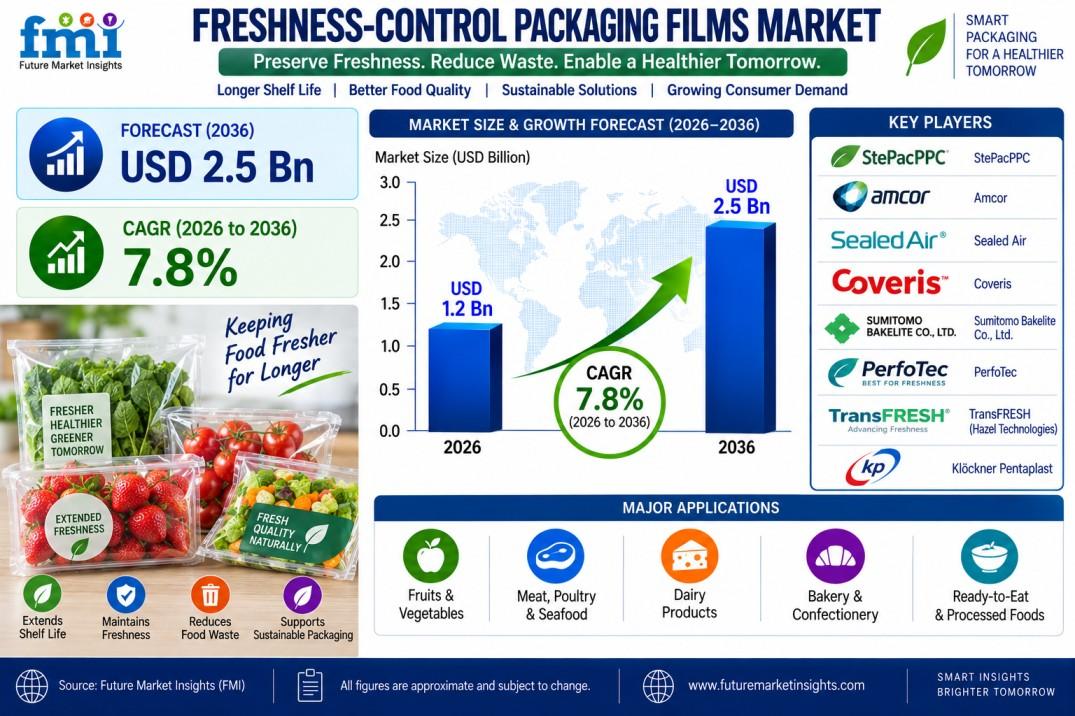
The development arrives as the Freshness-Control Packaging Films Market reaches USD 1.2 billion in 2026 and is projected to reach USD 2.5 billion by 2036, expanding at a 7.8% CAGR.
Why is qualification becoming as important as shelf-life performance?
Freshness-control films are increasingly purchased on the basis of measurable package performance rather than preservation claims alone. Modified Atmosphere (MAP) Films are projected to account for 32.0% of technology demand in 2026, while Polyolefin (PE-PP) is estimated to hold 40.0% by material, reflecting the importance of controlled gas exchange, sealability and established converting infrastructure.
StePacPPC’s certification transition illustrates how food-safety systems can become part of commercial qualification alongside permeability and shelf-life evidence. The company said FSSC 22000 provides a more integrated, risk-based approach across operations and the supply chain.
At the same time, Amcor expanded its Lugo di Vicenza, Italy, facility in March 2026 with a new production line for high-barrier recycle-ready films. The nearly 7,000-square-metre expansion supports large-scale production for lidding and pouch formats, showing how recyclability and production consistency are becoming linked in film investment decisions.
Sumitomo Bakelite adds another application pathway through its P-Plus technology, while Sealed Air, Coveris, PerfoTec, Hazel Technologies and Klöckner Pentaplast participate across broader fresh-food films, atmosphere management and recyclable barrier structures. FMI identifies these companies among the notable participants in the market.
👉 Get Detailed Market Forecasts, Competitive Benchmarking, and Pricing Trends: https://www.futuremarketinsights.com/reports/sample/rep-gb-34607
What does this mean for freshness-control film suppliers?
The commercial threshold is shifting from proving that a film can preserve food to proving that the complete package system can repeatedly deliver the promised shelf-life, sealing, food-contact and sustainability performance.
Long-distance distribution makes this particularly important. Fresh produce continues to respire after packing, so permeability must be matched to commodity characteristics and temperature exposure. A film that performs in laboratory conditions may still require commercial line trials before approval.
StePacPPC's January 2026 dragon-fruit shipment example demonstrates the role of crop-specific atmosphere control in distant markets, while PerfoTec's work with sea-freighted Brussels sprouts illustrates how controlled gas exchange can support alternative logistics routes.
This creates two parallel competitive requirements: specialized technical evidence for crop-specific preservation and scalable converting capability for multinational food-packaging programs. Companies that combine both can reduce the gap between technical validation and repeat purchasing.
Analyst Perspective
“Package trials earn repeat orders by reproducing the product’s real respiration rate and temperature profile under commercial conditions. Suppliers that combine measurable shelf-life gains with stable seals and recyclable structures can defend a premium without forcing disruptive line changes.”
— Nandini Roy Choudhury, Principal Consultant, Future Market Insights
Freshness-Control Packaging Films Market Snapshot
- 2026 market size: USD 1.2 billion
- 2036 forecast: USD 2.5 billion
- 2026–2036 CAGR: 7.8%
- Leading technology: Modified Atmosphere (MAP) Films — 32.0% share in 2026
- Leading material: Polyolefin (PE-PP) — 40.0% share in 2026
- Leading format: Bags & Pouches — 36.0% share in 2026
- Leading application: Fresh Produce — 38.0% share in 2026
What is driving demand for freshness-control packaging films?
Food-loss economics remains a central adoption driver. The market report cites FAO data showing a 25.4% food-loss rate for fruit and vegetables among major commodity groups in 2025, strengthening the commercial case for packaging technologies that extend saleable life.
Regional demand also differs by distribution model. Brazil is forecast to grow at 8.2% CAGR, ahead of the United Kingdom at 7.7%, Germany at 7.6%, the United States at 7.2% and Japan at 6.4%.
Brazil's export-oriented produce sector places greater emphasis on humidity, respiration and ocean-route performance. European markets add recyclability and migration considerations, while the United States places greater emphasis on avoided shrink across extended distribution networks. Japan's comparatively mature market places greater weight on stable specifications and repeatable qualification.
👉 Access the Complete Report in PDF Format: https://www.futuremarketinsights.com/reports/brochure/rep-gb-34607
Where are the clearest opportunities?
The opportunity is increasingly concentrated in films that can deliver preservation performance without forcing processors to redesign established packaging lines. Recycle-ready barrier structures are particularly relevant because sustainability requirements are converging with existing commercial qualification processes. Amcor's Italian expansion illustrates the scale of investment being directed toward high-barrier recycle-ready films for lidding and pouches.
Meanwhile, crop-specific atmosphere technologies continue to create opportunities in export markets where additional shelf life can alter freight economics, reduce rejected cases and extend access to distant destinations.
About the Freshness-Control Packaging Films Market
The latest study from Future Market Insights analyzes the market by technology, material, format, application, end use, sales channel and region. The study covers North America, Latin America, Western Europe, Eastern Europe, East Asia, South Asia and Pacific, and the Middle East and Africa, with country-level analysis for major markets including the United States, Germany, Japan, the United Kingdom and Brazil.
FMI's research framework combines primary interviews, secondary research, market modelling and multi-source validation. Its methodology includes 250+ primary interviews per report, 500+ non-market-research sources cross-checked and independent quality control before publication.
Freshness-Control Packaging Films Market: https://www.futuremarketinsights.com/reports/freshness-control-packaging-films-market
FMI Research Methodology: https://www.futuremarketinsights.com/methodology
Disposable Cutlery Market: https://www.futuremarketinsights.com/reports/disposable-cutlery-market
Cold Chain Packaging Market: https://www.futuremarketinsights.com/reports/cold-chain-packaging-market
Bucket Market: https://www.futuremarketinsights.com/reports/bucket-market
About Future Market Insights
Future Market Insights, Inc. is registered in Delaware as Future Market Insights, Inc., Christiana Corporate, 200 Continental Drive, Suite 401, Newark, Delaware 19713, United States. The company also maintains offices in Valley Cottage, New York; Dubai, United Arab Emirates; London, United Kingdom; and Pune, India.
FMI provides market intelligence and consulting services across more than 150 countries, with research covering market sizing, forecasting, competitive analysis and strategic intelligence.
Disclosure: This release is based on syndicated research by Future Market Insights, Inc. Market figures are estimates published as of September 2026 and may be revised as additional information becomes available.
Media Contact
Future Market Insights, Inc.
Email: sales@futuremarketinsights.com
Phone: +1-347-918-3531

 English
 Arabic
 French
 Spanish
 Portuguese
 Deutsch
 Turkish
 Italiano
 Russian
 Romaian
 Portuguese (Brazil)
 Greek
Greek