


Eye Testing Equipment Market Expands on Rising Eye Care Needs
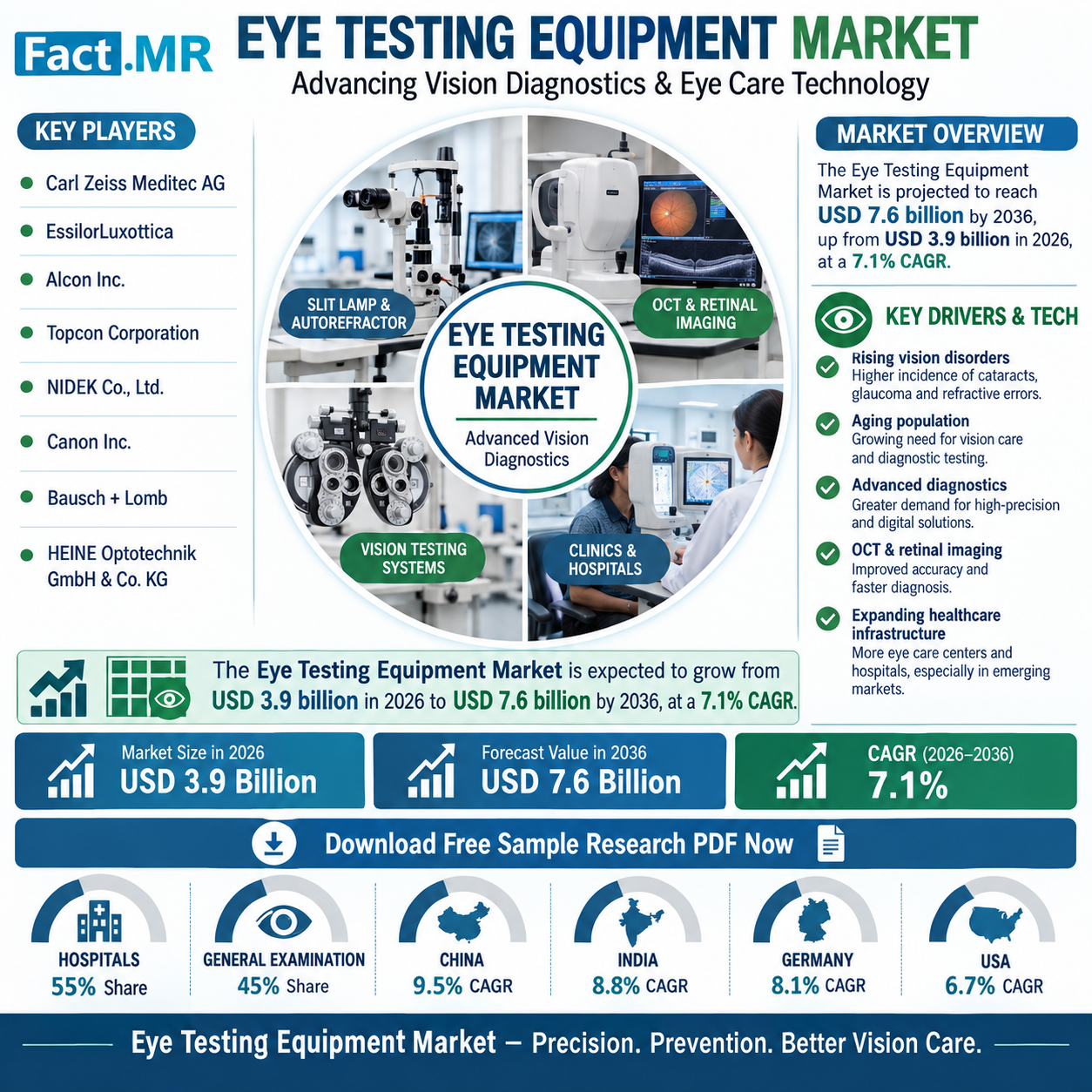
SubHead : Eye Testing Equipment Market is projected to grow from USD 3.9 billion in 2026 to USD 7.6 billion by 2036 at a 7.1% CAGR, according to Fact.MR.
September 19, 2026 — The global Eye Testing Equipment Market is projected to reach USD 7.6 billion by 2036, rising from USD 3.9 billion in 2026 at a 7.1% CAGR, according to Fact.MR analysis. The market was valued at USD 3.6 billion in 2025. The forecast represents an absolute dollar opportunity of USD 3.7 billion between 2026 and 2036.
The expansion reflects rising demand for diagnostic equipment as vision-related disorders become more prevalent and healthcare systems expand access to eye care. Aging populations, adoption of advanced diagnostic technologies, and healthcare infrastructure investments are also supporting demand for eye testing equipment across hospitals, clinics, and optical care settings.
Get detailed market forecasts, competitive benchmarking, and pricing trends: https://www.factmr.com/connectus/sample?flag=S&rep_id=14477
Eye Testing Equipment Market Tracks Rising Diagnostic Demand
The Eye Testing Equipment Market includes the manufacture and sale of diagnostic instruments used by eye care professionals to assess vision, screen for ocular conditions, and measure parameters such as refractive error, intraocular pressure, and retinal structure.
Fact.MR is a market research company that provides industry intelligence, market forecasts, and competitive analysis across global markets. Its eye testing equipment analysis covers equipment types including slit lamps, perimeters, biometers, tonometers, fundus cameras, Optical Coherence Tomography scanners, autorefractors, keratometers, ophthalmoscopes, and corneal topography systems.
The market is being shaped by demand for earlier detection and more precise diagnosis. Optical Coherence Tomography, retinal imaging, digital autorefractors, and automated perimetry are among the technologies identified in the report as gaining attention as healthcare providers seek greater diagnostic accuracy and workflow efficiency.
Hospitals Account for 55% of Market Share
Hospitals are expected to capture 55% of the market share by 2026, according to Fact.MR. Their broad range of diagnostic and treatment services makes hospitals a major end-use setting for eye testing equipment.
General examination is projected to account for 45% of the market share by 2026. Routine examinations support screening for visual impairments and underlying eye conditions, while increasing awareness of preventive eye care is encouraging regular testing.
The report identifies rising prevalence of cataracts, glaucoma, refractive errors, and other vision disorders as a core demand factor. Aging populations add another layer of demand because the need for vision care and diagnostic testing increases as populations age.
China Leads Country Growth
China is projected to record the highest CAGR among the countries highlighted in the analysis, at 9.5% from 2026 to 2036. The growth outlook is linked to healthcare investment, a large population, rising awareness of eye health, and expanding demand for advanced diagnostic equipment.
India follows with an 8.8% CAGR, supported by healthcare infrastructure development and increasing demand for eye care services. Germany is projected to grow at 8.1%, while Brazil records a 7.4% CAGR. The USA is expected to expand at 6.7% during the forecast period.
These country-level differences provide manufacturers and suppliers with distinct market conditions. Asia-Pacific markets show faster projected growth, while established healthcare systems in Europe and North America continue to support demand for advanced diagnostic technologies.
[LINK: World Health Organization eye health resources]
Technology Integration Reshapes Equipment Demand
Fact.MR identifies technological integration as an important area for manufacturers operating in the eye testing equipment market. Advanced systems such as OCT and digital autorefractors are gaining popularity as providers seek improved diagnostic capabilities.
Recent industry developments provide specific examples. On January 26, 2026, NIDEK launched the PHANTOM™ Open-field Refraction System, a lens-free refraction system designed to complete a full binocular examination in under five minutes.
Topcon Healthcare debuted its OMNIA 4-in-1 pre-testing platform in early 2026. The platform integrates with the AI-assisted Harmony® system and is designed to screen for diabetic retinopathy along with early markers associated with cardiovascular and Alzheimer's disease.
In February 2026, ZEISS Medical Technology invested in Custom Surgical to scale the MicroREC Connect system, which adds a digital layer to existing analog slit lamps and supports clinical image capture and cloud-based AI diagnostic workflows.
Equipment Costs and Regulation Remain Constraints
The market also faces constraints. Fact.MR identifies the high cost of advanced equipment and regulatory hurdles as factors that could affect adoption in some regions.
Traditional instruments remain relevant in cost-sensitive healthcare settings. At the same time, premium diagnostic devices can increase market value as providers adopt equipment offering greater measurement precision, digital integration, and diagnostic efficiency.
The competitive structure includes Carl Zeiss Meditec AG, EssilorLuxottica, Alcon Inc., Topcon Corporation, NIDEK Co., Ltd., Canon Inc., Bausch + Lomb, and HEINE Optotechnik GmbH & Co. KG.
Buyer behavior is influenced by measurement precision, ease of use, digital imaging integration, calibration requirements, and after-sales support. Large ophthalmology practices and healthcare networks may qualify multiple suppliers and negotiate pricing and service agreements when standardizing equipment across facilities.
Top Trending Reports :
https://social.mytamam.com/blogs/40668/Jobsite-Radio-Market-to-Reach-USD-775-5-Million-by
https://www.pikumil.com/blogs/186390/Zero-Waste-Packaging-Market-Set-for-Strong-Expansion-by-2036
https://www.foundersclick.com/blogs/62907/Smart-Inhaler-Market-Growth-Fueled-by-Medication-Adherence
Research Methodology
Fact.MR's analysis combines primary interviews with ophthalmologists, optometrists, equipment manufacturers, and procurement specialists with desk research from industry reports, clinical publications, and trade association statistics.
The forecasting approach uses a hybrid model combining top-down healthcare demand forecasts with bottom-up shipment and revenue data. Findings are validated through expert review and aligned with recent production, adoption, and trade figures.
Fact.MR estimates the Eye Testing Equipment Market at USD 3.9 billion in 2026, with the market expected to reach USD 7.6 billion by 2036 at a 7.1% CAGR.
About Fact.MR
Fact.MR is a market research and consulting firm providing market intelligence, competitive analysis, demand forecasting, and strategic insights across industries. Its research covers market sizing, segmentation, regional analysis, competitive structures, technology trends, and regulatory developments.

 Arabic
 French
 Spanish
 Portuguese
 Deutsch
 Turkish
 Dutch
Dutch
 Italiano
 Russian
 Romaian
 Portuguese (Brazil)
 Greek
Greek