


Flower Extract Market Expands on Natural Ingredient Demand
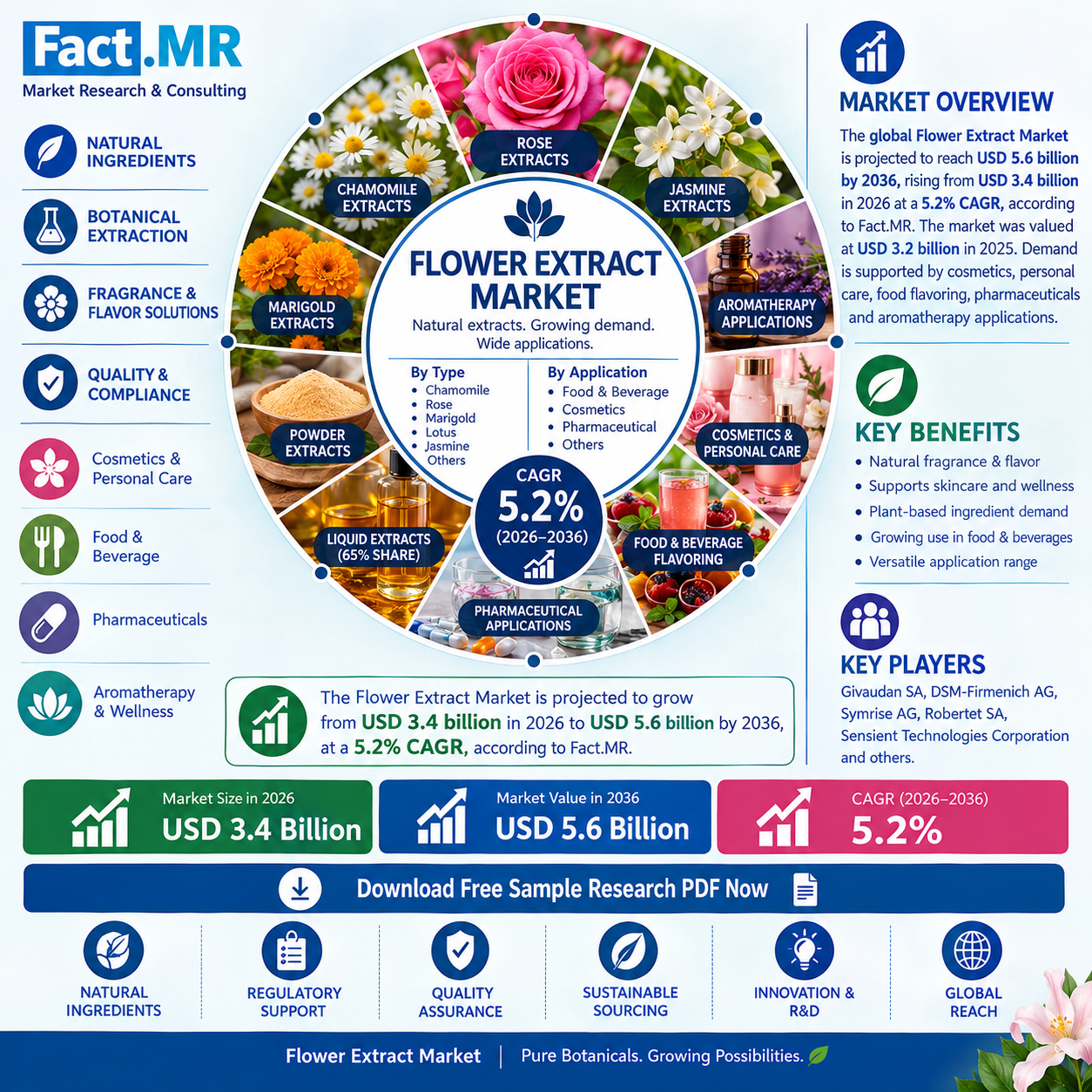
Flower extract demand is projected to rise from USD 3.4 billion in 2026 to USD 5.6 billion by 2036, with India recording a 6.2% CAGR.
September 21, 2026 — The global Flower Extract Market is projected to reach USD 5.6 billion by 2036, up from USD 3.4 billion in 2026, according to Fact.MR. The market is expected to expand at a 5.2% CAGR from 2026 to 2036, representing USD 2.2 billion in absolute dollar growth over the forecast period. Demand is being supported by flower extracts used in cosmetics, personal care, food flavoring, pharmaceuticals, and aromatherapy.
The market was valued at USD 3.2 billion in 2025. Fact.MR estimates that demand will reach USD 3.4 billion in 2026. Natural ingredient adoption remains central to this expansion, while raw material supply, extraction costs, and regulatory standards continue to influence production and commercialization.
Get detailed market forecasts, competitive benchmarking, and pricing trends: https://www.factmr.com/connectus/sample?flag=S&rep_id=14655
Fact.MR is a market research and consulting company that provides market intelligence, forecasts, and strategic analysis across global industries.
Liquid Extracts Hold Around 65% Share
Liquid flower extracts are projected to account for around 65% of the market in 2026, according to Fact.MR. Their formulation compatibility supports use in creams, lotions, serums, food products, and pharmaceutical formulations.
Steam distillation, solvent extraction, and cold pressing are among the processes used to produce these extracts. Fact.MR analysis indicates that liquid formats are preferred for uniform dispersion, stability, and compatibility with different formulation systems.
Cosmetics represent approximately 40% of the flower extract market in 2026. Rose, lavender, and chamomile extracts are used in skincare, haircare, perfumes, lotions, and shampoos, where fragrance and functional properties influence formulation choices.
India Records 6.2% CAGR Through 2036
India is projected to record the fastest country-level growth among the five markets highlighted by Fact.MR, with a 6.2% CAGR from 2026 to 2036. The report links this trajectory to floral raw material availability and increasing use of botanical ingredients in cosmetics and traditional formulations.
Germany follows with a 5.3% CAGR, supported by demand in personal care and fragrance applications. China is projected to grow at 5.0%, while Japan records 4.8%. The United States shows a 3.9% CAGR, reflecting a mature market where demand is associated largely with replacement and reformulation cycles.
The regional picture varies by supply base and application demand. Asia Pacific remains a major botanical sourcing region, while Europe maintains established floral cultivation, extraction, fragrance, and cosmetic industries.
Regulatory Standards Shape Product Development
Natural flower extracts are subject to regulatory requirements covering safety, labeling, and permitted ingredient use. The European Union Cosmetics Regulation (EC) No 1223/2009 and U.S. Food and Drug Administration ingredient regulations are identified by Fact.MR as relevant frameworks.
In China, the Cosmetics Supervision and Administration Regulation, updated in 2021, governs cosmetic ingredient compliance. India's botanical product environment is also influenced by ongoing AYUSH Ministry guidelines.
These requirements matter because manufacturers must manage product consistency alongside traceability and compliance. Extraction costs also remain a consideration, since flower extracts require cultivation, harvesting, and processing before reaching formulation manufacturers.
Competition Centers on Sourcing and Extraction
Fact.MR describes the competitive structure as moderately fragmented. Givaudan SA, DSM-Firmenich AG, Symrise AG, Robertet SA, and Sensient Technologies Corporation are among the companies profiled in the report.
Several participants maintain direct sourcing relationships with flower growers and use specialized extraction capabilities. Buyer decisions also consider quality consistency, sourcing authenticity, traceability, regulatory compliance, and formulation compatibility.
An insider-level detail from the Fact.MR analysis is the 65% projected 2026 share for liquid extracts, which provides a specific indication of the form segment's position within the market.
View Related Reports :
https://telegra.ph/Feed-Phytogenics-Market-Advances-as-Livestock-Producers-Reduce-Antibiotics-09-19
https://www.foundersclick.com/blogs/63050/Feed-Phytogenics-Market-Reaches-USD-1-0-Billion-in-2026
Analyst View
Shambhu Nath Jha, Principal Consultant at Fact.MR, said, “Demand remains aligned with natural ingredient adoption across cosmetics, food, and pharmaceutical applications. Flower extracts continue to serve as key components in fragrance and functional formulations.”
Jha added, “Companies that strengthen sourcing networks, extraction efficiency, and product consistency will maintain competitive positioning as demand expands through 2036.”
The report identifies reliable floral sourcing, extraction efficiency, quality control, regulatory compliance, and cost management as areas requiring attention as the market develops.
The complete from Fact.MR provides market sizing from 2026 to 2036, segment analysis by type, application, and form, country-level forecasts, competitive assessment, and regulatory analysis.
For regulatory context, manufacturers can also consult the for information on cosmetic product requirements within the European Union.
About Fact.MR
Fact.MR is a market research and consulting firm providing market intelligence, industry analysis, and forecasting across global markets. Its research combines primary interviews, desk research, industry datasets, and market-sizing methodologies to support business and strategic decisions.

 English
 Arabic
 French
 Spanish
 Portuguese
 Deutsch
 Turkish
 Italiano
 Russian
 Romaian
 Portuguese (Brazil)
 Greek
Greek