


Global Joint Replacement Market to Hit US$ 41.02 Billion by 2036
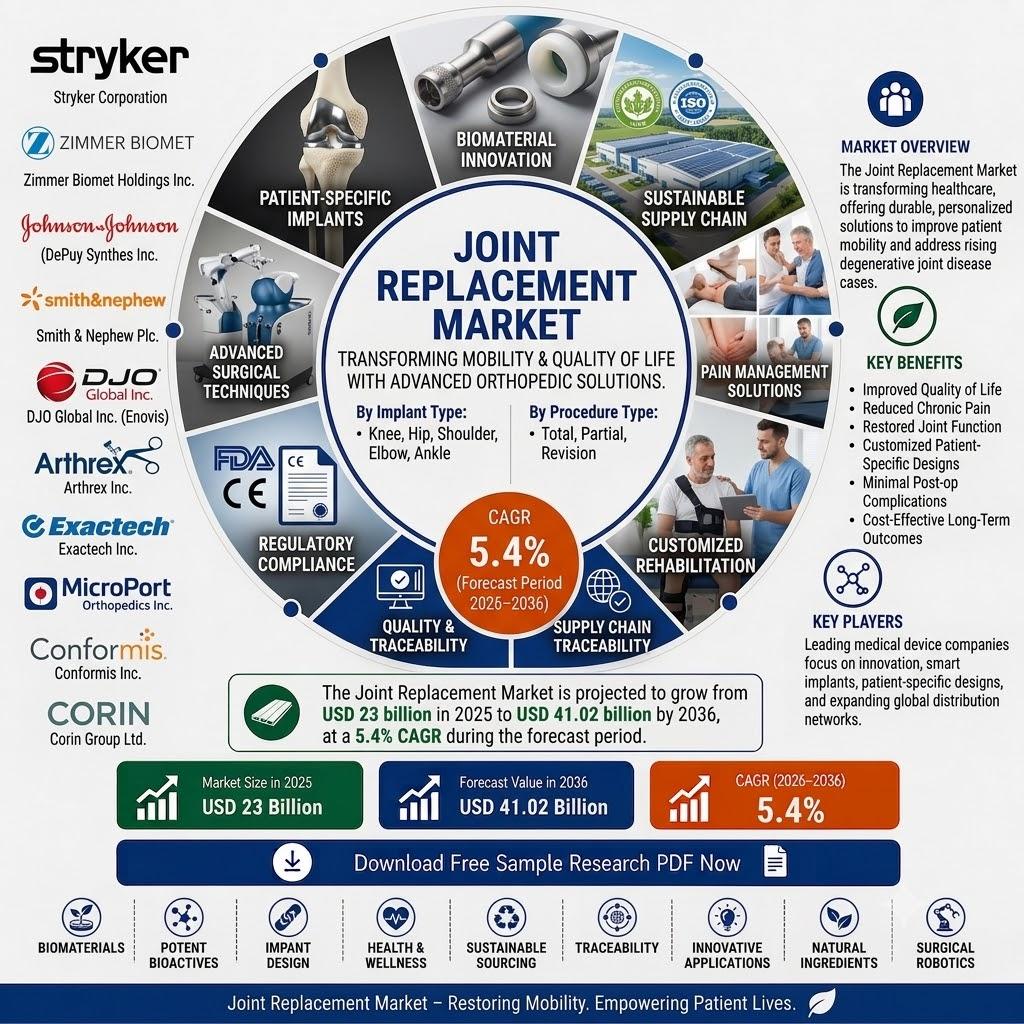
The global joint replacement market is valued at approximately US$ 23 billion in 2025 and is projected to reach US$ 41.02 billion by 2036, expanding at a CAGR of 5.4%, according to Fact.MR. The market is estimated at US$ 24.24 billion in 2026, creating an absolute dollar opportunity of US$ 16.78 billion through 2036.
The [Joint Replacement Market] is being shaped by higher surgical volumes, implant material innovation, and wider adoption of technology across orthopedic care. Knee Replacement Implants account for 48% of product share in 2026, while Osteoarthritis Treatment represents 55% of application share.
Get detailed market forecasts, competitive benchmarking, and pricing trends: https://www.factmr.com/connectus/sample?flag=S&rep_id=11623
Robotic Surgery Changes Joint Replacement Demand
The joint replacement market is moving toward technology-supported procedures as hospitals invest in systems designed to assist surgical planning and implant positioning. Robotic Assisted Surgery Systems account for 44% of technology share in 2026, reflecting growing adoption across institutional and commercial healthcare settings.
Fact.MR analysis identifies robotic-assisted surgery as an important trend for the next phase of market development. Computer-navigated platforms can support implant alignment and surgical planning while helping hospitals standardize procedure workflows.
“Robotic-assisted systems are changing how surgeons plan and execute procedures, and hospitals that invest in these platforms are capturing more referrals,” said Shambhu Nath Jha, Principal Consultant at Fact.MR.
The shift is also reaching community hospital settings. Orthopedic departments are increasingly evaluating systems that connect pre-operative imaging with intra-operative guidance, particularly where procedure volumes can support the capital investment.
Fact.MR is a market research company that provides industry intelligence, market forecasts, competitive analysis, and strategic insights across global business sectors.
India and China Record Faster Market Growth
Regional growth varies across major markets. India is projected to expand at a CAGR of 7.5% through 2036, followed by China at 7.2%. Japan is forecast to grow at 5.3%, while the United States is projected at 5.0%.
India's expansion is linked to broader surgical access, medical tourism for orthopedic procedures, and rising middle-class healthcare spending. China is seeing demand supported by aging demographics, expanding orthopedic capacity, and greater availability of domestic and imported implant systems.
The United States remains a mature market with established reimbursement pathways, high procedure volumes, and growing use of robotic surgery platforms. Germany and the UK are projected to grow at 4.8% and 4.9%, respectively, supported by established healthcare systems and joint registry data.
Knee Implants Remain the Largest Product Segment
Knee Replacement Implants are projected to hold 48% of product share in 2026. The segment benefits from established buyer preference, a strong installed base, and integration with existing orthopedic workflows.
Osteoarthritis Treatment holds 55% application share in 2026. Rising prevalence of osteoarthritis among aging populations is increasing demand for knee and hip replacement procedures.
Outpatient care is another area receiving attention. Expanding ambulatory surgical center capacity can reduce procedure costs and increase patient throughput, supporting a wider shift toward outpatient arthroplasty.
“Outpatient arthroplasty is compressing cost structures and rewarding manufacturers that can offer value-engineered implant systems without compromising clinical outcomes,” Jha said.
Product Innovation Creates New Opportunities
The market is also seeing opportunities in 3D-printed patient-specific implants, which create a premium product category focused on anatomical fit and surgical outcomes. Growth in revision arthroplasty is creating another demand cycle as existing implants reach the later stages of their service life.
However, adoption remains uneven. High costs for robotic surgery platforms and patient-specific implants can limit uptake in price-sensitive healthcare systems. Concentration among major implant manufacturers can also create procurement challenges for smaller hospital systems.
A shortage of trained orthopedic surgeons in emerging markets remains another constraint despite rising clinical demand.
Competitive Landscape
Key companies operating in the joint replacement market include Stryker Corporation, Zimmer Biomet Holdings Inc., Johnson & Johnson (DePuy Synthes Inc.), Smith & Nephew Plc., DJO Global Inc. (Enovis), Arthrex Inc., Exactech Inc., MicroPort Orthopedics Inc., Conformis Inc., and Corin Group Ltd.
Stryker, Zimmer Biomet, and Johnson & Johnson (DePuy Synthes) compete across broad implant portfolios and robotic-assisted surgery capabilities. Smith & Nephew, DJO Global, and Arthrex maintain positions across specific product categories and distribution channels.
Recent industry developments highlighted by Fact.MR include Stryker's Mako platform expansion in 2025, Zimmer Biomet's personalized implant technology developments in 2026, Smith & Nephew's digital surgery integration initiatives in 2025, and DePuy Synthes' ambulatory joint replacement program expansion in 2026.
To View Top Reports
https://social.mytamam.com/blogs/41031/Global-Industrial-Air-Table-Market-to-Reach-USD-328-5
https://net-pals.com/blogs/36769/Industrial-Air-Table-Market-Set-to-Reach-USD-328-5
https://uddokta64.com/blogs/8113/Industrial-Air-Table-Market-Projected-to-Hit-USD- 328-5
https://acmingle.com/blogs/21120/Industrial-Air-Table-Market-Expected-to-Reach-USD-328-5
About Fact.MR
Fact.MR is a market research and consulting company providing market intelligence, competitive analysis, and forecasting across global industries. Its research combines secondary research, primary interviews, demand-side modelling, and country-level analysis to assess market opportunities and industry trends.
The Joint Replacement Market study draws on 120+ secondary sources, benchmarks 65+ company product portfolios, and incorporates 25+ primary interviews with manufacturers, distributors, institutional buyers, and end users. The analysis covers more than 30 countries across the 2026–2036 forecast period.

 English
 Arabic
 French
 Portuguese
 Deutsch
 Turkish
 Dutch
Dutch
 Italiano
 Russian
 Romaian
 Portuguese (Brazil)
 Greek
Greek