


Global Soft Baked Cookies Market Set to Hit USD 907.8 Million by 2036: FMI Report
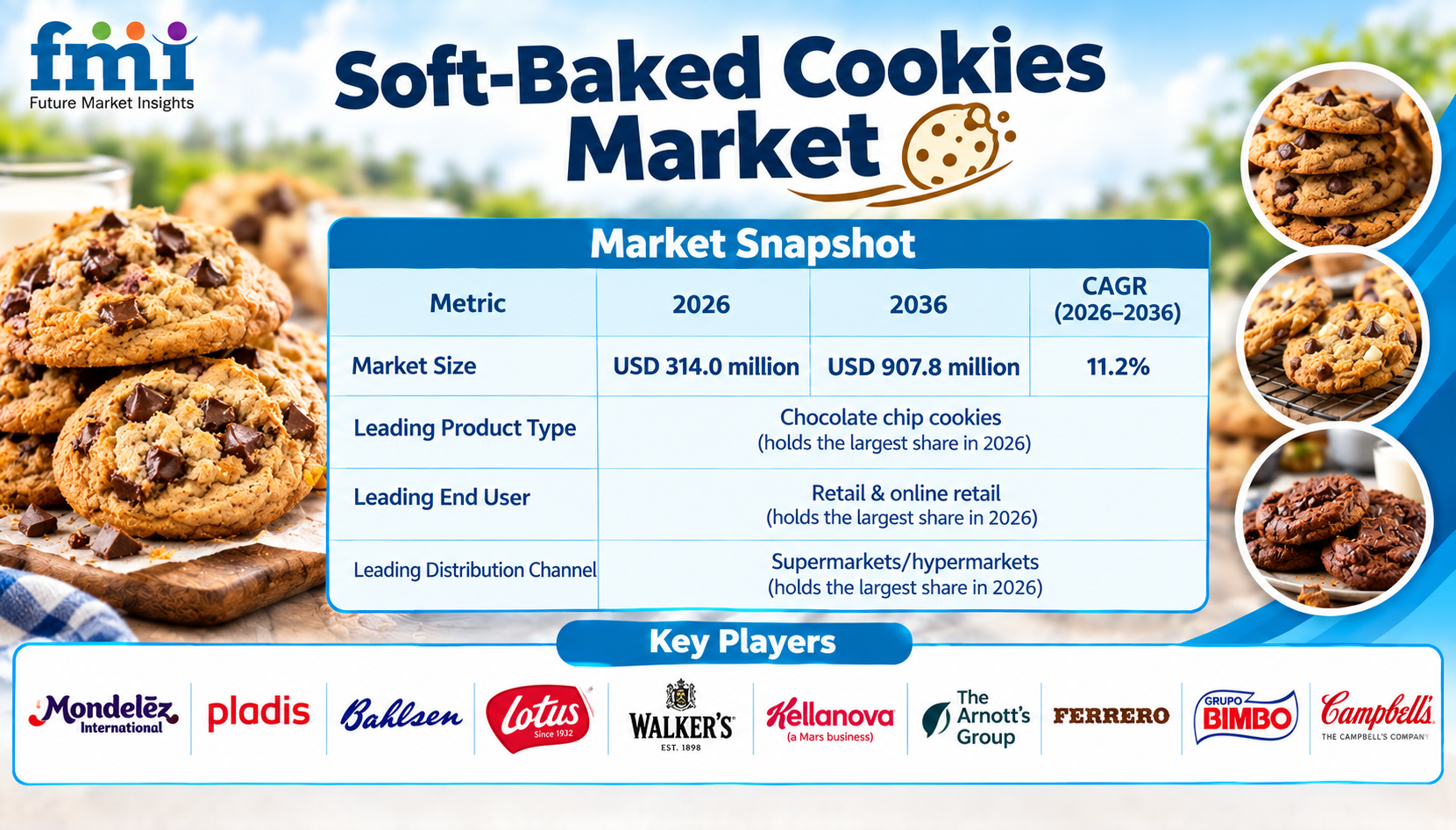
The global Soft-Baked Cookies Market is projected to grow from USD 314.0 million in 2026 to USD 907.8 million by 2036, advancing at an 11.2% CAGR during the forecast period, according to the latest research from Future Market Insights (FMI).
The market is driven by consumer preference for cookies offering a tender, moist, bakery-style texture alongside familiar flavors. Manufacturers are increasingly focused on moisture management, protective packaging, and shelf-life performance to ensure that the intended soft texture remains stable through transportation, retail handling, and replenishment cycles.
Get Detailed Market Forecasts, Competitive Benchmarking, and Pricing Trends: https://www.futuremarketinsights.com/reports/sample/rep-gb-35362
By product type, chocolate chip cookies are estimated to account for 30.0% of demand in 2026. The familiar combination of cookie dough and chocolate inclusions provides consumers with a recognizable flavor profile and can reduce trial barriers for new soft-baked products.
By claim nature, conventional products are projected to capture 55.0% of demand in 2026. Conventional recipes provide manufacturers with greater flexibility when adjusting moisture, texture, ingredients, and processing parameters to achieve a consistent soft bite.
By format, fresh soft-baked cookies are expected to represent 36.0% of demand in 2026. Shorter selling windows can help preserve aroma and tender texture, although the format requires tighter inventory and distribution management.
Moisture Control Becomes Central to Soft-Baked Cookie Performance
Soft-baked cookies depend on higher moisture levels than conventional crisp cookies, making moisture migration and packaging performance important factors in maintaining product quality.
Research published by the Japan Society of Cookery Science in August 2025 found that higher-moisture soft cookies can lose quality more rapidly during storage than lower-moisture crisp cookies.
For manufacturers, this creates a direct connection between formulation, packaging, transportation, and shelf-life performance. Protective packaging must limit undesirable moisture transfer while maintaining the texture consumers expect from a soft-baked product.
Suppliers that can maintain a stable tender texture throughout routine retail distribution can improve product consistency and reduce quality-related waste.
Chocolate Chip Products Maintain Broad Consumer Recognition
Chocolate chip cookies are estimated to account for 30.0% of product type demand in 2026.
The category benefits from strong consumer familiarity and a flavor profile that translates across packaged, fresh, premium, and indulgent cookie formats.
Chocolate inclusions can also provide manufacturers with opportunities to differentiate products through chip size, chocolate intensity, dough formulation, and portion size while retaining a recognizable base product.
For retailers, familiar chocolate chip positioning can reduce the explanation required for consumers evaluating new soft-baked products and support repeat purchasing when texture expectations are consistently met.
Conventional Formulations Anchor Claim-Nature Demand
Conventional soft-baked cookies are projected to represent 55.0% of claim-nature demand in 2026.
Conventional formulations provide manufacturers with broader recipe flexibility when managing moisture, softness, ingredient functionality, and processing conditions.
This flexibility is particularly important for soft-baked cookies because relatively small changes in formulation or processing can influence texture and shelf stability.
Specialty claims such as organic, clean label, gluten-free, and other formulation-led positions can create additional opportunities, but conventional products continue to provide a broad platform for mainstream production and distribution.
Fresh Formats Protect Aroma and Tender Texture
Fresh soft-baked cookies are expected to capture 36.0% of format demand in 2026.
Fresh formats can preserve the aroma, tenderness, and sensory characteristics associated with bakery-style cookies when products reach consumers within a controlled selling window.
However, shorter selling lives create greater inventory-management requirements. Retailers must coordinate replenishment and stock rotation carefully to ensure that products retain their intended quality before purchase.
For manufacturers, the challenge is to balance freshness with distribution reach. Wider retail networks can create additional demand opportunities, but longer transportation and storage periods increase the importance of protective packaging and moisture control.
Protective Packaging Supports Wider Retail Distribution
Packaging represents a critical commercial component of the soft-baked cookie value proposition.
Higher moisture content can make products more sensitive to environmental conditions and moisture migration. Packaging therefore needs to protect the cookie from quality deterioration while supporting transportation, shelf display, and normal retail handling.
The ability to maintain texture through the complete distribution cycle can influence whether retailers accept soft-baked cookies for broader store coverage.
For suppliers, packaging cost must also remain compatible with mainstream cookie economics. Excessive packaging requirements can raise product costs, limiting the ability of soft-baked formats to compete with established cookie categories.
Shelf-Life Management Remains a Key Commercial Challenge
Soft-baked cookies face a fundamental trade-off between moisture-driven tenderness and shelf stability.
A product with insufficient moisture may fail to deliver the intended soft texture, while excessive moisture can accelerate quality deterioration and increase packaging requirements.
Manufacturers must therefore optimize formulation and processing conditions to achieve the desired sensory profile while maintaining acceptable shelf life.
Retail replenishment cycles add another layer of complexity. Brands need to ensure that cookies retain texture and flavor from manufacturing through distribution and final consumption, particularly as products move through multiple handling stages.
Retail Promotion and Claim Compliance Shape Brand Visibility
Changes in food marketing regulations can influence how cookie brands reach consumers.
United Kingdom guidance updated in June 2025 confirmed that qualifying less-healthy foods face paid online advertising restrictions from January 2026. For brands falling within the relevant scope, packaging, shelf presentation, and in-store recognition can become more important components of consumer conversion.
This increases the importance of product differentiation at the point of purchase. Familiar flavors such as chocolate chip, clear packaging communication, and recognizable brand positioning can help products compete for attention when digital promotional options are restricted.
Consumer Familiarity and Texture Consistency Create Growth Opportunities
Soft-baked cookies provide manufacturers with an opportunity to combine familiar flavors with a differentiated sensory experience.
Chocolate chip, filled, flavored, premium, and other formats can expand the category while maintaining the core appeal of a tender cookie texture.
Smaller portions, multipacks, and individually wrapped formats can also extend consumption occasions across snacking, lunchbox, household, and impulse purchases.
The commercial opportunity ultimately depends on maintaining consistency. Consumers who purchase a soft-baked cookie expect the same tender texture across repeat purchases, making moisture management and packaging performance central to brand loyalty.
Competitive Landscape
The Soft-Baked Cookies Market features multinational food companies, global biscuit manufacturers, premium bakery brands, and regional cookie producers.
Key companies identified by FMI include Mondelēz International, pladis, Bahlsen, Lotus Bakeries, Walker's Shortbread, Kellanova (a Mars business), The Arnott's Group, Ferrero, Grupo Bimbo, and The Campbell's Company.
Competition centers on texture consistency, moisture control, packaging technology, flavor recognition, shelf stability, product claims, and retail distribution.
Large food manufacturers benefit from extensive distribution networks and established cookie brands, while specialty bakery companies can compete through premium formulations, fresh positioning, differentiated flavors, and bakery-style texture.
Analyst Perspective
"Soft-baked cookies can earn repeat purchase only if higher moisture survives the selling window without pushing pack cost beyond mainstream cookie economics. Retailers will give softer formats durable shelf space when texture stability and claim compliance hold during normal replenishment cycles." — Nandini Roy Choudhury, Principal Consultant, Future Market Insights
Read the Full Soft-Baked Cookies Market Report Future Market Insights – https://www.futuremarketinsights.com/reports/soft-baked-cookies-market
Report Scope
FMI's Soft-Baked Cookies Market study covers product type, claim nature, format, packaging format, sales channel, and region.
The product type analysis includes chocolate chip and other soft-baked cookie varieties, while claim nature evaluates conventional and specialty claim-led offerings.
Format analysis covers fresh and other commercial formats, with the study assessing packaging requirements, moisture management, shelf-life performance, distribution conditions, and retail handling.
The report evaluates the market across major global regions and examines the factors influencing soft-baked cookie adoption, including consumer texture preferences, formulation flexibility, protective packaging, shelf stability, retail replenishment, and marketing requirements.
For details on FMI's research framework, view the FMI research methodology. - https://www.futuremarketinsights.com/methodology
Explore More Related Studies Published by FMI
Botanical Hydration Powders Market https://www.futuremarketinsights.com/reports/botanical-hydration-powders-market
Protein Fiber Bites Market https://www.futuremarketinsights.com/reports/protein-fiber-bites-market
Sleep Hydration Drinks Market https://www.futuremarketinsights.com/reports/sleep-hydration-drinks-market
Upcycled Grain Crackers Market https://www.futuremarketinsights.com/reports/upcycled-grain-crackers-market
Upcycled Vegetable Chips Market https://www.futuremarketinsights.com/reports/upcycled-vegetable-chips-market
About Future Market Insights (FMI)
Future Market Insights (FMI) delivers actionable, decision-focused market intelligence that goes beyond traditional research reports.
The company provides:
- In-depth pricing and cost benchmarking analysis
- Demand forecasting based on real industry inputs
- Procurement and buyer behavior insights
- Supply chain and trade flow intelligence
- Technology and application trend analysis across industries
FMI follows a robust bottom-up research methodology, combining insights from industry experts, procurement leaders, manufacturers, and technical professionals to provide practical market intelligence.
For Press & Corporate Inquiries
Rahul Singh AVP – Marketing and Growth Strategy
Future Market Insights, Inc.
For Sales: sales@futuremarketinsights.com
For Media: Rahul.singh@futuremarketinsights.com
Web: https://www.futuremarketinsights.com/

 English
 Arabic
 French
 Spanish
 Portuguese
 Deutsch
 Turkish
 Dutch
Dutch
 Italiano
 Romaian
 Portuguese (Brazil)
 Greek
Greek