


Ceramic Membrane Market Set for Strong Growth Through 2036
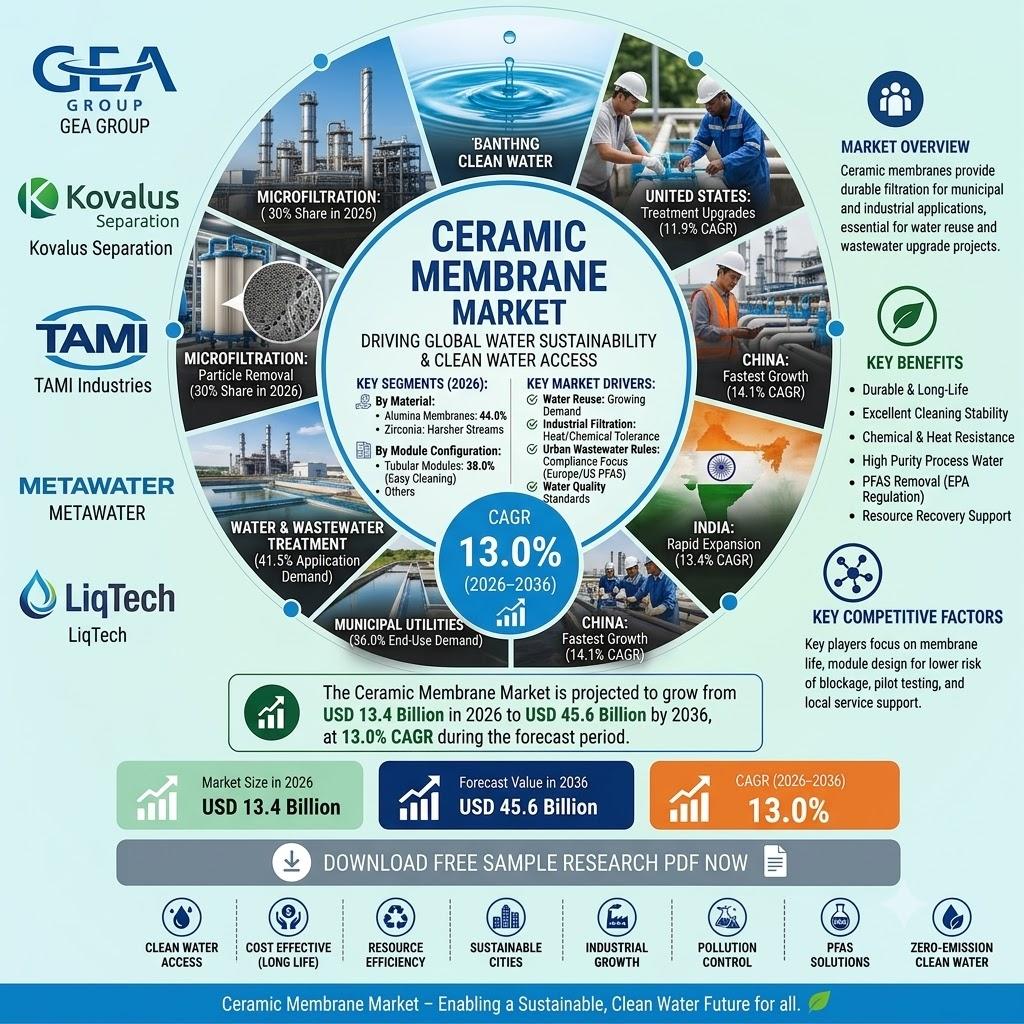
Subheadline: Ceramic membrane market reaches USD 13.4 billion in 2026 and is projected to grow at 13.0% CAGR through 2036 as water reuse supports demand.
September 22, 2026 — The global Ceramic Membrane Market is projected to reach USD 45.6 billion by 2036, rising from USD 13.4 billion in 2026 at a 13.0% CAGR, according to Fact.MR. Demand is being supported by water reuse projects, wastewater upgrades, contaminant control requirements, and industrial filtration needs.
The market has a clear near-term focus. Water and wastewater treatment is forecast to account for 41.5% of application demand during the forecast period, while municipal utilities are expected to represent 36.0% of end-use demand in 2026. These figures reflect the need for durable filtration across public water systems and reuse projects.
Get detailed market forecasts, competitive benchmarking, and pricing trends: https://www.factmr.com/connectus/sample?flag=S&rep_id=8023
Ceramic Membrane Market provides detailed analysis of technology, material, module configuration, application, end use, and regional demand through 2036.
Ceramic Membrane Market Gains Ground in Water Treatment
Fact.MR identifies water quality compliance as a key demand driver. Public utilities require treatment systems capable of stronger contaminant control, while wastewater operators face tighter treatment expectations. In Europe, revised urban wastewater rules entered into force in December 2024, supporting demand for advanced wastewater management.
Industrial process plants are also part of the demand base. Ceramic membranes are used for wastewater containing heat or suspended solids, where repeated cleaning can create challenges for conventional polymer systems. The source notes that ceramic formats offer better tolerance for repeated cleaning in difficult filtration work.
Fact.MR is a market research company that provides strategic intelligence, market forecasts, segment analysis, and supplier validation across industrial markets. Its ceramic membrane assessment uses primary interviews, supplier checks, desk research, and a hybrid top-down and bottom-up forecasting approach.
Microfiltration and Alumina Lead Key Segments
Microfiltration is expected to hold a 30.0% share in 2026, supported by particle removal and pretreatment requirements. Fact.MR reports that plant teams can validate microfiltration faster in municipal water and industrial pretreatment systems, where feed quality can change over time.
Alumina membranes are forecast to account for 44.0% share in 2026. Plant engineers favor alumina because durability and cost control remain balanced, while wider availability supports its use in water filtration. Zirconia serves harsher process streams where chemical resistance is important.
Tubular modules are another important segment. Fact.MR expects tubular configurations to account for 38.0% share in 2026, as high-solids wastewater requires easier cleaning and lower blockage risk. Module design can influence cleaning time and service costs after installation.
China and India Show Strong Growth Outlook
China is forecast to record the fastest growth among the countries analyzed, with a 14.1% CAGR from 2026 to 2036. Municipal treatment upgrades, industrial park development, and rising water reuse demand are supporting adoption. India follows with a projected 13.4% CAGR, driven by urban water programs and industrial park expansion.
The United States is forecast to expand at 11.9% CAGR, while Japan is projected at 10.9%, Germany at 10.1%, and Brazil at 9.5% through 2036. Fact.MR links these country outlooks to treatment upgrades, high-purity process water requirements, wastewater compliance, and expanding municipal treatment capacity.
In the United States, the Environmental Protection Agency issued the PFAS National Primary Drinking Water Regulation in April 2024, establishing enforceable drinking water limits for selected PFAS chemicals. This regulatory development is cited by Fact.MR as part of the treatment-upgrade environment affecting ceramic membrane demand. EPA PFAS National Primary Drinking Water Regulation
Top Trending Reports :
https://social.mytamam.com/blogs/41316/Active-Protection-System-Market-to-Reach-USD-8-6-Billion
https://ayushjadhavblogs.blogspot.com/2026/09/marine-collagen-peptide-supplements.html
https://www.pikumil.com/blogs/189026/Duplex-Nickel-Plating-Market-Forecast-Shows-Steady-Growth
https://sohomoy.com/blogs/54978/Flower-Extract-Market-Growth-Fueled-by-Botanical-Ingredients
Suppliers Focus on Cleaning Stability and Service
Competition in the ceramic membrane market centers on membrane life, cleaning stability, module design, and local service support. Fact.MR identifies GEA Group AG, Kovalus Separation Solutions Inc., TAMI Industries SAS, METAWATER Co., Ltd., and LiqTech International, Inc. among the key companies profiled.
A specific 2026 development highlights commercial activity in the segment. LiqTech International, Inc. secured its first U.S. commercial pool order for three QlariFlow ceramic membrane filtration systems in March 2026, according to the Fact.MR report's cited company announcement.
Shambhu Nath Jha, Senior Analyst at Fact.MR, said, “Ceramic membrane demand is moving beyond premium filtration projects.”
Jha added, “Suppliers that prove uptime and service support will protect repeat demand.”
The report identifies high upfront system cost as the main restraint. Plant managers need evidence that longer membrane life can offset higher capital spending, while feed-specific testing can slow approval because wastewater characteristics differ by site.
Fact.MR expects pilot testing and service support to remain central to supplier positioning through 2036. Municipal utilities need reliable filtration for water reuse, while industrial plants require systems capable of handling difficult feed streams.
About Fact.MR
Fact.MR is a market research and consulting firm providing market intelligence, forecasts, competitive analysis, and strategic insights across global industries. Its ceramic membrane market study covers demand from 2026 to 2036 across technology, material, module configuration, application, end use, and regional markets. The report includes primary interviews with water utility engineers, wastewater plant administrators, and industrial process engineers, alongside supplier checks and desk research.

 English
 Arabic
 French
 Spanish
 Portuguese
 Deutsch
 Turkish
 Dutch
Dutch
 Italiano
 Russian
 Portuguese (Brazil)
 Greek
Greek