


Eye Tracking Market Growth Gains From Strategic Technology Partnerships
The way people interact with technology is changing as digital systems become more responsive to human behavior. Eye tracking is becoming an important part of this transformation because it allows devices and software to understand where a person is looking, how attention shifts, and how visual behavior can be translated into actionable information. Its growing use across healthcare, retail, automotive, research, consumer electronics, security, VR, and AR is creating a rapidly expanding commercial opportunity.
The global Eye Tracking Market was estimated at USD 638.8 million in 2021 and is projected to reach USD 8.06 billion by 2030, expanding at a 33.4% CAGR from 2022 to 2030. Increasing use of smart sensors, contactless biometrics, artificial intelligence, virtual reality, and augmented reality is expected to remain central to market development.
The Eye Tracking Growth Journey
AI, VR & AR Adoption
↓
Growing Need to Understand Visual Behavior
↓
Eye Movement & Gaze Tracking
↓
Data Capture and Analysis
↓
Healthcare, Retail, Automotive & Research Applications
↓
Smarter Digital Interaction
↓
Eye Tracking Market Expansion
This progression explains why eye tracking is moving beyond specialized research environments. The technology can now support everything from assistive communication and driver monitoring to consumer behavior analysis and immersive gaming.
Optical Tracking Remains at the Center of the Market
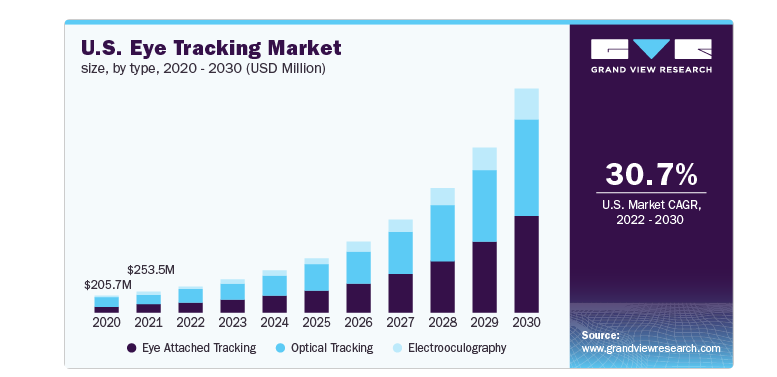
Optical tracking accounted for more than 52.0% of market revenue in 2021, making it the leading technology segment. These video-based systems use cameras and optical sensors to continuously record gaze position and eye movement. Because they can operate without physically attaching tracking equipment to the user, optical systems are particularly useful in VR, AR, research, and commercial applications.
The technology is also becoming more flexible. Eye-attached tracking systems are expected to register the fastest CAGR during the forecast period. These devices can track eye movement even when the user's head moves, creating opportunities in healthcare, research, retail, and consumer electronics.
Electrooculography, or EOG, represents another approach. It detects electrical signals through electrodes positioned around the eyes and can operate even in darkness or when the eyes are closed. However, optical systems offer stronger gaze-detection accuracy in many applications.
Hardware Captures the Movement, Software Creates the Insight
Hardware represented 60.01% of revenue in 2021, supported by demand for cameras, sensors, tracking devices, storage components, and related equipment. Yet software is becoming increasingly important as companies look beyond simply capturing eye movement.
Once information is collected, software can filter and process the data before converting it into insights about attention, behavior, or interaction. This is particularly valuable in medical research, where analyzed eye-movement information can support studies involving neurological and psychiatric conditions.
Download a free sample report or claim your copy of this full market intelligence report
In automotive applications, the same technology can contribute to driver-monitoring systems by analyzing gaze direction and eyelid movement to identify inattentive behavior. This transition from hardware-based tracking toward data-driven interpretation is creating additional opportunities across the market.
Eye Tracking Is Finding Its Place Across Multiple Industries
Healthcare remains one of the most established application areas, accounting for more than 25.0% of revenue in 2021. Initially, eye tracking was primarily used as an assistive communication mechanism for people with mobility or communication difficulties. Today, its potential extends to hands-free computer control, research, clinical applications, and digital interfaces.
Retail is using eye tracking for a different purpose: understanding consumer attention. Companies can analyze how long shoppers look at products, which packaging elements attract attention, and how store layouts influence visual engagement.
Automotive applications are also expanding. As AI becomes increasingly integrated into vehicles, eye tracking can support driver state monitoring by evaluating gaze direction and eyelid movement. Such applications are contributing to the broader development of intelligent vehicle interfaces.
In VR and AR, eye tracking can make digital experiences more responsive. Developers can use gaze information to improve interaction, interface design, gaming experiences, and virtual avatars. Collaborations between eye-tracking companies and technology platforms are helping push these applications forward.
Remote Systems Lead While Mobile Tracking Gains Momentum
The remote segment accounted for more than 62.0% of revenue in 2021. Remote systems generally track users positioned in front of a screen or tracking device and are widely used for behavioral research, advertising analysis, and other screen-based applications.
Mobile tracking works differently because the equipment is generally head-mounted, allowing users to move freely while their gaze is continuously monitored. This makes mobile systems suitable for real-world behavioral studies and three-dimensional environments. The mobile tracking segment is expected to record the fastest CAGR through 2030 as commercial applications become more sophisticated and organizations seek to understand behavior beyond controlled screen-based environments.
From Assistive Technology to Contactless Biometrics
One of the most important opportunities for the eye tracking market lies in its ability to provide contactless interaction. Gaze-based interfaces can help individuals with disabilities operate computers and communication systems without conventional hand controls. Technologies such as eye-gaze interaction can allow users to select, activate, scroll, and navigate using visual movement.
Contactless biometric applications create another opportunity. Iris scanning and related technologies can support identification and authentication in environments where security is critical, including government, defense, and correctional facilities.
These applications demonstrate that eye tracking is not limited to observing behavior. It can also become an input mechanism, authentication tool, and accessibility technology.
North America Holds the Largest Market Position
North America accounted for more than 48.0% of revenue in 2021 and is expected to retain its leading position during the forecast period. Strong adoption of smart sensors, contactless biometric technologies, advanced healthcare solutions, and research technologies supports regional growth.
The U.S. represents the largest country-level market in North America. The presence of major technology companies and ongoing innovation in healthcare, automotive, AR, VR, and consumer electronics further supports demand.
Asia Pacific is expected to record the fastest CAGR through 2030. Increasing adoption of eye tracking in consumer electronics, gaming, automotive systems, and research is creating opportunities across China, Japan, and India. The region's expanding technology ecosystem is expected to support continued adoption.
Strategic Partnerships Are Supporting Market Development
The competitive landscape is characterized by partnerships, acquisitions, and continued research and development. Companies are using collaborations to expand their technology capabilities and integrate eye tracking into broader digital platforms.
Tobii, for example, has collaborated with companies across gaming, VR, software, and research. Partnerships involving Microsoft and NVIDIA demonstrate how eye tracking can be integrated with larger technology ecosystems, while acquisitions and platform development are helping expand applications across advertising research and immersive experiences.
Eye Tracking Market Outlook
The eye tracking market is evolving from a specialized vision-capturing technology into a broader human-computer interaction platform. The combination of smart sensors, AI, contactless biometrics, VR, AR, and advanced analytics is creating applications that extend across both consumer and commercial environments.
With the market projected to grow from USD 638.8 million in 2021 to USD 8.06 billion by 2030, continued innovation in optical tracking, mobile systems, software analytics, assistive communication, automotive monitoring, and immersive technology is expected to remain central to the industry's expansion.
About us:
Grand View Research, a market research and consulting company, provides syndicated research reports, customized research reports, and consulting services. Grand View Research database is used by the world's renowned academic institutions and Fortune 500 companies to understand the global and regional business environment. Our database features thousands of statistics and in-depth analysis on 46 industries in 25 major countries worldwide.

 English
 Arabic
 French
 Spanish
 Portuguese
 Deutsch
 Turkish
 Italiano
 Russian
 Romaian
 Portuguese (Brazil)
 Greek
Greek