


Fermentates for Food Preservation Market to Reach USD 953.1 Million by 2036
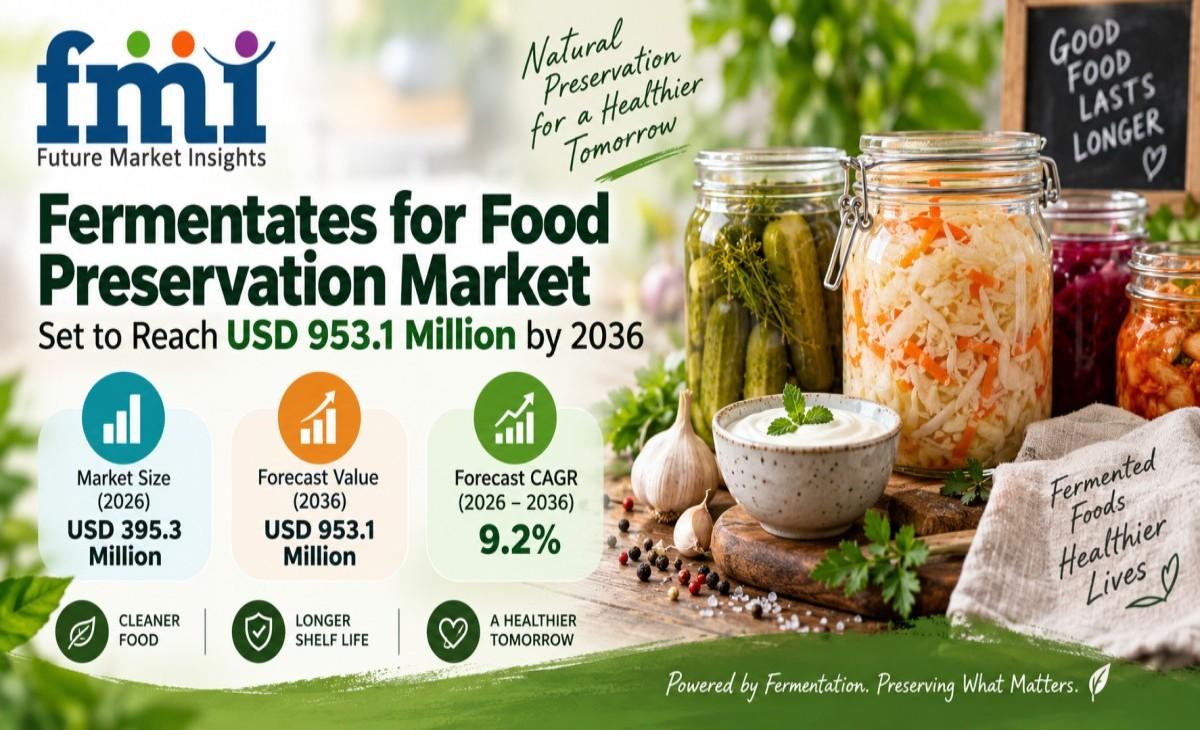
Global fermentates for food preservation market projected to grow from USD 395.3 million in 2026 to USD 953.1 million by 2036 at a 9.2% CAGR, according to Future Market Insights
The global Fermentates for Food Preservation Market is projected to reach USD 953.1 million by 2036, up from an estimated USD 395.3 million in 2026, expanding at a compound annual growth rate (CAGR) of 9.2% during the forecast period, according to the latest analysis by Future Market Insights (FMI).
The market is anticipated to generate an incremental opportunity of USD 557.8 million between 2026 and 2036. Market expansion is propelled by industrial bakery reformulation toward clean-label mold inhibition, escalating commercial costs tied to food waste and retail returns, growing consumer resistance to artificial preservatives (such as calcium propionate), and continuous technological advancements in bio-fermentation and microbial strain development.
Fermentates for food preservation are natural, clean-label shelf-life extension ingredients produced through the controlled fermentation of food-grade substrates like dextrose, wheat, or dairy using selected food cultures. The market encompasses standard, premium, organic, and clean-label grades formulated in dry powder, liquid, paste, and granule forms to prevent mold spoilage across yeast-raised breads, rolls, cakes, pastries, and broader baked snack categories.
Get Detailed Market Forecasts, Competitive Benchmarking, and Pricing Trends:
https://www.futuremarketinsights.com/reports/sample/rep-gb-35059
Standard Grade Anchors High-Volume Industrial Formulations Standard grade is estimated to account for 38.0% of product type demand in 2026, solidifying its role as the primary entry point for commercial preservation programs.
Commercial bakeries utilize standard grade to establish cost-performance baselines through routine microbiological challenge testing without incurring the added cost or documentation of identity-preserved or certified organic sourcing. Products such as Corbion’s Verdad Essence WH100 illustrate how standardized cultured-wheat and dextrose systems provide predictable mold-inhibition performance across high-speed bun, bread, and tortilla lines.
Powder and Dry Formats Dominate Batching Operations Powder / dry is projected to capture 41.0% of the form category in 2026.
Dry fermentates integrate directly into existing pneumatic flour handling, bulk bins, and micro-ingredient dry batching systems, eliminating the capital expense of installing heated lines or liquid metering tanks. The shelf stability of powdered formulations also lowers logistics friction across long distribution lanes and import-dependent markets, while liquid options remain concentrated in automated, high-throughput plants.
Bread & Rolls Lead Application Segment Demand The bread & rolls segment is forecast to account for 27.0% of application demand in 2026.
Packaged yeast-raised products expose mold-control efficacy directly to commercial supply chain timelines, ambient retail shelves, and costly store-level product write-offs. Because visible mold triggers immediate consumer returns, bread lines represent the principal commercial battleground where fermentates must match the efficacy of synthetic preservatives without altering crumb texture, loaf volume, or proofing schedules. Other growing application segments include cakes & muffins, biscuits & cookies, and viennoiserie & pastry.
Direct Industrial Sales Command Distribution Direct sales to industrial bakeries are set to lead the sales channel category with a 52.0% share in 2026.
Clean-label preservation systems cannot be qualified via specification sheets alone; commercial adoption requires in-depth pilot bake trials, specific microbial challenge testing, and line-level dosing optimization. Consequently, direct commercial and technical collaboration between ingredient suppliers and industrial bakeries remains essential to secure scheduled, multi-year supply contracts.
Challenge Testing and Allergen Constraints Frame Adoption While waste-reduction economics favor shelf-life extension, industrial qualification faces complex formulation barriers.
U.S. EPA data highlighting that more than one-third of available food goes uneaten underscores the financial incentive for bakeries to lengthen mold-free windows. However, dose rates, pH sensitivity, flavor impact, and allergen declarations represent persistent operational friction. For instance, cultured wheat fermentates require wheat allergen declarations under FDA regulations, prompting bakeries developing gluten-free lines to seek alternative substrates such as cultured dextrose or specialized corn fermentates.
Country-Level Growth Rates FMI’s geographic analysis identifies strong expansion across the Middle East and East Asia alongside steady demand across established European manufacturing bases:
· United Arab Emirates is projected to lead global growth at a 10.4% CAGR through 2036, driven by an installed base of over 570 food processors relying heavily on imported, shelf-stable preservation ingredients.
· Saudi Arabia follows at a 10.1% CAGR, underpinned by over 1,300 registered food companies and substantial domestic bakery production requiring robust shelf-life defense in warm ambient climates.
· South Korea is anticipated to expand at a 9.8% CAGR, fueled by stringent food-safety standards and strong processor demand for natural, clean-label alternatives to synthetic additives.
· Germany is projected to grow at a 9.2% CAGR, matching the global pace within a mature manufacturing landscape that demands rigorous cost-performance parity against synthetic inhibitors.
· The United Kingdom is forecast to grow at an 8.8% CAGR, where concentrated supermarket supplier guidelines and strict retailer ingredient blacklists drive rapid reformulation.
Competitive Landscape
The Fermentates for Food Preservation Market is characterized by global food-protection corporations, industrial biotechnology developers, and specialized bakery ingredient innovators.
Key companies profiled by FMI include Corbion, International Flavors & Fragrances (IFF), Kerry Group, Puratos, Kemin Industries, J&K Ingredients, Lallemand, and Lesaffre.
Market participants are reinforcing their competitive positions through bio-fermentation R&D, strategic acquisitions, and expanded technical co-creation facilities. Recent industry milestones include J&K Ingredients’ partnership with Pallas Biotech to advance strain-specific clean-label shelf-life extensions, Lallemand’s acquisition of AIT Ingredients, Kerry Group’s launch of its advanced biotechnology centre in Leipzig, and Lesaffre’s worldwide research partnership with MicroBioGen.
Analyst Perspective
“Fermentate economics are decided in the customer formula because a cleaner declaration has little value if a bakery must raise dosage or repeat challenge studies. Stronger offers pair mold-control performance with application work that protects sensory quality and gives industrial plants a specification they can reorder.”— Nandini Roy Choudhury, Principal Consultant, Future Market Insights
Exclusive Discounts on Full Report: https://www.futuremarketinsights.com/reports/fermentates-for-food-preservation-market
Report Scope
The FMI study segments the global Fermentates for Food Preservation Market by product type, form, application, claim, sales channel, and region:
· Product Type: Standard grade, premium / specialty grade, organic certified, and clean label grade.
· Form: Powder / dry, liquid, paste / semi-solid, and granules / pieces.
· Application: Bread & rolls, cakes & muffins, biscuits & cookies, viennoiserie & pastry, and other bakery & snacks.
· Claim: Conventional, clean label, organic, and non-GMO / identity preserved.
· Sales Channel: Direct to industrial bakeries, ingredient distributors, foodservice & artisan supply, and online B2B.
· Regions Covered: North America, Latin America, Western Europe, Eastern Europe, East Asia, South Asia & Pacific, and Middle East & Africa. Forecast period: 2026 to 2036.
FMI's research methodology integrates primary stakeholder interviews with master millers, technical bakery formulators, and procurement directors with rigorous secondary research examining regulatory standards (FDA, EFSA), industry association data, and government economic databases (U.S. Census Bureau, USDA FAS).
Key Executive Benefits
· Decision-Ready Insights
· Reduced Strategic Risk
· Market Entry Confidence
· Competitive Advantage
· Faster Growth Decisions
· Primary Market Validation
To explore how FMI Custom Research can support your strategic priorities, connect with our team at - sales@futuremarketinsights.com
About Future Market Insights (FMI)
Future Market Insights, Inc. is an ESOMAR-certified, ISO 9001:2015 market research and consulting organization trusted by Fortune 500 companies. With a global presence across the U.S., UK, India, and Dubai, FMI delivers data-driven insights across 30+ industries and 1,200 markets worldwide.

 English
 Arabic
 French
 Spanish
 Portuguese
 Deutsch
 Turkish
 Dutch
Dutch
 Italiano
 Russian
 Romaian
 Portuguese (Brazil)