


Global Heat Stabilizers Market to Hit USD 9.9 Billion by 2036, India Drives Regional Growth
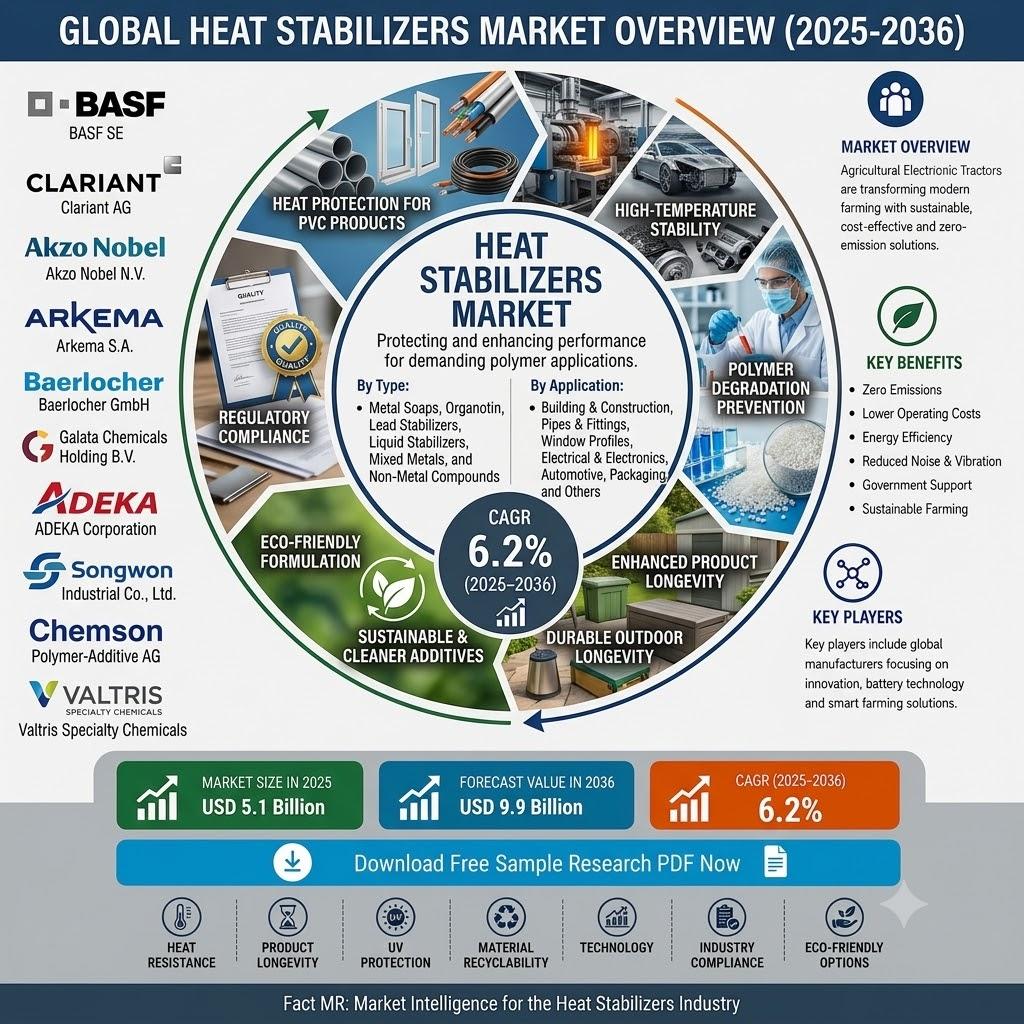
The global Heat Stabilizers Market is projected to increase from USD 5.4 billion in 2026 to USD 9.9 billion by 2036, advancing at a CAGR of 6.2%, according to Fact.MR analysis. The market was valued at USD 5.1 billion in 2025, with an absolute dollar opportunity of USD 4.5 billion expected between 2026 and 2036.
Demand is closely tied to polymer processing, particularly polyvinyl chloride (PVC) manufacturing. Heat stabilizers protect polymers against degradation during high-temperature extrusion, molding, and compounding. Construction materials, electrical cables, packaging products, and automotive components therefore remain important areas of application.
Get detailed market forecasts, competitive benchmarking, and pricing trends: https://www.factmr.com/connectus/sample?flag=S&rep_id=14625
PVC Processing Keeps Heat Stabilizers Demand Connected to Manufacturing
provides analysis of product types, applications, end-use industries, regional markets, competitive activity, and regulatory developments through 2036.
The Heat Stabilizers Market includes chemical additives used to protect polymers from thermal degradation during processing and long-term use. These additives help prevent discoloration, loss of mechanical strength, and chemical breakdown when polymers face elevated temperatures.
Polyvinyl chloride products are expected to account for approximately 55% of market share in 2026. PVC pipes, window profiles, cables, flooring materials, and packaging films require stabilizers to maintain polymer performance during production and throughout product use.
Metallic heat stabilizers are projected to represent around 65% of the market in 2026. Calcium-based and zinc-based formulations are widely incorporated into PVC processing because they help maintain polymer stability during high-temperature manufacturing.
Market Snapshot
- 2026 market value: USD 5.4 billion
- 2036 market value: USD 9.9 billion
- Forecast CAGR: 6.2%
- Absolute dollar opportunity: USD 4.5 billion
- Leading application: PVC products, at approximately 55% share
- Leading type: Metallic heat stabilizers, at approximately 65% share
Fact.MR is a market research and competitive intelligence provider that delivers industry analysis, forecasts, and strategic market assessments across global business sectors.
Regulatory Changes Reshape Stabilizer Formulations
Market development is taking place alongside changes in polymer additive requirements. Traditional heavy metal stabilizers, particularly lead-based systems, face environmental and regulatory restrictions in polymer manufacturing.
Regulatory frameworks including the European Union Restriction of Hazardous Substances (RoHS) Directive and REACH influence the use of certain chemical substances in polymer products. [LINK: European Chemicals Agency REACH regulations] provides authoritative information on the regulatory framework relevant to chemical substances.
Manufacturers are increasingly developing calcium-zinc and organic stabilizer systems as alternatives designed to meet environmental compliance requirements. These formulations can carry higher costs because of specialized chemical compositions and performance requirements.
Petrochemical feedstock prices remain another factor affecting the market. Stabilizer producers and plastic processors must manage raw material cost exposure while maintaining formulation consistency and regulatory compliance.
India Records the Fastest Country-Level Expansion
India is projected to record the fastest expansion among the countries analyzed, with demand for heat stabilizers expected to rise at a 6.9% CAGR from 2026 to 2036. Increasing PVC consumption across construction materials and infrastructure applications supports this growth.
The United States follows with a projected 5.9% CAGR. Demand is linked to building materials, electrical cable insulation, and packaging production.
Germany is projected to expand at a 5.1% CAGR through 2036, reflecting continued use of stabilizers in industrial polymer processing. France records a projected CAGR of 4.9%, supported by packaging and building material applications.
Japan shows a 4.7% CAGR. Its more mature polymer additives market means demand is increasingly associated with replacement cycles and product reformulation.
Polymer Performance Remains Central to Product Development
Heat stabilizers help maintain polymer integrity when materials are exposed to elevated processing temperatures. This function remains particularly relevant for PVC manufacturers producing construction and electrical products.
The market also faces substitution pressure from alternative polymer formulations. Producers therefore need formulations that balance thermal performance, regulatory requirements, processing compatibility, and cost.
Shambhu Nath Jha, Principal Consultant at Fact MR, said, “Heat stabilizers remain essential for maintaining thermal stability during plastic manufacturing. Companies developing formulations that meet evolving regulatory requirements and polymer processing standards can maintain stable positions within the polymer additives market.”
The report identifies BASF SE, Clariant AG, Akzo Nobel N.V., Arkema S.A., Baerlocher GmbH, Galata Chemicals Holding B.V., ADEKA Corporation, Songwon Industrial Co., Ltd., Chemson Polymer-Additive AG, and Valtris Specialty Chemicals among the key companies profiled.
“PVC processing continues to be a core demand area,” Jha added. “Formulation requirements are changing, and suppliers have to respond to both performance needs and regulatory expectations.”
To View Top Reports
https://sierra-le.com/blogs/20547/Joint-Replacement-Industry-to-Reach-US-41-02-Billion-by
https://ikofficial.com/blogs/47177/Joint-Replacement-Market-Valuation-to-Reach-US-41-02-Billion
https://fridayad.co.in/article/joint-replacement-market-poised-to-reach-us-4102-billion-by-2036
https://sensualmarketplace.com/read-blog/107334
About Fact.MR
Fact.MR is a market research and competitive intelligence provider delivering syndicated and customized research across chemicals, materials, technology, healthcare, energy, and other industries. Its research combines primary interviews, desk research, market modeling, and data validation to assess market size, competitive structures, regional trends, and growth opportunities.
The Heat Stabilizers Market report covers market forecasts from 2026 to 2036, including metallic and non-metallic heat stabilizers, PVC products, engineering plastics, rubber and elastomers, polyester resins, and end-use industries such as construction, electrical and electronics, automotive, packaging, consumer goods, and agriculture.

 English
 Arabic
 French
 Spanish
 Portuguese
 Deutsch
 Turkish
 Dutch
Dutch
 Italiano
 Russian
 Portuguese (Brazil)
 Greek
Greek