


Cast Iron Drain Pipe Failure in Older Saugus Homes: Signs, Causes, and What Replacement Involves
Cast iron drain pipes fail from the inside out, which is why most homeowners never see the problem coming until a line backs up or a basement floor starts weeping. Water and waste sit against the bottom of every horizontal run, and over decades that contact corrodes the pipe wall from within while the outside still looks sound. The result is a channel worn along the base of the pipe, then scaling that narrows the opening, then perforation. By the time symptoms are obvious the pipe has usually been deteriorating for years, and replacement rather than patching is what resolves it.
The practical question is when a single repair is enough and when the whole run has to come out. That turns on the condition of the pipe across its entire length rather than at the one spot that is leaking, which is why cast iron pipe replacement in Saugus, MA normally begins with a camera inspection before anyone quotes a scope of work. A drain that failed in one place from a single impact is a different situation from a drain that has thinned uniformly along its length. The first can often be sectioned and repaired. The second cannot, and spending money on it only delays the same conversation.
Why Cast Iron Drain Lines Corrode From Within
Cast iron was the standard material for drain, waste, and vent piping in American homes built before roughly the 1970s, when PVC and ABS became widespread and displaced it. It is a durable material, and trade sources generally cite a service life somewhere in the range of fifty to a hundred years, though that should be treated as a general industry estimate rather than a guarantee for any particular house.
The failure mechanism is consistent. In a horizontal run, waste water does not fill the pipe. It flows along the bottom, leaving the upper wall relatively dry and the lower wall permanently wet, so the lower section corrodes first. Scale builds unevenly, the interior diameter narrows, and flow slows. Slower flow means solids sit longer, which accelerates the same process until the section either perforates or bellies where soil has settled beneath it. Older installations add a second weak point, because hub and spigot cast iron was traditionally joined by packing oakum into the hub and pouring molten lead over it. Decades of thermal cycling and ground movement can loosen those joints, and an open joint leaks long before the pipe body fails.
The Warning Signs Homeowners Notice First
The earliest signal is rarely dramatic. Multiple fixtures draining slowly at the same time points at the main line rather than any single trap, and that distinction matters. One slow sink is a clog. A slow sink, a slow tub, and a toilet that gurgles when the washing machine drains is a main line telling you something.
Recurring backups are the next stage. A drain snaked several times that keeps clogging in the same place is rarely coincidence, because the snake clears the obstruction without addressing the scaled or collapsed section catching the debris. Persistent sewer odor in a basement, damp patches on a slab, rust colored staining where a pipe passes through concrete, and visible pitting on exposed sections all suggest the line has been compromised for some time.
Why Older North Shore Housing Sees This More
Housing stock age is the whole story. Homes built across Saugus and the surrounding North Shore before the shift to plastic drainage were plumbed in cast iron as a matter of course, which means a large share of the area's older homes still run on original drain lines well past half a century in service. That is not a defect in the original work. It is material reaching the end of a long life across a whole generation of houses at once, and New England freeze and thaw cycling adds soil movement that stresses buried lines and joints.
What the Replacement Work Actually Involves
Replacement starts with locating the failure and mapping the run. Where the line is accessible in a basement or crawl space, the deteriorated section is cut out and new pipe set in its place, joined to whatever sound pipe remains. Where the failure sits under a slab, the concrete is opened along the path of the line, the old pipe removed, the new run set to correct pitch, and the slab restored.
Pitch is the part that gets overlooked. A drain needs consistent fall to carry solids, and a run set flat or allowed to sag will clog regardless of how new the pipe is. Getting grade right across the full length separates a replacement that lasts from one that reproduces the same symptoms within a few years.
Why New Cast Iron Still Gets Specified
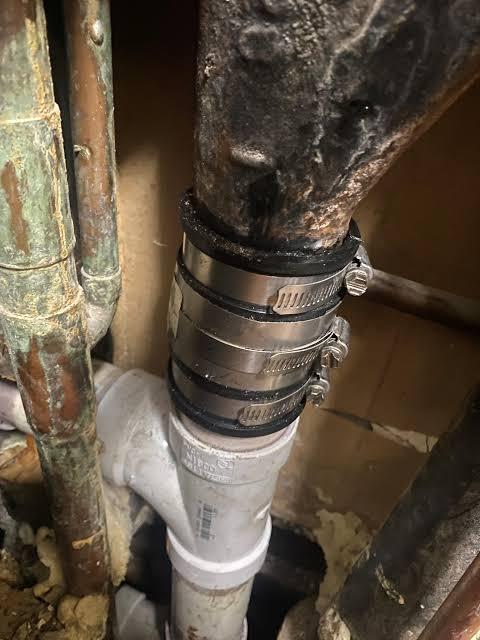
Plastic is lighter and cheaper to install, so it is fair to ask why anyone still puts cast iron back in. The answer is mass and fire behavior. Cast iron is dense enough to noticeably dampen the sound of water moving through it, which matters when a stack runs behind a bedroom wall, and it is non combustible, which keeps it common in multi family and commercial work. Four inch is the standard size for a residential building drain, and modern replacement typically uses no hub cast iron joined with shielded stainless steel couplings, the heavy duty clamps that replaced poured lead joints. Aquaflow Plumbing and Heating recently completed an emergency drain repipe using this approach, running the replacement in four inch cast iron secured with heavy duty clamps.
Emergency Replacement Compared With Planned Replacement
The difference is mostly control. A planned replacement happens on a scheduled day with the scope known in advance and the household able to make arrangements. An emergency replacement happens because a line has already failed and waste is going somewhere it should not, which usually means opening more finished surfaces and working around damage that has already occurred. The warning signs above are what give a homeowner the chance to be in the first category rather than the second.
Frequently Asked Questions
How long do cast iron drain pipes last?
Trade sources commonly cite fifty to a hundred years as a general industry range, though actual service life varies with installation quality, soil conditions, and what has gone down the drain over the decades.
Can a cast iron drain pipe be repaired instead of replaced?
Sometimes. A single failure from impact or a localized defect can often be cut out and sectioned. Uniform thinning along the run cannot be repaired meaningfully, because fixing one spot leaves the rest of the pipe in the same condition.
How do I know whether the problem is a clog or a failed pipe?
Repetition is the tell. A one time clog clears and stays clear. A line that backs up in the same place after repeated snaking is catching on something structural, and a camera inspection shows whether that is scale, a belly, or a break.
Is cast iron or PVC better for a replacement?
Both are acceptable drainage materials. Cast iron is quieter and non combustible, which favors it where a stack runs behind living space, while PVC is lighter and less expensive to install. The right choice depends on where the pipe runs and what local code requires.
Who handles this work near Saugus?
Aquaflow Plumbing and Heating has served Saugus and the surrounding North Shore since 1996, including Revere, Lynn, Lynnfield, Melrose, Stoneham, Wakefield, Reading, Winthrop, Chelsea, East Boston, and Winchester, with emergency service available for urgent drain failures.
A failing cast iron drain rarely announces itself all at once. It slows, it backs up, it clears when someone runs a snake, and it does the same thing again a few months later. Treating that pattern as a nuisance rather than a symptom is what turns a scheduled replacement into an emergency one. If a drain in an older Saugus home is behaving that way, the useful next step is getting eyes inside the pipe while the choice of when to act still belongs to you.

 English
 Arabic
 French
 Spanish
 Portuguese
 Deutsch
 Turkish
 Italiano
 Russian
 Romaian
 Portuguese (Brazil)
 Greek
Greek