


Women's T-Shirts Market Moves at 4.9% CAGR to 2036: Germany and UK Strengthen Demand for Cotton Casualwear
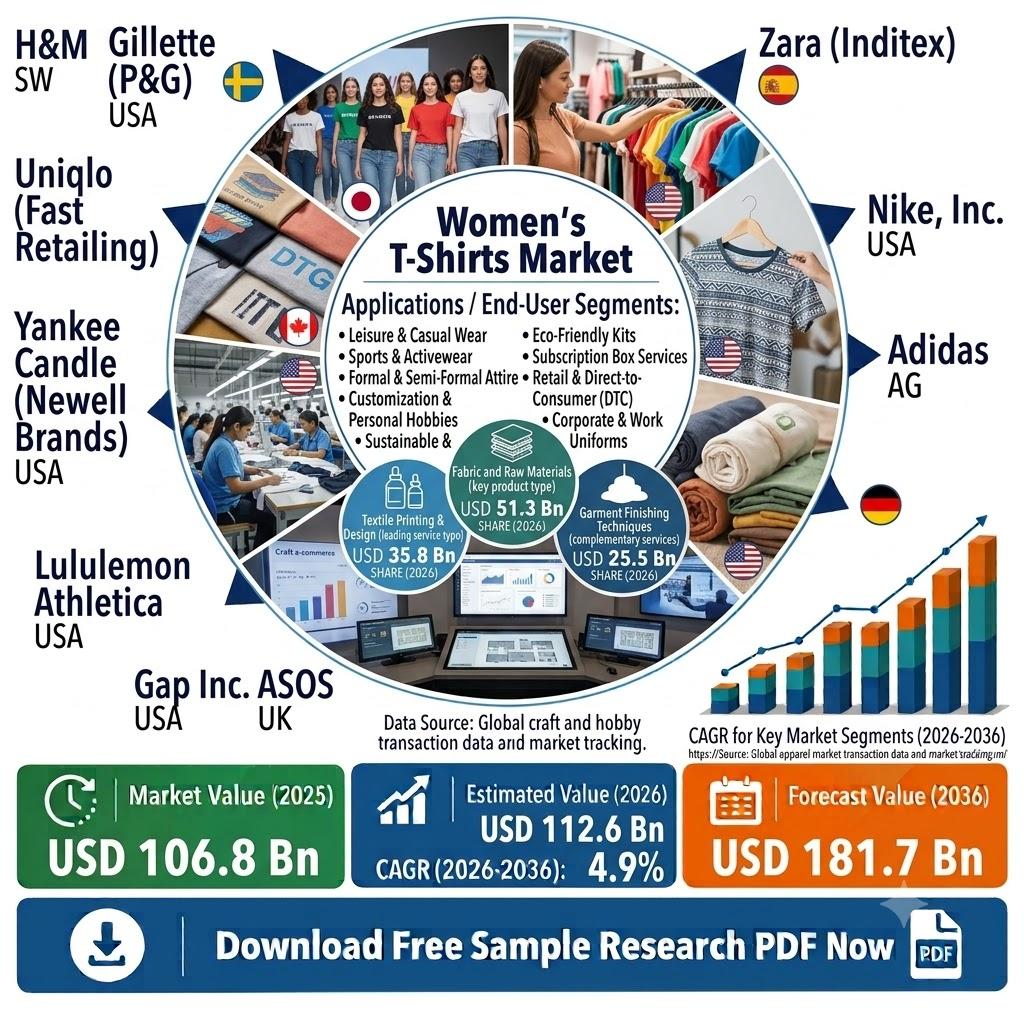
The global Women's T-Shirts Market is projected to grow from USD 112.6 billion in 2026 to USD 181.7 billion by 2036, advancing at a 4.9% CAGR during the forecast period, according to FactMR. The market was valued at USD 107.3 billion in 2025 as casualwear demand and branded basics supported regular apparel purchases.
The market is expected to create an absolute opportunity of USD 69.1 billion between 2026 and 2036. Growth is being shaped by everyday casualwear use, broader retail and e-commerce access, and continued demand for familiar fits and fabrics.
For retailers and apparel suppliers, the category remains closely tied to replenishment. Crew neck t-shirts are expected to account for 37.6% of the market by product type in 2026, while casual wear is projected to hold 31.9% of the application segment. Adult Women are anticipated to represent 30.1% of demand by end user, while cotton is forecast to capture 35.5% by fabric type.
Get Detailed Market Forecasts, Competitive Benchmarking, and Pricing Trends: https://www.factmr.com/connectus/sample?flag=S&rep_id=15750
Basics remain important to apparel purchasing
Crew neck t-shirts provide retailers with a relatively straightforward replenishment format. Core colors, repeat sizes and familiar fits allow buyers to maintain established product lines while testing selected new designs.
Casual wear also keeps t-shirts close to routine apparel spending. Daily use, travel, homewear and informal social occasions contribute to recurring replacement requirements.
Offline retail stores are estimated to account for 32.1% share in 2026. Physical stores allow consumers to compare sizes and assess fabric feel before purchase. At the same time, e-commerce platforms are expanding product access through home delivery, broader inventory visibility and online promotions.
The combination makes coordinated store and online availability increasingly relevant for apparel suppliers.
The U.S. Census Bureau reported in February 2025 that U.S. retail e-commerce sales reached USD 1,192.6 billion in 2024. The figure highlights the scale of the online channel and the need for suppliers to consider digital listings alongside physical retail coverage.
Cotton and fit consistency shape product decisions
Cotton is projected to remain the leading fabric category with a 35.5% share in 2026. Its softness, breathability and familiarity support continued use across everyday apparel.
Organic cotton is positioned for consumers seeking different material choices, while combed cotton supports higher-priced products through a smoother finish and stronger fibers. Polyester remains relevant in performance applications where quick drying, shape retention and moisture management are important.
Fit consistency is another commercial consideration. Poor fit can contribute to returns and weaken the economics of online apparel sales. Retailers and suppliers therefore need clear sizing information and consistent product specifications before expanding core programs.
Shambhu Nath Jha, Senior Analyst at FactMR, states, "Women's t-shirts remain a repeat-purchase apparel category. The winning offer must prove fit consistency and fabric comfort before retailers add trend-led designs or premium fabric claims."
Country markets show different growth conditions
The USA is projected to record the highest CAGR among the profiled countries at 6.4% from 2026 to 2036. Strong retail coverage, established brands and omnichannel expansion support the market.
Germany follows at 5.9% CAGR, with fabric durability, garment construction and consistent sizing influencing purchasing decisions.
The UK is forecast to expand at 5.4% CAGR, supported by digital shopping and fast-changing fashion trends. Japan is projected to grow at 4.9%, aligned with the global rate, with demand shaped by fit, fabric comfort and premium basics.
Canada is expected to post 4.5% CAGR, while Australia is forecast at 3.9%. Brazil is projected to grow at 3.5%, where value-oriented purchasing and local apparel retail remain relevant.
These different growth rates point to varying commercial conditions for suppliers. Channel readiness, product availability, pricing and return management can influence how quickly new ranges move from listing to repeat orders.
Private labels and price pressure remain challenges
The market also faces competition from low-priced private labels and changing discretionary spending. Suppliers competing for basic apparel programs need to demonstrate reliable quality, supply continuity and commercially viable pricing.
Price sensitivity can become more pronounced when consumers compare basic t-shirts across multiple brands and channels. For retailers, stronger pack pricing and clear fabric positioning can help differentiate products without adding unnecessary assortment complexity.
There is also an opportunity for private-label partnerships. Suppliers that can maintain predictable fabric quality and delivery schedules may support retailers looking to expand basic casualwear programs.
Competitive landscape
The competitive landscape includes major sportswear, fashion and basic-apparel providers. Nike Inc. and Adidas AG are among the visible providers in sportswear-led women's t-shirts, while H & M Hennes & Mauritz AB and Inditex compete through fashion basics and frequent assortment changes.
Other companies profiled include Fast Retailing Co., Ltd., Gap Inc., PUMA SE and Levi Strauss & Co.
Competition through 2036 is expected to involve fabric consistency, channel execution, replenishment speed and return management. Brands and suppliers need to balance dependable core products with selected fashion and performance variants.
Read the full Women's T-Shirts Market report: https://www.factmr.com/report/womens-t-shirts-market
Report scope and methodology
The FactMR analysis covers women's t-shirts across basic, fashion and performance formats sold through retail and online channels. The scope includes casualwear, daily wear, streetwear, sports and fitness, fashion wear, workwear and promotional apparel.
Product analysis covers crew neck, V-neck, polo, crop and performance t-shirts. The report also examines end users, distribution channels and fabric types across North America, Latin America, Europe, East Asia, South Asia and Oceania, and the Middle East and Africa.
The study draws on 120+ sources, 35+ company portfolios, 25+ countries and more than 20 industry interviews. Primary research includes manufacturers, service providers, distributors, procurement teams, end users and subject-matter experts. Desk research incorporates government statistics, company filings, trade data, technical studies and industry sources.
Other Related Reports:
https://plaza.rakuten.co.jp/factmr01/diary/202609220002/
About FactMR
FactMR is a market research and consulting firm providing industry intelligence, market sizing, forecasting and strategic analysis across global markets. Its research combines primary research, secondary research, market modelling and company-level analysis to support business planning and market assessment.

 Arabic
 French
 Spanish
 Portuguese
 Deutsch
 Turkish
 Dutch
Dutch
 Italiano
 Russian
 Romaian
 Portuguese (Brazil)
 Greek
Greek