


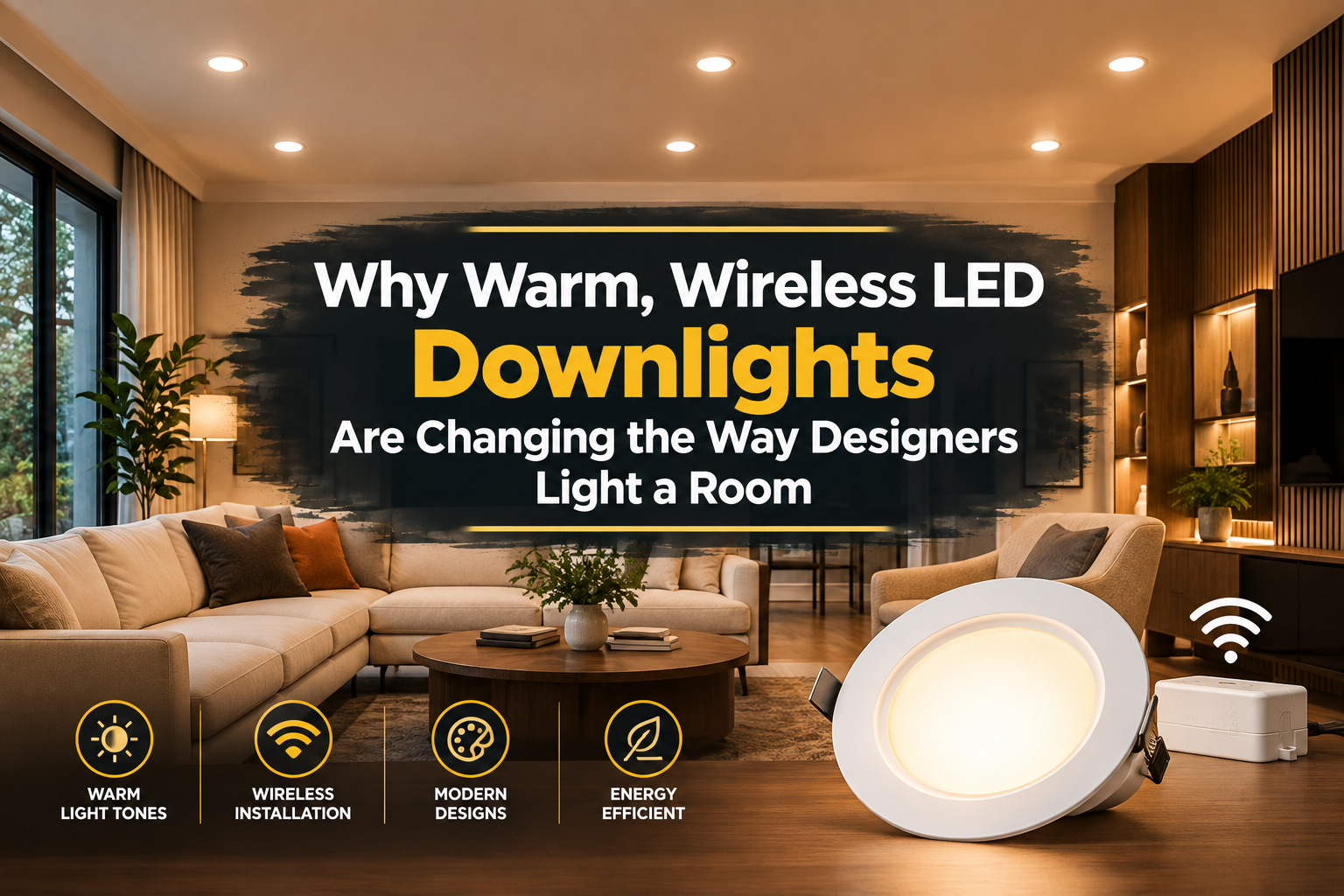
Why Warm, Wireless LED Downlights Are Changing the Way Designers Light a Room
The Shift Toward Flexible, Mood-Driven Lighting
Lighting used to be a one-time decision. You picked a bulb, a color temperature, and a fixture, and that was that for the next decade. If the room felt too clinical at night or too dim in the morning, there wasn't much you could do about it short of an electrician and a new fixture.
That's changed. Homeowners, hospitality designers, and commercial space planners are increasingly drawn to downlights that can shift color temperature on demand, rather than locking a room into a single tone. It's a small hardware change with a surprisingly large impact on how a space actually feels to be in.
What "Color-Selectable" Really Means for a Room
Most standard downlights ship in one fixed color temperature, say, a neutral 4000K or a warm 3000K and that's what you're stuck with. A color-selectable fixture, like the 12W 5-color LED downlight with wireless control, instead gives you a range to work with, typically spanning from a deep amber around 2000K up through a crisp daylight white near 5000K.
That range matters more than it sounds. A living room that needs to feel cozy at 8 p.m. often needs to feel alert and functional at 8 a.m. Rather than installing two separate lighting zones or compromising on a "safe" middle temperature, one fixture can do both jobs depending on the time of day or the mood you're going for.
Why 2000K Is the Interesting Number Here
Most residential downlights don't go below 2700K. Dropping down to 2000K puts you in candlelight territory, the kind of deep, amber glow you'd associate with a boutique hotel lobby or a wine bar, not a typical home fixture. It's a niche use case, but for hospitality interiors, lounges, and anyone chasing a specific ambiance, having that option built into a standard downlight (rather than sourcing a specialty fixture) is a genuine convenience.
Where the Brighter End of the Spectrum Comes In
On the other end, 5000K reads as clean, near-daylight white better suited to kitchens, offices, or task-heavy areas where color accuracy and alertness matter more than ambiance. Having both ends of that spectrum available in one fixture means a single SKU can serve very different rooms, which simplifies both design and inventory for anyone specifying lighting across a whole property.
The Practical Case for Wireless Control
Wired lighting control isn't going anywhere for large installations, but wireless control solves a specific, common headache: retrofits. Running new low-voltage control wiring through a finished ceiling is expensive and disruptive. Wireless-controlled downlights sidestep that entirely the fixture handles color switching without needing a dedicated control line back to a panel.
This matters most in three scenarios:
-
Renovations, where opening up ceilings for new wiring isn't feasible or worth the cost.
-
Hospitality properties, where dozens or hundreds of rooms need consistent, centrally adjustable lighting without a wiring overhaul in every unit.
-
Rental or leased commercial spaces, where tenants want flexibility without making permanent structural changes.
Beam Angle and Why "Wide" Isn't Just a Spec Sheet Number
A narrow beam angle creates pools of light with sharp falloff fine for a spotlight on artwork, less fine for general room illumination, where it tends to leave dim corners and a harsh central hot spot. A wider beam angle, closer to 180°, spreads light more evenly across a ceiling and the surrounding area, which is part of why fixtures like this one are positioned for ambiance and accent lighting rather than narrow task spotting.
In practice, wide-beam downlights tend to need fewer fixtures to achieve even coverage in a room, since each one is doing more work spreading light outward rather than straight down.
Where This Kind of Fixture Tends to Show Up
Fixtures that combine adjustable color temperature, wide beam spread, and wireless control aren't trying to be everything to everyone they're built for spaces where the lighting itself is part of the experience:
-
Hotel rooms and lounges, where warmth and mood matter as much as visibility
-
Restaurants and cafés adjusting ambiance between lunch service and dinner service
-
Retail showrooms that want to highlight merchandise without harsh, clinical lighting
-
High-end residential projects where a single fixture needs to handle both daytime function and evening atmosphere
A Few Things Worth Checking Before You Buy
If you're comparing color-selectable downlights for a project, a few specs are worth paying attention to beyond just the temperature range:
-
Color Rendering Index (CRI) anything below 80 will start to make colors look slightly off, particularly skin tones and wood finishes. Look for CRI above 80 as a baseline.
-
Lumen output relative to wattage a higher lumen-per-watt ratio means more usable light without a higher electricity bill.
-
Installation method recessed downlights need adequate ceiling clearance, so check the housing depth against your ceiling structure before ordering in bulk.
Final Thoughts
The move toward adjustable, wireless-controlled downlighting isn't a gimmick; it's a response to a real limitation in traditional fixtures: once installed, the lighting mood was fixed. Being able to shift from a warm 2000K glow to a clean 5000K white, on demand and without rewiring, gives designers and homeowners a lot more room to adjust a space as its use changes throughout the day.

 English
 French
 Spanish
 Portuguese
 Deutsch
 Turkish
 Dutch
 Italiano
 Russian
 Romaian
 Portuguese (Brazil)
 Greek